Product1 publisher3 min readPublished
Electrochemical strain microscopy can read probe contact as ion movement, so a KAIST team etched trenches into ion-blocking silicon to prove it. Their fix is an argon-beam polishing step, not a new microscope.
The Product Desk · Product desk

Compiled by The Product DeskSomething wrong?How this is made
The figure that now has to be re-argued is the one with a bright line running along a grain boundary, captioned as a fast path for ions. In the KAIST work, that brightness held up on graphite anodes and on sodium solid electrolytes right until the surface was smoothed, and then it was gone [6].
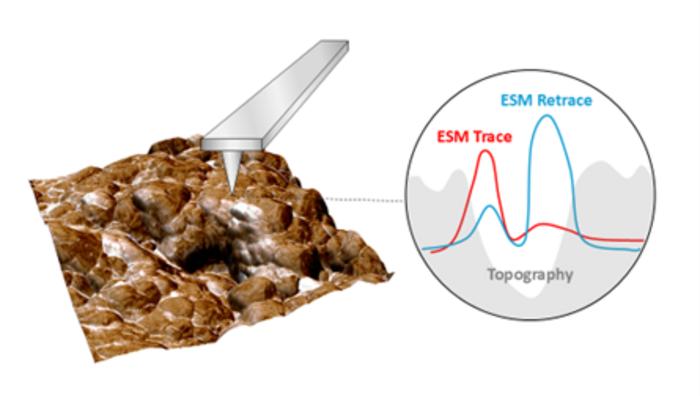
The instrument itself reports the mechanical interaction between a very fine tip and the surface it is dragged across, converted into a strain map [3]. What teams read off that map is chemistry. Ion migration does expand and contract the material under the tip, which is why the technique exists [3]. Roughness also changes the contact, and the resulting electrical fluctuation is nearly identical to the one real ion transport produces [4]. The map records that contact faithfully, but it does not distinguish which of the two causes produced any given signal.
The cleanest part of the study is the null test. The team etched trenches into single-crystal silicon, a material that cannot carry ions, and the height variation alone produced strong ESM signals [5]. With the ionic contribution fixed at zero, every bit of that contrast is artifact [12], and any lab can now run the same trench test to set its own artifact floor before treating a signal as chemistry.
Interesting Engineering frames the result as calling years of foundational data into question [10]. The reported work does not put a number on that: no count of affected papers, no named dataset, no estimate of what share of published ESM contrast was topographic [13]. What the evidence does support is narrower and more awkward, because the artifact concentrates at grain boundaries, which are exactly the features people publish about and exactly where height varies [6]. Professor Seungbum Hong, who led the work with Professors Jong Min Yuk and Nam-Soon Choi, puts it as a demonstration that surface height variation affects nanoscale battery-material results [9][2].
For the person who owns sample prep, the remedy is a step, not a capital cycle: an argon ion beam that flattens the surface without disturbing the chemistry underneath [7], and the group did not have to build new instrumentation to get there [8]. The write-up does not say what a cooling cross-section polisher costs, how long a sample takes, or what happens to throughput when every specimen goes through one [14]. A lab manager still has to find those numbers before budgeting the change.
A way to sort what you already have on the shared drive: put each ESM-derived claim on two axes. First, does the contrast sit on a feature that also has topography, such as a grain boundary, a crack, or a particle edge? Second, is the surface preparation for that sample documented well enough that someone else could reproduce its flatness? Documented prep paired with flat-feature contrast can stand. A topographic feature with undocumented prep is still a hypothesis, not a measurement, and it should be labelled that way in the deck before a materials-design decision leans on it.
The same logic reaches the lifetime models. Interesting Engineering argues that machine-learning predictions fed artifact-ridden nanoscale data will return bad results [11], and a training set cannot tell height from chemistry if the microscope could not. The silicon coupon is the cheaper of the two available answers. It is also the one a reviewer can repeat.
Ranked by verification strength, evidence, and original report placement.
KAIST researchers found that a signal long believed to show ion movement inside batteries is often an artifact caused by rough surfaces, with bumps and microscopic unevenness altering the probe's touch and creating false signals that look like moving ions.
When the scanning tip encounters a rough surface, the mechanical contact between probe and sample changes, producing an electrical fluctuation nearly identical to real ion transport.
The study was led by Professor Seungbum Hong alongside Professors Jong Min Yuk and Nam-Soon Choi, and was published in the journal Small Methods.
Electrochemical Strain Microscopy tracks ion movement by running an ultra-fine, needle-like probe across a material's surface; as ions migrate they expand or contract the material underneath, and the microscope translates that nanoscale strain into a visual map of ion flow.
The KAIST team etched tiny trenches into single-crystal silicon, which cannot conduct ions, and the height variations alone generated strong ESM signals.
Testing real graphite anodes and sodium solid electrolytes produced the same ghost signals, particularly at grain boundaries, and once the surfaces were smoothed the strong readings vanished, showing that regions long believed to be fast lanes for ion transport were microscopic valleys on the surface.
Follow any of these and your For You feed starts watching them — no settings page required.
Evidence-backed comparisons of source perspectives and observed adoption signals. Read the methodology
Which Builder, Operator, and Investor concerns the observed source mix emphasized—not a truth score.
Evidence, demonstrated adoption, hype gap, incentives, and confidence are assessed independently, each on its own current evidence. How these are measured.
Clean control, single retelling
The silicon trench test is the kind of control that settles a mechanism question: a crystal that cannot carry ions still produced ion-like readings, and the same signature in graphite and sodium electrolytes disappeared after polishing. The score is held down by the paper trail rather than the physics. Everything reaches us through one trade-press account of a KAIST announcement, with no magnitudes, no figures from the Small Methods paper and nobody outside the group reading it back.
No uptake reported
Nothing in this reporting speaks to who else is doing this. There is no sign of another group adding an argon polish before ESM scanning, no instrument-maker response, and no indication that battery labs are revisiting their own grain-boundary maps. A methodological correction with no reported second user cannot be scored for adoption.
Scope framing runs ahead of the count
Interesting Engineering documents the mechanism carefully and then extends it well past anything it counted. "Calls into question years of foundational data" and the warning about machine-learning lifespan models arrive without a number of papers, a fraction of published contrast that was topographic, or one named dataset. The finding may prove that broad; the accounting that would show it is not in this reporting.
One institution, one voice
The only person speaking is the lead author, describing his own group's result, and a story in which everyone else's readings were illusions flatters the group that caught it. Pulling the other way: the method being called unreliable is one KAIST's own materials people depend on, so this is not the shape of a claim aimed at a competitor.
Convincing physics, thin sourcing
The physics argument is close to self-checking, since an ion-blocking crystal that yields ion signals is hard to explain another way. Confidence leaks on the sourcing side: one outlet, one institutional account, and no answer to the two questions a reader would press on, namely how much published data is affected and what the polishing step costs in time or money.
product
KAIST puts protons on a schedule to make zinc-ion cells store more and charge faster1 publisher
product
Iron ions carry a sodium-ion pouch cell to 206 Wh/kg across a 100-cycle test1 publisher
product
US grid storage nears 52GW, and arbitrage is now writing the evening price curve1 publisher
science
The skull is running a lymph node, and it has opinions about your brain tumour3 publishers
Publishers with included, body-backed reporting in this cluster.
1 article · September 7, 2026