Science1 publisher2 min readPublished
Ribose helps dissolve the borate minerals that shield it from breakdown, lab tests suggest
Ribose, the fragile RNA sugar found in meteorites, helped borate minerals dissolve and stay dissolved in lab tests reported in Scientific Reports. Borate shields ribose from breakdown, so the sugar may have helped keep its own protector in solution on early Earth.
The Scientist · Science desk
What happened
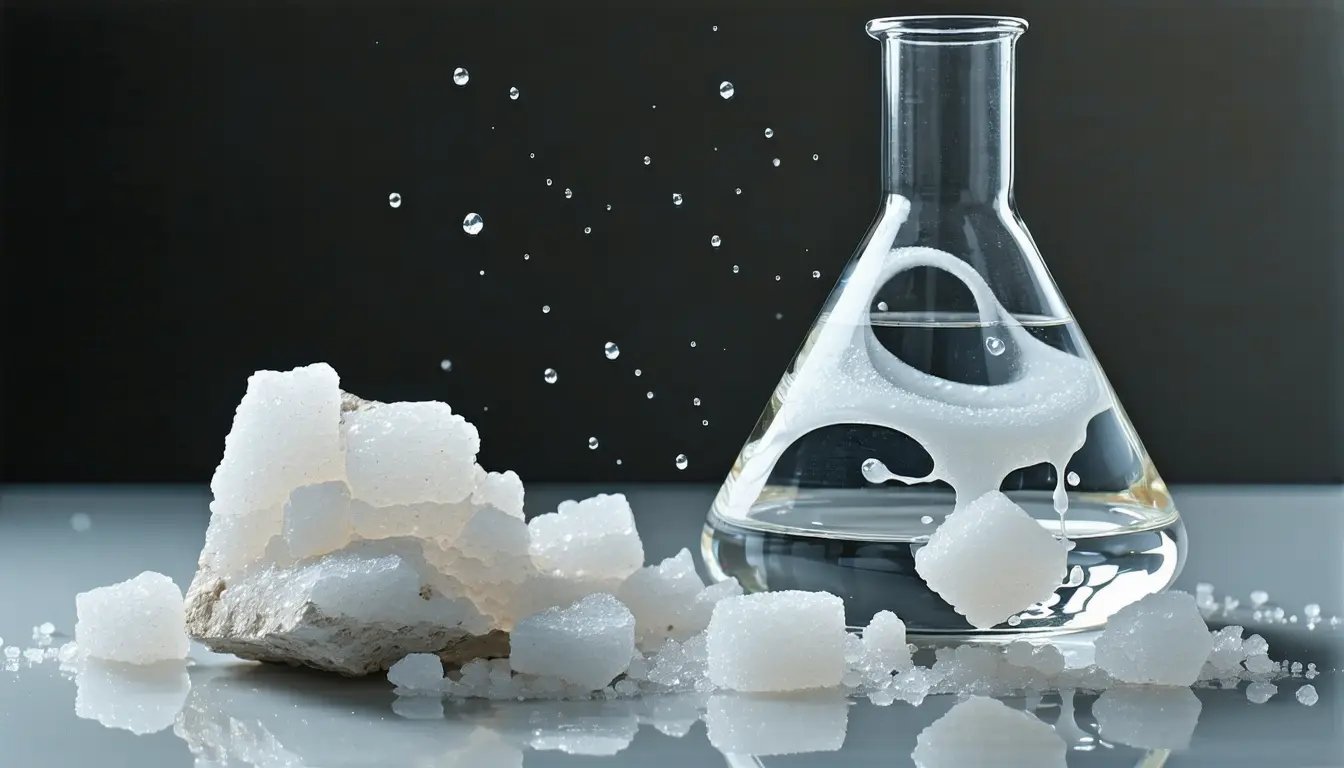
- The experiments used real minerals, including borate salt crusts collected at the Puga hot springs in the Indian Himalayas.
- Puga's waters are boron-rich enough to leave crunchy borate crusts, yet hold only a few percent of the boron used in some purified-ingredient experiments.
- Boron-bearing minerals often dissolve poorly and precipitate as crystals, leaving less boron in water for the reactions thought to lead to life.
- Ribose has been identified, along with other sugars, in the Murchison meteorite that fell in Victoria in 1969.
Compiled by The ScientistSomething wrong?How this is made
Why it matters
- capability Chemists can now test borate protection of ribose at boron levels that natural minerals reach with the sugar present, instead of dosing purified boron tens of times above a spring like Puga.
- constraint The feedback only starts if ribose is already in the water, and a million tons a year of meteoritic carbon counts every compound, so the evidence cannot yet show early pools held enough sugar.
- precedent Because natural borate minerals changed their behaviour once ribose was present, results on ribose stability built only on purified salts become easier to challenge.
Borate binds ribose and helps keep it from breaking down [3]. The open question has been the dose. Tests of that protective effect often use simple mixtures of purified ingredients [4]. If "a few percent" means 2 to 5 percent, some of those mixtures hold roughly 20 to 50 times more dissolved boron than the water at Puga [1]. At Puga, borate crust covers the ground like snow [5].
Natural minerals were the right material for testing that gap [8]. A purified borate salt shows how much boron a chemist can put in a flask. A crust collected from a real spring shows what the ground will give up [4]. With ribose in the water, borate minerals dissolved more readily and fewer solid grains formed, so more boron stayed in solution [9]. "Borate protects ribose from breakdown, while ribose helps keep borate dissolved and available," the authors wrote [10].
That account of the study was written by the researchers themselves [14]. It does not report how much more boron dissolved, or how much ribose it took to get there.
The thing this doesn't tell you is whether an early-Earth pool ever held enough ribose to move borate chemistry at all. Researchers estimate that around a million tons of carbon a year could have arrived during the early bombardment [12]. That figure covers every carbon compound, and the ribose in the Murchison meteorite sits among other sugars [13]. A loop in which the sugar raises the level of its own protector needs a starting stock of sugar. That stock also has to last: heated ribose breaks down into brown goop, much as table sugar turns to caramel [2].
In my view this is a well-aimed experiment. It takes one concrete objection to borate-protected ribose, that natural water cannot hold enough boron, and tests it with minerals from a real site [8]. The finding is how Himalayan crusts behave in laboratory water with ribose present [9]. The crusts came from a modern spring, chosen because it may resemble the places where life began [5]. Earth four billion years ago had little oxygen in the atmosphere, far more active volcanism and green, iron-rich oceans [11].
The study concerns ribose and borate. RNA, whose backbone contains this sugar, does not form easily [15], and assembling it is a separate problem from keeping its sugar intact.
What to watch
- The Scientific Reports data on how much extra boron dissolved and at what ribose concentration, set against plausible meteorite delivery rates of the sugar.
- Whether heated ribose survives measurably longer in mixtures of real borate minerals, at boron levels springs like Puga actually reach.