Science1 publisher2 min readPublished
Mantle chemistry suggests Earth grew mostly by pebble accretion and Mars mostly from planetesimals
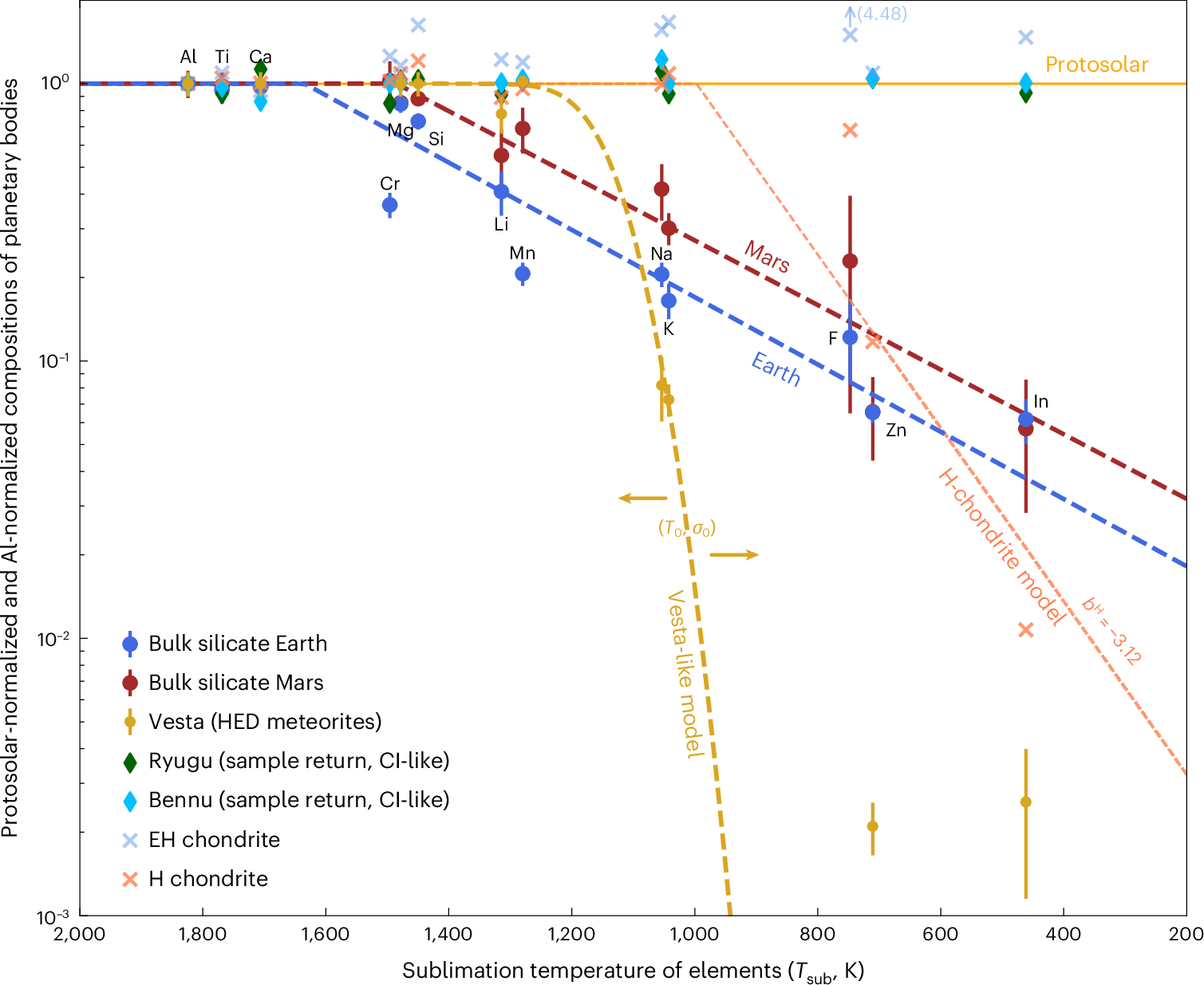
University of Copenhagen researchers estimate at least 75% of Earth's mass came via pebble accretion and about three-quarters of Mars' from planetesimals. On this evidence, rocky neighbours can grow by different routes, though the models have to assume what the building blocks were made of.
The Scientist · Science desk
Drafted by a language model from the sources cited here and checked against its claim ledger before publication. How we use AISend a correction
What happened
- The team examined volatile elements such as sodium, zinc and potassium, which evaporate easily at high temperatures, in the crust and mantle of both planets.
- In the Earth fit, most of the mass traces to two young protoplanets that grew large by accreting pebbles, with planetesimals contributing up to 25%.
- Planetary scientists broadly accept planetesimal collisions, pebble accretion and hybrids of the two as formation routes, but have not settled which best explains rocky planets.
- Anders Johansen of the University of Copenhagen's Globe Institute co-led the study with assistant professor Haiyang Wang, and it is published in Nature Astronomy.
Compiled by The ScientistSomething wrong?How this is made
Why it matters
- constraint Formation models that give neighbouring rocky planets the same accretion history now have to account for two planets whose pebble and planetesimal shares are close to reversed.
- capability If volatile loss tracks how a planet grew, the same fingerprint could help missions studying Earth-like exoplanets estimate how much water those worlds kept.
- decision Groups reconstructing planet formation from isotopes now have an element-based method to test against, and they will have to decide how much weight it gets when the two disagree.
The study rests on the idea that a mantle keeps its chemistry for billions of years. "It is a major detective job to figure out what happened back then when most of the evidence disappeared long ago. But even after 4.5 billion years, the compositions of Earth's and Mars' mantles remain the same. You can think of them as an imprint of the formation process," Johansen said [7]. If that holds, what a mantle retains today reflects what its material went through while the planet grew. The models then look for growth histories that would leave the same pattern of depletion [6].
The difference between the two planets is large. On Wang's figures, pebble accretion supplied at least 75% of Earth's mass and about a quarter of Mars' [4]. So Earth's pebble share is roughly three times Mars', and the two sets of proportions are close to mirror images [1]. "The most surprising result was that Earth and Mars appear to have formed in different ways. You might have expected that two planets formed side by side in the same solar system would share a more similar formation history," Johansen said [10].
Neither of the two standard routes wins outright [2]. The authors say the result supports the hybrid model [3], and the paper's title describes volatile depletion as "a chemical fingerprint of hybrid accretion" [12]. Both planets come out as mixtures. They differ in proportion [4].
The thing this doesn't tell you is how firm the individual percentages are. The sample is two planets, and every share comes out of a model [6]. One of the model's inputs, the chemical composition of the solar system's original building blocks, is unknown. The team therefore had to assume it, and the researchers say the main conclusion held when they adjusted those assumptions [8]. "The exact percentages may vary somewhat, but our analyses consistently indicate that Earth and Mars formed in two different ways," Wang said [9]. The press account does not give the size of that variation, so I would treat the direction of the split as the finding and the specific shares as provisional.
Wang also makes a claim about method. His team's approach, he said, "provides a more precise and direct way of understanding planet formation than the more widely used isotope-based approach, which can often be interpreted in multiple ways" [13]. That comparison is his own assessment. It is a reasonable argument for adding elemental data to isotopic data, and the Earth and Mars result is the first place the two will be checked against each other.
What to watch
- Independent constraints on the composition of the solar system's original building blocks, the input the models currently have to assume.
- Whether isotope-based reconstructions of Earth and Mars arrive at the same pebble-versus-planetesimal split or a conflicting one.
- The spread of the Earth and Mars shares across the paper's alternative assumptions, which would show how much 'vary somewhat' means in numbers.