Science1 publisher3 min readPublished
Two electron orders, one crystal, two different ways of freezing
MIT physicists report that two charge density waves in erbium tritelluride form by different mechanisms: one gradual, one nucleating in expanding pockets. Coexisting phases are not one knob.
The Scientist · Science desk
Drafted by a language model from the sources cited here and checked against its claim ledger before publication. How we use AISend a correction
What happened
- MIT physicists found that two electronic phases inside the same quantum material emerge through different mechanisms, one smoothly and the other in expanding pockets resembling growing ice crystals.
- The findings were published in Nature Physics.
- The researchers, led by Nuh Gedik, the Donner Professor of Physics at MIT, investigated erbium tritelluride, a rare-earth material with unusual electronic behavior.
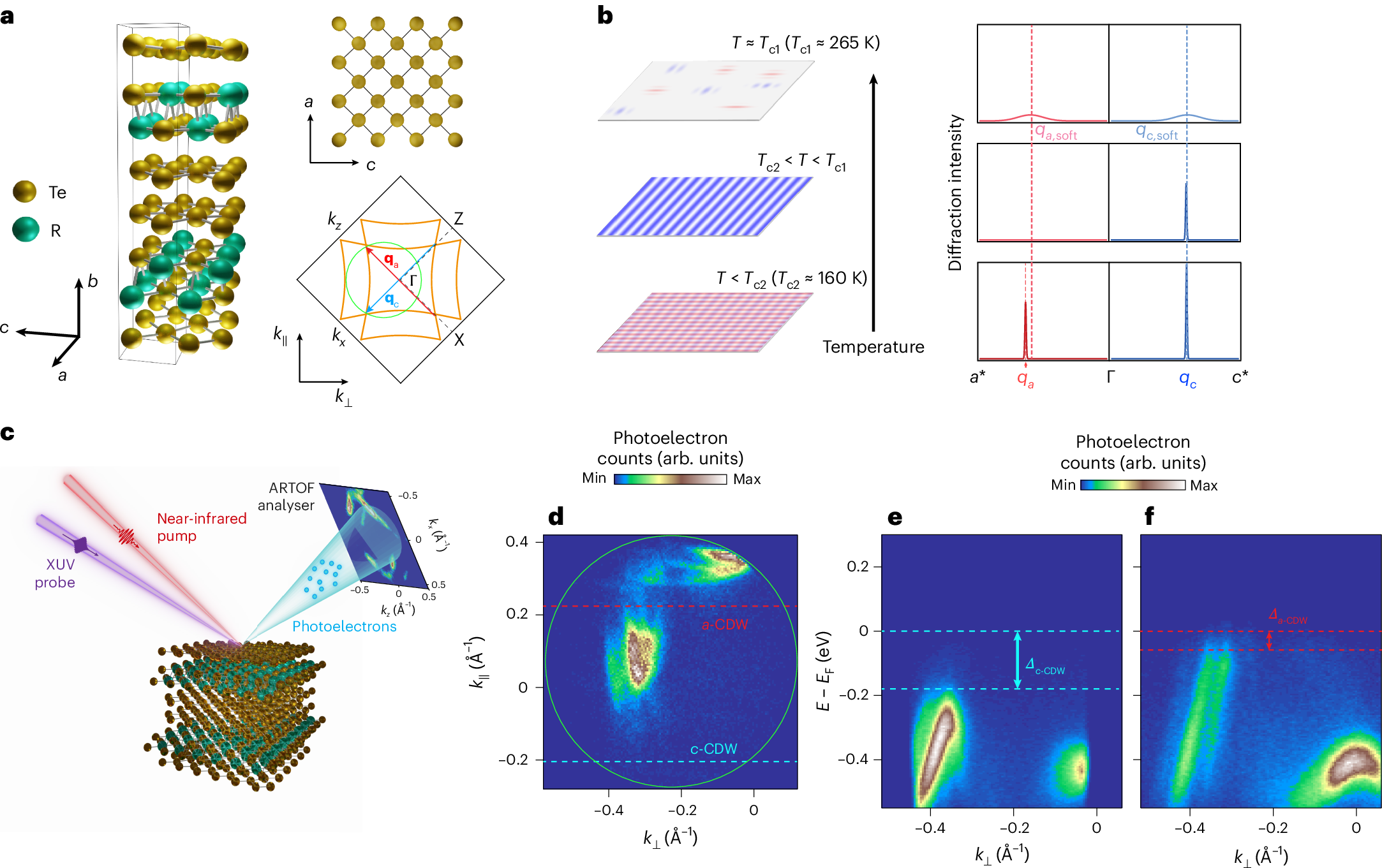
- Under ordinary conditions electrons are distributed relatively evenly throughout erbium tritelluride; when the material is cooled to specific temperatures the electrons begin organizing into a wave-shaped arrangement known as a charge density wave phase.
- Cooling the material further produces a second wave pattern running perpendicular to the first, and together the two electronic phases form something resembling an atomic-scale checkerboard.
Compiled by The ScientistSomething wrong?How this is made
Why it matters
MIT physicists report that two forms of electron organisation inside the same crystal of erbium tritelluride arrive by different routes: the first spreads gradually through the material, while the second starts in isolated regions that expand outward, in the manner of ice crystals growing in water [1][3][7][8]. The work, published in Nature Physics, matters less for the material than for the modelling habit it breaks, because coexisting electronic phases are routinely treated as one system tuned by one parameter [2].
Erbium tritelluride is a rare-earth compound with unusual electronic behaviour [3]. At ordinary temperatures its electrons sit relatively evenly across the material; cooling to particular temperatures makes them organise into a wave-shaped arrangement, a charge density wave, where the crests hold more electrons than the troughs [4][11]. Cooling further produces a second wave running perpendicular to the first, so the two orders together resemble an atomic-scale checkerboard [5]. The group, led by Nuh Gedik, the Donner Professor of Physics at MIT, was able to separate the two phases and watch each one develop [3][6].
The first transition behaved as textbooks say it should, appearing gradually across the sample [7]. The second did not [8]. "The mechanism responsible for the emergence of this second phase has long been debated, and our approach provides a powerful new way to uncover the hidden physics behind phase transitions in quantum materials," Gedik says [9].
The consequence is spatial. An order that appears uniformly can be described by a single number that grows as the sample cools; an order that nucleates and grows cannot, because at intermediate temperature the crystal is a mixture of ordered pockets and unordered surroundings [17]. Same crystal, same control parameter, two different pathways [18]. Anyone treating a two-phase quantum material as one tunable knob is therefore averaging over a domain structure that the second transition creates and the first does not.
The framing around the result is more speculative than the result. "People believe the cornerstone of replacing silicon lies in quantum materials that have multiple coexisting phases," says co-author Alfred Zong, who co-led the study as an MIT graduate student and is now an assistant professor at Stanford [10][15]. That is a stated belief, not a finding here. The defensible case for studying charge density waves is narrower and made by first author Yifan Su: they are collective electron states like superconductivity but simpler, and, in his words, "offer a playground for fundamental understanding" [13]. Charge density waves have been studied for decades and turn up in materials that also host magnetism and superconductivity, which is what makes the pathway question portable [12].
What to watch: whether the same separation technique resolves the long-standing argument about the second phase's mechanism in other materials, or only in this one [9]. The public account gives no transition temperatures and no description of the probe used, so the reproducibility details sit in the paper rather than the announcement [19]. Also worth tracking is whether groups chasing controllable superconductivity start reporting domain structure alongside order parameters; if the second-order-nucleates picture generalises, averaged measurements will keep hiding it. The other co-authors are Bai-Qing Lv, Dongsung Choi, Doron Azoury and Masataka Mogi, with collaborators at other institutions [14].