Invest1 publisher2 min readPublished
Canada answers a 50% US tariff with a matching levy on $20 billion of American goods
Washington put 50 per cent tariffs on US$20 billion of Canadian goods on August 22 and Ottawa answered at the same scale. At unchanged volumes that is about $10 billion of duty facing each side, on two very different export bases.
The Investor · Invest desk
What happened
- The United States applied 50 per cent tariffs on US$20 billion worth of Canadian goods on August 22, according to an opinion column in the South China Morning Post.
- Prime Minister Mark Carney announced that Canada would impose matching tariffs on American exports of the same scale.
- The counter-tariff came with a decision to walk away from talks with Washington, ending the negotiating track that had been running alongside the duties.
Compiled by The InvestorSomething wrong?How this is made
Why it matters
- constraint With talks abandoned, Ottawa's leverage lives in a tariff schedule instead of a draft agreement, so any concession it wants to trade has to be made by unwinding duties in public.
- exposure Canadian exporters absorb both sides of a dollar-matched fight while selling into a market that takes nearly three-quarters of the country's merchandise exports.
- contradiction The column presents Canada's response as an example for US allies while reporting no other government that has matched and no costing of retaliation against accommodation, so the template claim is a forecast.
Fifty per cent of twenty billion is ten billion, the top of what either side collects, reachable only if the same goods keep crossing at the same prices [11]. They will not. A duty at that rate is set to change behaviour. The base under the ten billion shrinks with every order rerouted, and both treasuries end up collecting less than the headline while both sets of exporters pay the disruption.
The match is exact in dollars. The exposure under it is lopsided. Canada sends nearly three-quarters of its merchandise exports to the United States [4], and the column that reports the matched response omits the reciprocal American share and any costing of retaliation against accommodation [12]. A seller with one buyer replaces demand more slowly than a buyer replaces suppliers. In my view the matched figure conceals that asymmetry.
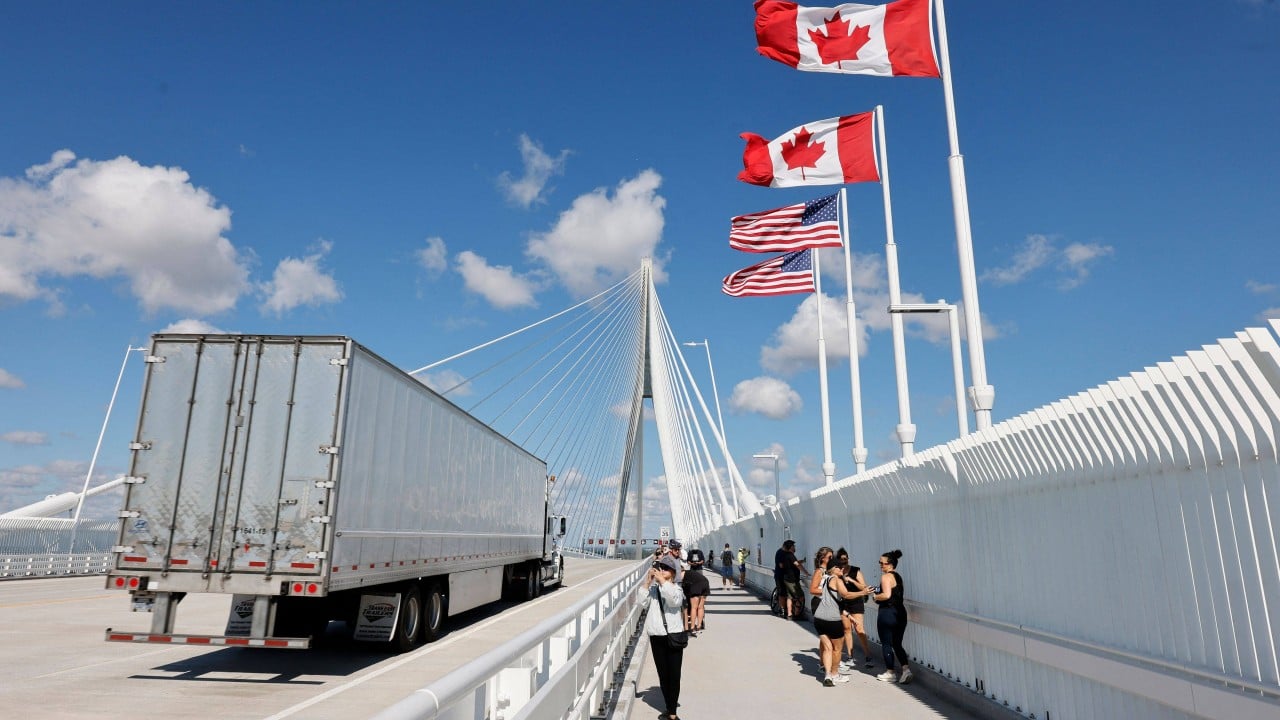
Carney's counter-tariff came bundled with walking away from talks [3]. The Canadian position now sits in a tariff schedule instead of a draft text. The two governments still have to run a border of nearly 9,000 kilometres [5] and a joint air defence command [6], with no trade negotiation open.
The opinion column in the South China Morning Post that carries the account calls this a "rebellion of the reasonable" [8] and wrote that "Canada's stance should shatter any lingering illusions among US allies" [9]. It points to the administration's open suggestion that Canada become the 51st state and reported demands to roll back French-language and Quebec cultural protections [7]. That is a reading of intent, offered by a writer describing a country whose default posture toward Washington he characterises as polite, deferential and almost allergic to confrontation [10].
If the counter-tariff was the price of a seat at the table, exemptions and carve-outs will appear before the duties do much damage. If it holds, each schedule collects steadily less than ten billion as supply chains reroute around it. The column implies a third path, in which some other exporter answers a US tariff at matched scale, and its evidence stops short of it [12].
What would settle it is dull and near-term. A Canadian exemption list, or a return to talks within a few months, would make the matched twenty billion a negotiating instrument [1][2]. On the record so far, the only government that has answered at scale is the one that sends nearly three-quarters of its merchandise exports to the buyer it is now taxing [4][12].
What to watch
- A Canadian exemption list or carve-out on the counter-tariff schedule would mark it as a bargaining position.
- Monthly Canadian export data showing how much of the US$20 billion base still crosses the border at 50 per cent.
- Whether any other US trading partner answers a tariff with a matched-scale counter-tariff of its own.