Loading today’s stories
Invest1 distinct publisher3 min readUpdated
Washington's 50% Canada tariffs invoke a 1930 statute never used before, and Ottawa is matching
US importers remit the duty on $20 billion of Canadian goods. Canada says it will match dollar for dollar, and the future of the three-country trade pact is now the open question.
The Investor · Invest desk
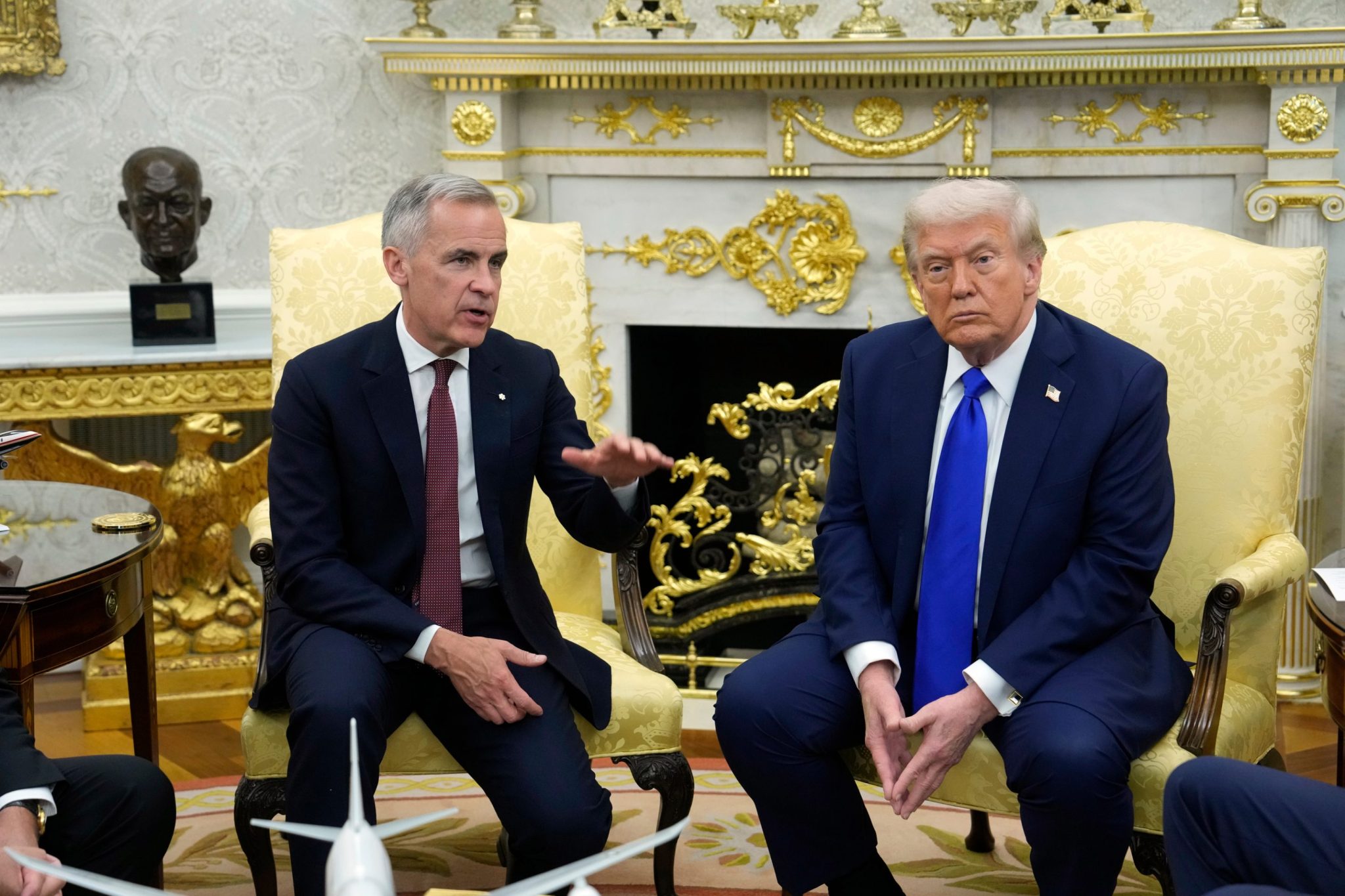
What happened
- The United States imposed 50% tariffs on $20 billion worth of Canadian products early Saturday, after last-ditch negotiations failed.
- Fortune describes the tariffs as invoking a notorious Great Depression law from 1930 that has never before been used to impose import taxes.
- The import taxes hit about 5% of what Canada ships to the United States every year, including products ranging from hockey sticks to tongue depressors.
- Prime Minister Mark Carney said: "Canada will match those tariffs dollar for dollar to protect our workers and businesses."
- Carney said last-minute changes in the US proposed terms were "unfair, uneconomic, and called into question the reliability of any deal," and said he had suspended negotiations and directed Canada's team to return to Ottawa.
Compiled by The InvestorSomething wrong?How this is made
Why it matters
"Dollar for dollar" is a budget, not a rate. Carney's commitment [4] admits at least two readings: Ottawa mirrors 50% on a comparable $20 billion of American goods, or it picks whatever import value yields a similar duty take. At the posted rate the US list carries roughly $10 billion of annual duty if volumes hold [1], and matching that revenue would require a very different basket than matching the value. Until the Canadian schedule exists, buyers on both sides are quoting against an unknown.
The incidence is settled even where the list is not: US importers remit the money and try to pass it to consumers through higher prices [11]. The same mechanism runs in reverse on the Canadian side, from a narrower base, since nearly 72% of Canada's goods exports went to the United States last year [13]. Equal dollar amounts will not mean equal damage.
Scale matters here. The covered goods are about 5% of what Canada ships south annually [3], which implies an export base near $400 billion [2], and the $20 billion list is roughly 2.3% of the $880 billion in two-way goods and services trade recorded last year [3][12]. The rest still moves. What changed is the terms under which it gets negotiated, and Fortune reports that the retaliation calls into question the future of the trade agreement covering the United States, Canada and Mexico [8], whose third signatory was nowhere near this week's bilateral table.
The sourcing problem is not the published schedule. Hockey sticks and tongue depressors [3] are not what Ottawa came to fix: it wanted movement on steel, aluminum, autos and lumber [7], and those asks went unresolved. So a manufacturer's real exposure is the absence of a settled rate on inputs, not the 50% on this particular list. With no further talks planned [9], nothing on the calendar resolves it, and the calendar has already proved soft: the duties were set for 12:01 a.m. Wednesday and pushed three days [10].
Then the instrument. The authority is, per Fortune, a Great Depression-era 1930 law that has never before been used to impose import taxes [2]. A first use has no litigation record bounding its scope and no established remedy if the duties are later voided, so money paid under it is a cost rather than a refundable deposit until a court says otherwise. It cuts the other way for planners too: an authority with no precedent has no demonstrated ceiling, which is the part procurement cannot hedge with a forward contract.
Carney has said Ottawa will announce support for affected workers and businesses [15], and Ontario Premier Doug Ford endorsed matching "tariff for tariff, dollar for dollar" with everything on the table [14]. Subsidy alongside escalation is the posture of a government budgeting for this to outlast the quarter.
Loading topic controls
Loading related stories