A 4B model edged the GPT-5 family at bargaining. The interesting number is the spread
Microsoft Research says a 4-billion-parameter model trained with SocialRL out-scored GPT-4.1, GPT-5.1 and GPT-5.2 across six bargaining domains. The winning margin is thinner than the method's effect.
The Investor · Invest desk
What happened
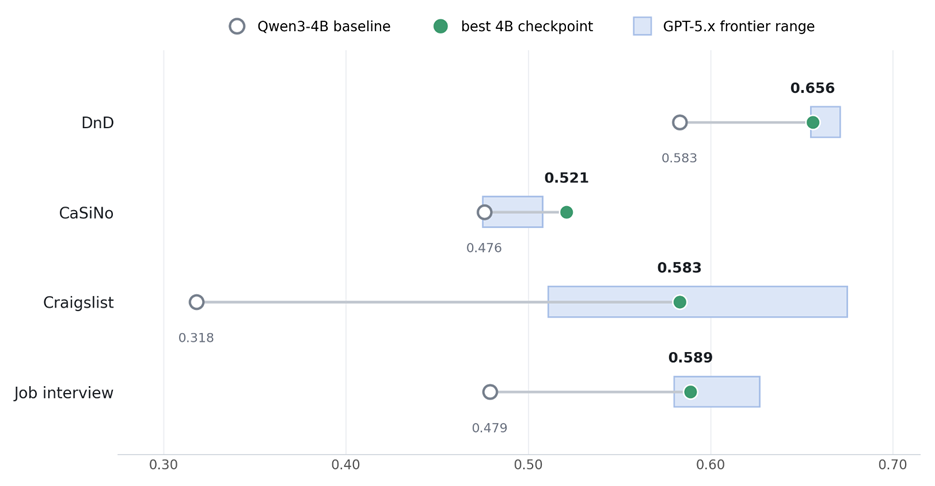
- A 4-billion-parameter model trained with SocialRL averaged 0.627 utility across six negotiation domains, against 0.625 for GPT-4.1, 0.619 for GPT-5.1 and 0.613 for GPT-5.2.
- The method folds several domain-specialist models into one policy by cascade reinforcement learning, plus a distillation step that trains the model to predict the counterparty's next move.
- Strategically anchored buyer openings went from 3% of cases before training to 78% after.
- Transfer between domains was one-sided: Craigslist and Marketplace helped each other, while domains with unique dynamics gained nothing.
Why it matters
- contradiction A 26-fold change in anchoring behaviour sits alongside an average utility lead of 0.002, so the score that will be quoted in procurement decks is the one with the least signal in it.
- cost Because consolidation only pays inside a family of similar scenarios, the buyer of the agent, not the model vendor, absorbs a separate data-collection and training cycle for every unrelated...
- capability An organisation with its own negotiation transcripts and a reinforcement learning harness can now aim at a competent in-house negotiator without buying frontier tokens for the job.
- exposure Anyone on the other side of a procurement, recruiting or scheduling conversation may soon be talking to something rewarded for withholding and holding firm, rather than for being accommodating.
Rank the four scores and the figure worth keeping is the spread, not the winner. Top to bottom is 0.014 utility points, about 2.2% of the leading score [14]. Inside that band, GPT-5.1 and GPT-5.2 both sit below GPT-4.1 [15], which is the part of the table nobody put in a headline: on these bargaining tasks, two later frontier releases scored worse than an earlier one. That is what makes the small-model result readable. Whatever this benchmark measures, it is not parameter count.
It does appear to measure the training objective. SocialRL rewards strategic behaviour rather than pure helpfulness, and the trained policy holds information back and anchors, conceding only where concession serves the user's overall utility [11]. The behaviour it corrects is not a knowledge gap but a disposition: unprompted disclosure and premature concession, which Microsoft casts as the obstacle to an agent that actually represents its principal [12]. A model that folds under pushback is doing what it was rewarded for.
The per-task figures say the advantage is uneven. Closure of the baseline-to-frontier gap runs from 73% to 122% depending on the task [9], and anything above 100% is an overshoot, so some of the six domains (Deal-or-No-Deal, CaSiNo, Craigslist, Job Interview, Calendar and Marketplace) [5] are carrying the average while others contribute nothing to it.
The cost argument everyone will draw from this is not actually in the work. As reported, the material contains utility scores, anchoring rates, gap-closure percentages and the parameter count of the model Microsoft trained, and no inference prices and no parameter counts for the GPT-5 family it was compared against [17]. So the claim on offer is a capability claim with the economics left to the reader to supply. The economics an operator would need are the ones nobody priced here: gathering domain transcripts and re-running the cascade when a counterparty's tactics change.
Two structural caveats before anyone reallocates an inference budget. Consolidating specialists into one policy worked within a family of similar scenarios and did nothing for domains with unique dynamics [10], so the single-model story holds inside a family and breaks between families. And this is Microsoft Research grading its own method, in a paper relayed through cryptobriefing.com's account of it [1][2]. The average lead will not survive a different scenario mix. The change in disposition probably will.
What to watch
- A third party reproducing the utility numbers with a different scenario mix, or with human counterparties instead of model opponents.
- Whether weights or a checkpoint are released, which decides if operators can run this or only cite it.
- Any vendor putting a price on a per-domain negotiation fine-tune against metered frontier API calls for the same task.
Clarity's read
What the record supports and how the coverage leans. The claims behind it follow.
Reality
- Evidence28
- Adoption
- Insufficient
- Hype gap+46
- Incentives68
- Confidence33
Claim ledger
Ranked by verification strength, evidence, and original report placement.
- [1]
Microsoft Research published a paper titled "From Passive Delegates to Strategic Negotiators: Reinforcing Social Reasoning in Small Language Models with SocialRL".
- [2]
The account of the paper and its figures comes from a report by cryptobriefing.com.
- [3]
The 4-billion-parameter model trained with SocialRL achieved an average utility score of 0.627 across six negotiation domains.
- [4]
On the same measure, GPT-4.1 scored 0.625, GPT-5.1 scored 0.619 and GPT-5.2 scored 0.613.
- [5]
The six domains are Deal-or-No-Deal, CaSiNo, Craigslist, Job Interview, Calendar and Marketplace.
- [6]
The core method is a cascade reinforcement learning approach that consolidates the skills of multiple domain-specific specialist models into a single unified policy, supported by theory-of-mind distillation that incorporates next-action predictions about the other party into the training loop.
- [7]
Microsoft's researchers say the theory-of-mind distillation step enhanced both performance and generalization during training.
- [8]
Before SocialRL training, 3% of buyer openings were strategically anchored below target values; after training, 78% were.
- [9]
The unified policy closed the performance gap between baseline models and state-of-the-art frontier models by 73% to 122% across negotiation tasks.
- [10]
Cross-domain transfer was asymmetric: related domains such as Craigslist and Marketplace strengthened each other during training, while isolated domains with unique dynamics showed no improvement from cross-pollination.
- [11]
SocialRL rewards strategic behaviour during training rather than pure helpfulness, producing an agent that holds information back when appropriate, anchors aggressively, and concedes only when doing so serves the user's overall utility.
- [12]
The paper frames the goal as building "principal-aligned agents" and characterises current language models as tending toward unprompted disclosures and premature concessions.
- [13]
The 4B model's lead over GPT-4.1 is 0.002 utility points, or about 0.32% in relative terms.
- [14]
The spread between the highest and lowest reported scores is 0.014 utility points, about 2.2% of the leading score.
- [15]
Both GPT-5.1 (0.619) and GPT-5.2 (0.613) scored below GPT-4.1 (0.625) on this measure.
- [16]
Strategic anchoring of buyer openings rose by 75 percentage points, a 26-fold increase.
- [17]
The reported figures consist of utility scores, anchoring rates, gap-closure percentages and the parameter count of the trained model; they include no inference cost figures and no parameter counts for the GPT-5 family models used as comparators.
Get this ledger inside ChatGPT. Ask about any of our stories and the answer brings its figure, each claim’s verdict and the sources. Free, no account.
Sources
1 independent publisher whose own reporting we read for this story.
- cryptobriefing.comMicrosoft reveals SocialRL improves negotiation outcomes for AI agents
1 article · August 23, 2026
Topics and entities
Follow any of these and your For You feed starts watching them — no settings page required.
Topics
- Reinforcement learning post-trainingFollow
- Small Model StrategyFollow
- Benchmark margins and interpretationFollow
- Principal-aligned agentsFollow
- Negotiation and bargaining agentsFollow