Product2 publishers3 min readPublished
Meta will let AI-made Horizon games play inside Instagram and Facebook feeds
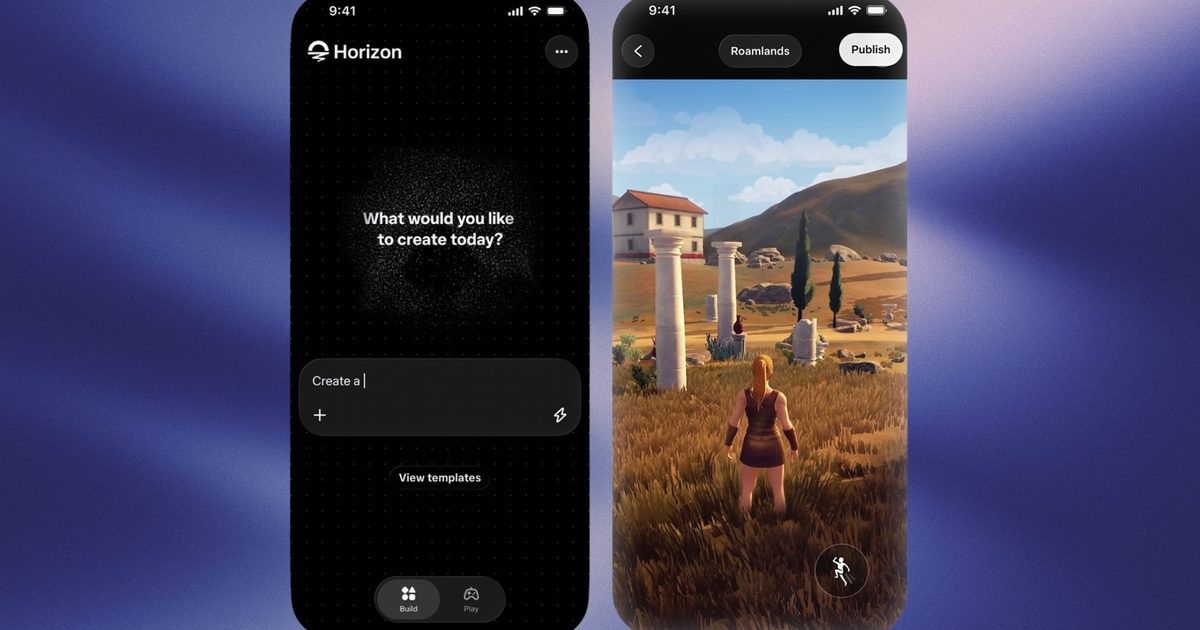
Meta will let games built in its two new AI tools, Horizon Create and Horizon Studio, play inside Facebook and Instagram feeds with no download. For a Horizon platform that has struggled to draw players, the feed slot matters more to creators than the prompt box.
The Product Desk · Product desk
What happened
- Horizon Create is a phone app, while Horizon Studio runs in a browser with no install and lets creators arrange scenes, swap assets and edit scripts by hand.
- Meta announced both tools at Meta Connect, and they open in early access through a waitlist.
- Meta says every game passes safety checks and receives an automated age rating before it goes live.
- Horizon started as a VR app and has recently moved to focus mainly on mobile.
Compiled by The Product DeskSomething wrong?How this is made
Why it matters
- capability A creator's game can now reach Facebook and Instagram users who have never opened Horizon, so installing an app is no longer the first step between a game and a player.
- constraint Meta decides who gets reach, and one of its criteria, cultural relevance, is a judgement a creator cannot test before publishing.
- exposure AI-built multiplayer games will land in general social feeds with automated checks as the only gate Meta has described, so the quality of that automation decides what feed users are served.
Someone scrolling Instagram sees a clip of a game and taps it. In Meta's telling, that person can "be in a multiplayer session within seconds, without needing to download an app or being redirected" [4]. Published games from the new tools can be recommended on Facebook and Instagram and played there [3]. The Verge described this as Meta's plan to give the games "significantly more reach" after Horizon "has struggled as a platform" [20].
Here's what platform teams tell themselves users do: install a dedicated app and keep coming back to it. Here's what users actually did with Horizon. The Verge reported in early 2022 that it had reached 300,000 monthly users [8]. Roblox has 123 million daily active users [7]. Side by side, that is about 410 to one [1]. The comparison is rough. It sets Roblox's daily count against Horizon's monthly one, a mismatch in Horizon's favour, and the Horizon figure is from 2022 [8].
The pitch and the thing being done are different. The pitch is making games from prompts [1]. Meta said both tools let creators "turn any idea into a complete 2D or 3D mobile game, complete with progression systems, balanced difficulty, art direction, multiplayer, and more" [15]. Other companies are doing that part too. Roblox is adding prompt-based game generation to its mobile app [10], and Meta already tried the idea in Pocket, an app for generating and sharing mini-games [17]. What is being done is distribution through Meta's own apps [3]. "Your game lives natively in the feeds where people already discover content and connect with friends," Meta said [5].
Reach in those feeds comes with conditions. Meta says games that are "engaging, stable, culturally relevant, and keep players coming back" will get more of it [6]. Only the last of those is a behaviour a creator can design for and count: a second session. A clip can draw taps from people who never return, so tap counts will overstate how a game is doing against the rule Meta published. The announcement as reported does not include creator revenue terms, a general-availability date, or any figure for how often feed viewers tap through.
For a small studio or a solo creator, I think this is worth a trial as a distribution test, judged on whether players come back the next day and not on taps. The tradeoff is control. Reach depends on Meta's ranking, and "culturally relevant" is a call Meta makes [6].
Two questions sort a project. First, whether a few seconds of clip explain the game, since the clip is where a feed viewer meets it [4]. Second, whether a player returns for another session, since that is the behaviour Meta says it rewards [6]. A game that passes both is the case the feed placement was built for. Clip well but lose players after the first session, and expect early taps followed by fading reach. If it holds players but clips badly, it keeps the few who find it and gives the feed little to show. Failing both leaves a prototype, and the backend Create and Studio share keeps its assets and iteration history if the idea gets reworked [12].
What to watch
- Whether Meta publishes revenue terms or payouts for creators whose games are played inside Facebook and Instagram feeds.
- Retention figures from the early-access cohort, which would show whether feed taps turn into return sessions.
- Which early games Meta's ranking pushes widely, as a practical read on what it counts as "culturally relevant".