Invest1 publisher2 min readPublished
Meta pays $115m to train the electricians its own contractors will hire
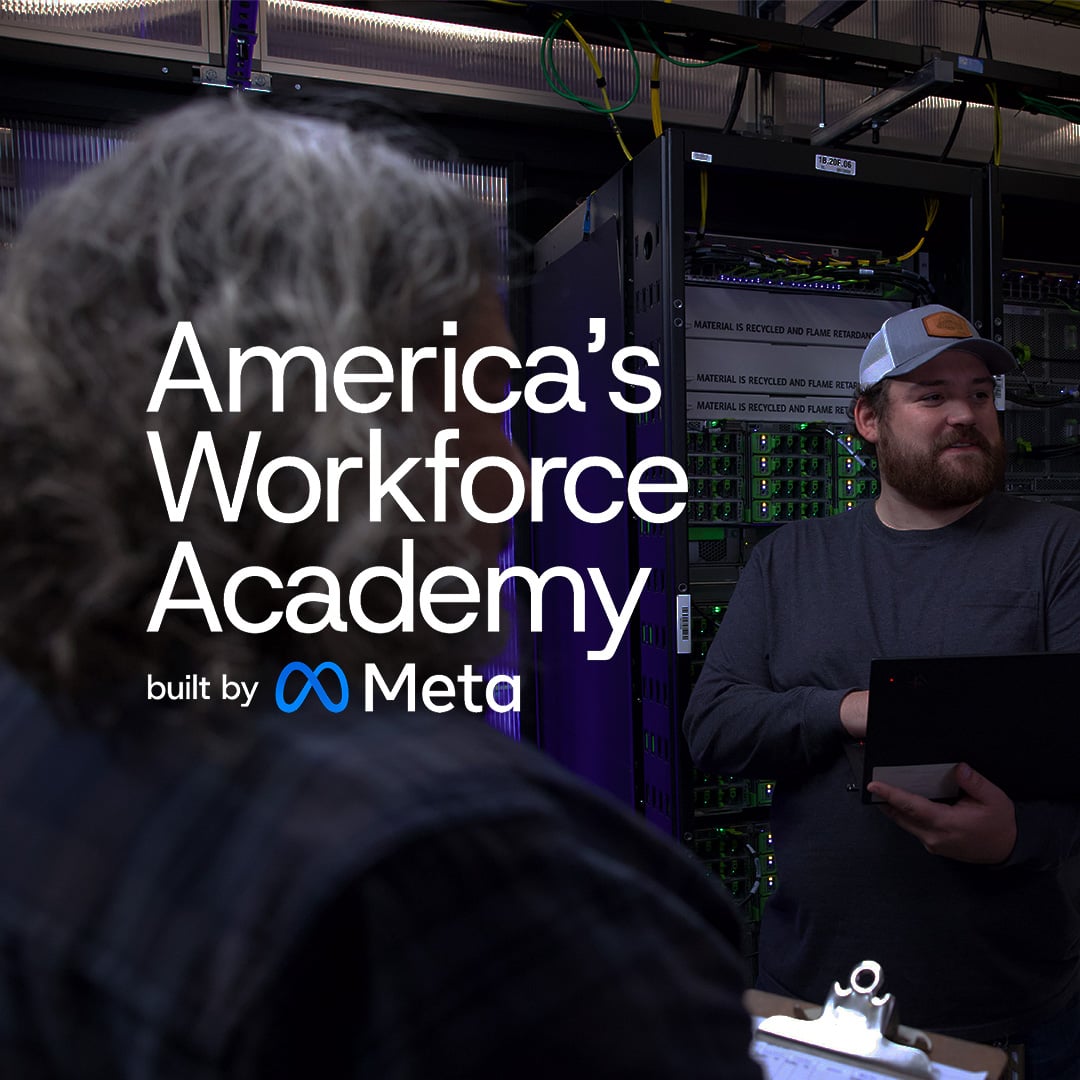
America's Workforce Academy opens with pilots in four metros where Meta already runs data centres, and it guarantees every graduate a job offer from one of Meta's construction partners. The credential they earn is portable.
The Investor · Invest desk
What happened
- Meta launched America's Workforce Academy with $115 million of first-year funding to train veterans, recent graduates and career changers for the trades that build data centres.
- Pilot programmes are rolling out in Houston, Baton Rouge, Indianapolis and Columbus, four cities where Meta already operates data centre facilities.
- The curriculum covers electrical work, plumbing, HVAC and general construction, and the programme takes applicants with no prior construction experience at all.
- Graduates leave with NCCER credentials, an America's Workforce Certificate and a guaranteed job offer from Meta's construction partners.
- Cryptobriefing reports that the first cohort graduated in August 2026 and has already started work on Meta's construction sites.
Compiled by The InvestorSomething wrong?How this is made
Why it matters
- cost Meta carries the training bill and the NCCER credential travels with the worker, so every other contractor in those four metros can hire trained labour it did not pay to produce.
- capability Open enrollment lets contractors draw from people who were not in the construction labour pool at all. That adds supply. It does not move existing crews between bidders.
- exposure The guaranteed offer sits with Meta's construction partners, so a slowdown in Meta's build schedule lands on contractor payrolls. Meta's own headcount does not take the hit.
- precedent A guaranteed-job-offer training fund of this size sets the local benchmark for what the next company siting a campus in Houston or Columbus is expected to put up.
The money and the job offer come from different parties. Meta funds the training, and the guaranteed offer at graduation is written by Meta's construction partners [4], with delivery running through Associated Builders and Contractors, CBRE, the National Urban League and local workforce organisations [6]. The trainees do not join Meta's payroll. The headcount lands on the contractors who build for it.
The credential goes with the worker. NCCER certifications are portable across the construction industry, and Cryptobriefing's account notes that graduates are not locked into Meta's ecosystem and can take the certification to any employer in the country [10]. Meta pays the training cost once. A builder in Columbus who funded no cohort can hire the output.
Cryptobriefing framed the commitment as "a bet that the biggest bottleneck in the AI race isn't chips or capital. It's people who can actually build the buildings" [11]. The account does not say how large that shortfall is [17]. The siting supports part of that. The pilot metros sit beside existing or planned Meta operations, so graduates move onto active job sites without relocating across the country [12], and Fox News Digital reported from a Houston training site where the first cohorts were preparing for construction jobs tied directly to Meta's infrastructure pipeline [13].
Scarcity is one reading. Contractors could not staff the sites at the wage Meta's partners wanted to pay, so Meta funded new supply. The second is a recruitment subsidy, in which Meta buys its partners a cheaper intake than a wage fight in four metros would produce. The third is standing with the local workforce bodies and permitting authorities in places where more campuses are planned. The open-enrollment design, which takes people with no construction experience at all and is meant to widen the talent funnel [5], argues for the first two over the third, because a goodwill programme does not need to accept beginners.
Cryptobriefing calls it the largest private-sector investment in skilled trades that carries a guaranteed job offer on graduation [7]. Set against the pipeline it feeds, the sum is small, and the per-head figures are the interesting part. The Level-Up component drew 35,000 applicants in its first week [9]. Divide the first-year commitment by those applicants and you get roughly $3,290 a head [15], which only means anything if every applicant takes a seat, and applications are not admissions. Split evenly across the four pilot metros, the first year is $28.75 million each [16].
What to watch
- Whether Meta's second-year funding comes in above or below the $115 million first year, and whether it stays inside the same four metros.
- A published graduate or completion count, which would let the first year be priced per worker instead of per applicant.
- Whether contractors outside Meta's partner list start hiring AWA graduates, and at what wage.