Invest1 distinct publisher3 min readPublished
Oracle, Meta, Google, Amazon and Microsoft plan more than $700bn of US data centers this year, roughly $58bn a month, and against that run rate a repealed state tax break costs less than two quarters of permitting delay.
The Investor · Invest desk

Compiled by The InvestorSomething wrong?How this is made
The ratio worth holding onto is subsidy against schedule. Texas's data center tax break, the one Governor Greg Abbott has promised to ask legislators to take away next year while also ordering regulators to keep data centers off residential electricity bills [9], costs the state more than a billion dollars annually, and the five largest builders expect to put more than $700 billion into US data centers this year alone [1], which makes the entire Texas break about one seven-hundredth of a single year's national capex, call it 0.14 percent [16]. Losing it dents a pro forma. Losing four months of interconnection does not appear on the pro forma at all, and against an industry run rate near $58 billion a month [15] that is the expensive input nobody puts a line item on.
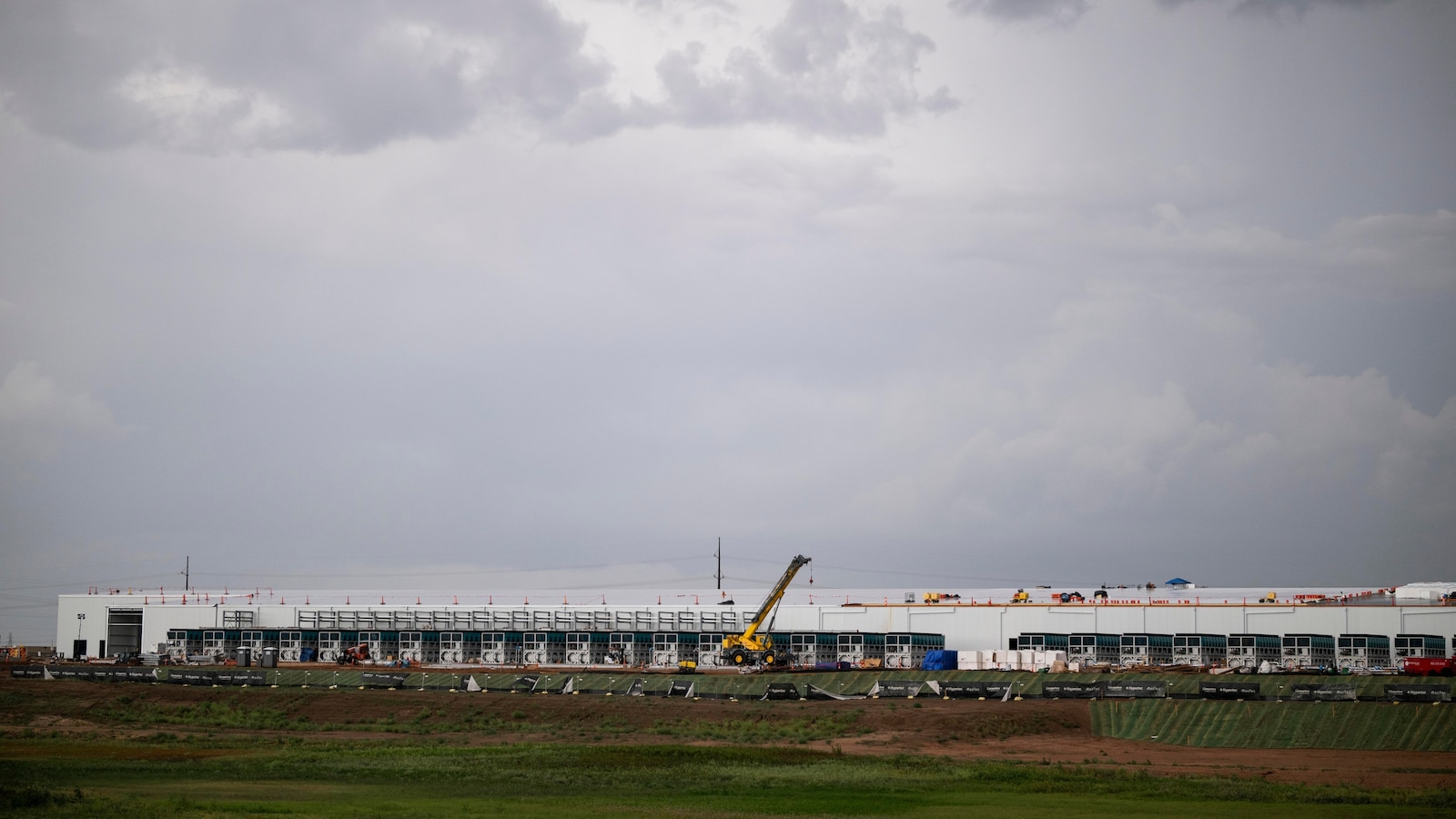
Which is why the New Mexico matter is the one to read closely. Project Jupiter, the Oracle and OpenAI complex planned near the Mexican border, carries a $165 billion price tag [3], about 24 percent of one year of the whole industry's US spending [14], and the challenge to it turns not on whether the water exists but on procedure: the Center for Biological Diversity says the state approved a well-drilling permit last year while ignoring public-notification steps written into state law [4]. Process defects are the cheapest thing for an opponent to litigate and among the slowest to cure.
The offsetting force is federal and it is loud. Trump said last week that as a mayor or governor he would "absolutely want" a big data center "because the jobs are enormous and the money paid, the taxes paid, are just enormous," while allowing that the industry needs "a little public relations help" [6], and his administration is working to connect data centers to power plants and high-voltage lines and to convert Cold War-era uranium enrichment plants into data center and power complexes [7]. That enthusiasm can move a transmission corridor; it cannot sign a county permit or attend a state water hearing.
The state layer is where the language turns binding. Several states now want data centers to fund their own electricity supply, cap water use, disclose operations and win community support before a permit or exemption issues [8], New York has a one-year ban on large projects [10], and Michigan, Oregon and Minnesota passed laws inside 18 months to protect their existing 2040 emissions-free electricity mandates [12]. Meanwhile the load has set off the biggest gas plant construction boom on record [11], and those turbines have to go somewhere that is not the three states that just fenced off 2040.
Separate the scenarios before taking a view. In the first, this is a routing problem: capital moves to counties that want it, aggregate spend stays above $700 billion, and the cost surfaces as a widening gap between announced and delivered in-service dates. In the second, cost allocation becomes the real levy, because a requirement to pay for your own generation and transmission bills the operator every year rather than once. In the third, water is a hard stop in the Southwest, where capital does not manufacture an aquifer.
My read is the first, and it is probably too calm: the money migrates rather than shrinks, and the losers are the projects that signed power contracts in states that then changed their minds. What would break that read is a Jupiter-scale project actually halting. If those New Mexico permits are voided and the site sits, the exposure stops being a routing cost and becomes a write-down, and every developer's schedule assumption gets re-underwritten alongside it.
Ranked by verification strength, evidence, and original report placement.
Oracle, Meta, Google, Amazon and Microsoft expect to put more than $700 billion into data centers in the US in the current year alone.
The Associated Press reports that snowballing community opposition to data centers across the United States has transformed the midterm elections, disrupted the plans of the world's richest companies and drawn President Donald Trump to the industry's defense.
In New Mexico, Oracle and OpenAI are building Project Jupiter, a $165 billion data center complex planned near the Mexican border, where concerns over dwindling water supplies are mounting.
The Center for Biological Diversity challenged New Mexico's approval of well drilling permits to supply millions of gallons of water to Project Jupiter, saying the state approved a permit last year after ignoring public-notification procedures in state law.
Samantha Barncastle Salopek, a water rights lawyer from a pecan-farming family who says farmers and ranchers are worried about their water rights in a drought-hammered state, is running as a Republican for a seat on the Dona Ana County commission.
Trump said last week that if he were a mayor or governor with a chance to land a big data center, "I would absolutely want it, because the jobs are enormous and the money paid, the taxes paid, are just enormous," while acknowledging that data centers need "a little public relations help."
Distinct publishers with included, body-backed reporting in this cluster.
Follow any of these and your For You feed starts watching them — no settings page required.
product
Siting Is Now a Schedule Risk: 75 Data Centre Projects, $130bn, One Quarter1 distinct publisher
product
Washington's secret AI test is coming for open weights, and release dates go with it2 distinct publishers
product
A $103,265 fee turns every H-1B hire into a capital approval1 distinct publisher
security
Texas turns the interconnection queue into a gate: 1,800 projects and 474 GW on hold1 distinct publisher
Evidence-backed comparisons of source perspectives and observed adoption signals. Read the methodology
Which Builder, Operator, and Investor concerns the observed source mix emphasized—not a truth score.
Evidence, demonstrated adoption, hype gap, incentives, and confidence are assessed independently, each on its own current evidence. How these are measured.
Single wire report, specific but uncorroborated
All claims trace to one Associated Press takeaways article. It is specific and attributable: named states, named officials with direct quotes, a named candidate, a named advocacy group and two large dollar figures. But nothing is corroborated by a second publisher in this cluster, no primary documents (permits, executive orders, filings, company guidance) are cited, and the load-bearing quantitative claims (>$700bn, $165bn, billion-dollar-plus tax break) arrive without company- or program-level breakdown. The framing claims about transformed elections and a record gas-plant boom are AP characterizations with no supporting metrics.
Buildout and countermeasures both in force
Both sides of the story are past the announcement stage. Project Jupiter is described as under construction with state-approved water permits, and the five hyperscalers' spend is an active-year plan rather than a roadmap. On the restriction side, New York's one-year ban is ordered, Texas's regulator directive is issued, and Michigan, Oregon and Minnesota have enacted protective statutes within 18 months. What holds the score below the top band is that several measures are promised rather than in force (Abbott's 2027 agenda, the pending California bill), the halted sales tax exemptions are unnamed, and no facility has been reported cancelled or delayed as a result.
Framing outruns the counted evidence
The story's framing, that community opposition has transformed the midterms and that water permits and county races now set the pace of a $700bn build, is supported by a thin evidentiary base: one county commission candidate, one permit challenge, one state ban and one governor's promised agenda. Meanwhile the arithmetic in the cluster cuts against the framing, since the Texas tax break at risk is around 0.14 percent of a single year of the five builders' capex and no project delay or cancellation is documented. Overstatement is modest rather than severe because the enacted state laws and the New York ban are real and verifiable as reported.
Heavily interested voices on every side
Nearly every actor quoted or described has a direct stake, and AP does not fully surface the resulting pull. Trump is described as the industry's biggest booster and frames data centers as central to beating China while his administration pushes interconnection and enrichment-site conversion. The Center for Biological Diversity is an advocacy organization litigating against permits, and the water-rights lawyer voicing farmer concern is herself a candidate for county office. Governors face ratepayer politics. Building trades unions, whose members work these projects and who advocate for them in statehouses and town halls, are described as the industry's remaining allies. The score is not higher because AP labels most of these interests explicitly rather than laundering them.
Credible sole source, no corroboration
Confidence is anchored by a reputable wire service reporting named, checkable facts, and undercut by the cluster containing exactly one publisher and one article. Policy actions (New York's ban, Abbott's directive, the three enacted state laws) are the most reliable elements; the aggregate capex figure, the record gas-plant boom and the electoral-transformation framing carry the most residual uncertainty, and the derived ratios inherit whatever imprecision sits in the underlying numbers.