Build1 distinct publisher3 min readPublished
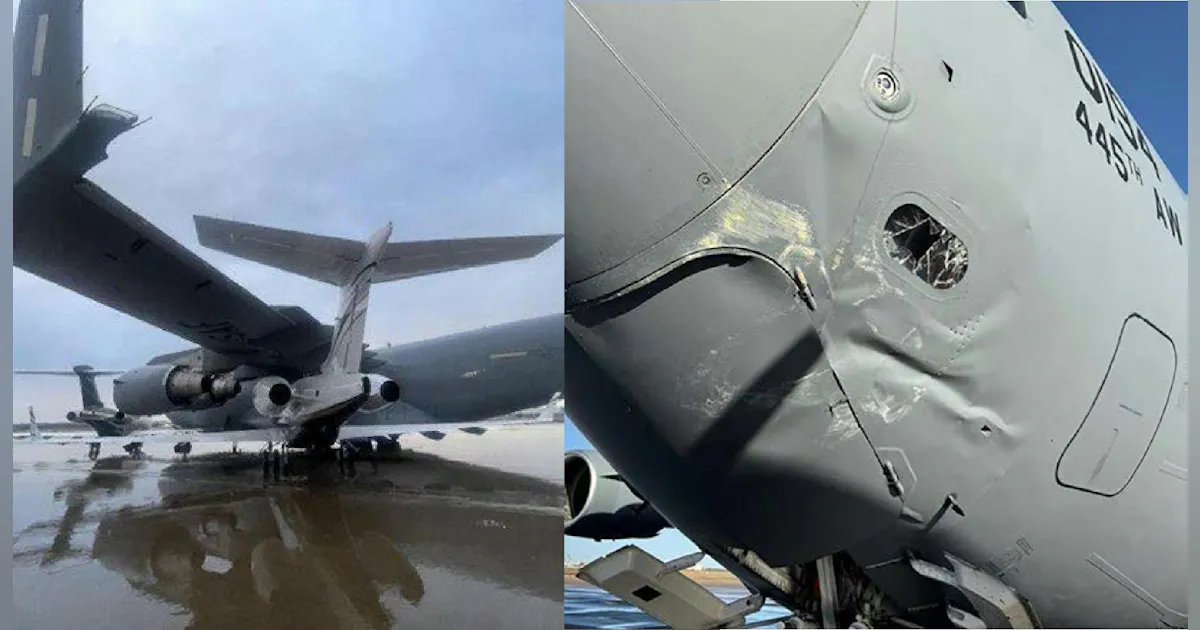
Machina Labs formed a C-17 nose panel without dies and the Air Force flew it on July 30, 2026. What got approved was one article on one aircraft, and the cycle times being quoted start from a moment nobody names.
The Engineer · Build desk

Compiled by The EngineerSomething wrong?How this is made
Amortization is the constraint that makes any of this necessary. A die earns its cost back across a production run, and the run here was one panel, which is why the Air Force account has Boeing determining that suppliers would not build dedicated tooling for it [8]. A die whose production run is a single unit is the most expensive way to buy a shape. RoboCraftsman moves the geometry into the tool path instead, progressively shaping sheet metal from digital designs without the dedicated dies and molds [3]. The spend moves from steel to setup, process control and inspection.
Then the schedule. The storm was March 4, 2025 [5], and the aircraft flew again on July 30, 2026 [1], about 17 months later [1]. After a further repair attempt failed, officials had projected at least a year of storage and another year of repair, which is at least 24 months [9][2]. Machina Labs puts manufacturing between March and May 2026 [13], roughly three months, or about a fifth of the elapsed span [3]. The rest was the approval chain: the Air Force says it ran fit checks and panel testing, completed a final fit check in April, and had Boeing and Air Force maintainers install the panel in July [14], followed by a landing-gear test and adjustments around the nose before flight [15]. The grounded jet was one of nine the wing counted as mission-essential [10]. The long pole was the approval chain, not the forming.
Treat the quoted durations the way you would treat someone else's benchmark table. Air Force program manager Mary Schuler said the effort turned a repair measured in years into one completed in months [16], and Col. Karen Gharst said the Rapid Sustainment Office delivered a panel for fit checking in just over a month [17]. For those numbers to move to your site, three conditions have to hold: the machine is already installed, as the office's was at its Ohio operations center [11]; research engineers are available to the job, as the University of Dayton Research Institute's were [12]; and the OEM will install the part and stand behind it, as Boeing did alongside the maintenance group [12]. The one-month figure also has no named start event, and the two published dates for when work began do not settle it [13].
Here is the part that decides whether this is a spares strategy or a good save. The account is explicit that a specific panel passed the testing and approvals required for installation and flight on this aircraft, and that this does not amount to blanket certification for every part RoboCraftsman could form [18]. Those two acceptance models scale differently. Article-by-article acceptance scales with test and inspection capacity, and each new panel repays the full bill. Process qualification scales with the machine, and the marginal panel gets cheap. Which one the Air Force bought is not stated in the published accounts.
Worth noting that the damaged aircraft had already flown once, home to Ohio, on a temporary nose-panel repair that Boeing had qualified and the service had approved, with its landing gear down [6]. Whatever the forming method, both flights rested on a qualification package someone signed.
Ranked by verification strength, evidence, and original report placement.
Machina Labs says its replacement left-nose panel, formed by RoboCraftsman, flew on a crewed U.S. Air Force C-17 when the repaired aircraft returned to flight on July 30, 2026, at Wright-Patterson Air Force Base.
The Air Force described the panel as the first part produced through incremental sheet forming to fly on an Air Force platform.
After a landing-gear test and adjustments around the nose, the C-17 returned to flight on July 30.
Air Force program manager Mary Schuler said the effort reduced a repair measured in years to one completed in months.
Col. Karen Gharst, commander of the 445th Maintenance Group, said the Rapid Sustainment Office delivered a panel for fit checking in just over a month.
RoboCraftsman progressively shapes sheet metal from digital designs, avoiding the dedicated dies and molds that make conventional forming expensive for a single replacement part.
Distinct publishers with included, body-backed reporting in this cluster.
1 article · August 29, 2026
Follow any of these and your For You feed starts watching them — no settings page required.
invest
Code Metal's $80M WarMatrix award shows OTA is where defense revenue now shows up1 distinct publisher
product
Boeing picks an engine that already exists, and JDAM LR becomes a rate problem1 distinct publisher
product
The Air Force just published its shopping list of threat signatures it wants to shoot at cheaply1 distinct publisher
product
The Air Force's JASSM bet: a second engine source beats a better engine1 distinct publisher
Evidence-backed comparisons of source perspectives and observed adoption signals. Read the methodology
Which Builder, Operator, and Investor concerns the observed source mix emphasized—not a truth score.
Evidence, demonstrated adoption, hype gap, incentives, and confidence are assessed independently, each on its own current evidence. How these are measured.
Specific, named, and entirely second-hand
The detail here is unusually concrete for a defense-manufacturing story — a storm date, a tail's wing assignment, two named officials, a month-by-month repair sequence. All of it reaches us through Runtime Wire relaying the Air Force Life Cycle Management Center and Machina Labs, and the two disagree about when the panel was actually made. Nothing describes what 'panel testing' consisted of, which is the one detail that would tell you how much the airworthiness gate was worth.
One panel, one airframe, one cell
Count what is actually in service: a single left-nose panel on a single C-17, formed on a system that was already sitting at the Rapid Sustainment Office. The 50-cell plant is financed, not built. That is a real deployment in a safety-sensitive job, which is more than a demo, and it is also a sample size of one.
The stopwatch has no starting gun
'Years to months' is the line doing the persuading, and it compares a real 17-month elapsed repair against a projection of at least 24 months that was never run. Trim it further and the company's own three-month forming window becomes the headline number, which is about a fifth of the time the aircraft was actually down. The overstatement is modest and mostly rhetorical — this reporting volunteers the narrow scope rather than burying it.
Both narrators are selling something
The vendor's CEO surfaced the milestone a month after the flight, with a $124 million round closed and Lockheed Martin Ventures on the cap table; the Rapid Sustainment Office gets a flying, quotable justification for having bought a forming cell before anyone asked it to. Neither is dishonest, but every number in the story passes through one of them, and the date conflict between the two is the visible seam.
The event holds; the arithmetic around it wobbles
We would bet on the core of this: a dieless-formed panel was installed and the aircraft flew on July 30, 2026. We would not bet on any duration quoted about it, and with one outlet and two interested narrators there is no second account to correct the first.