Orphan-free quote references place the Love Electric sample inside a production database
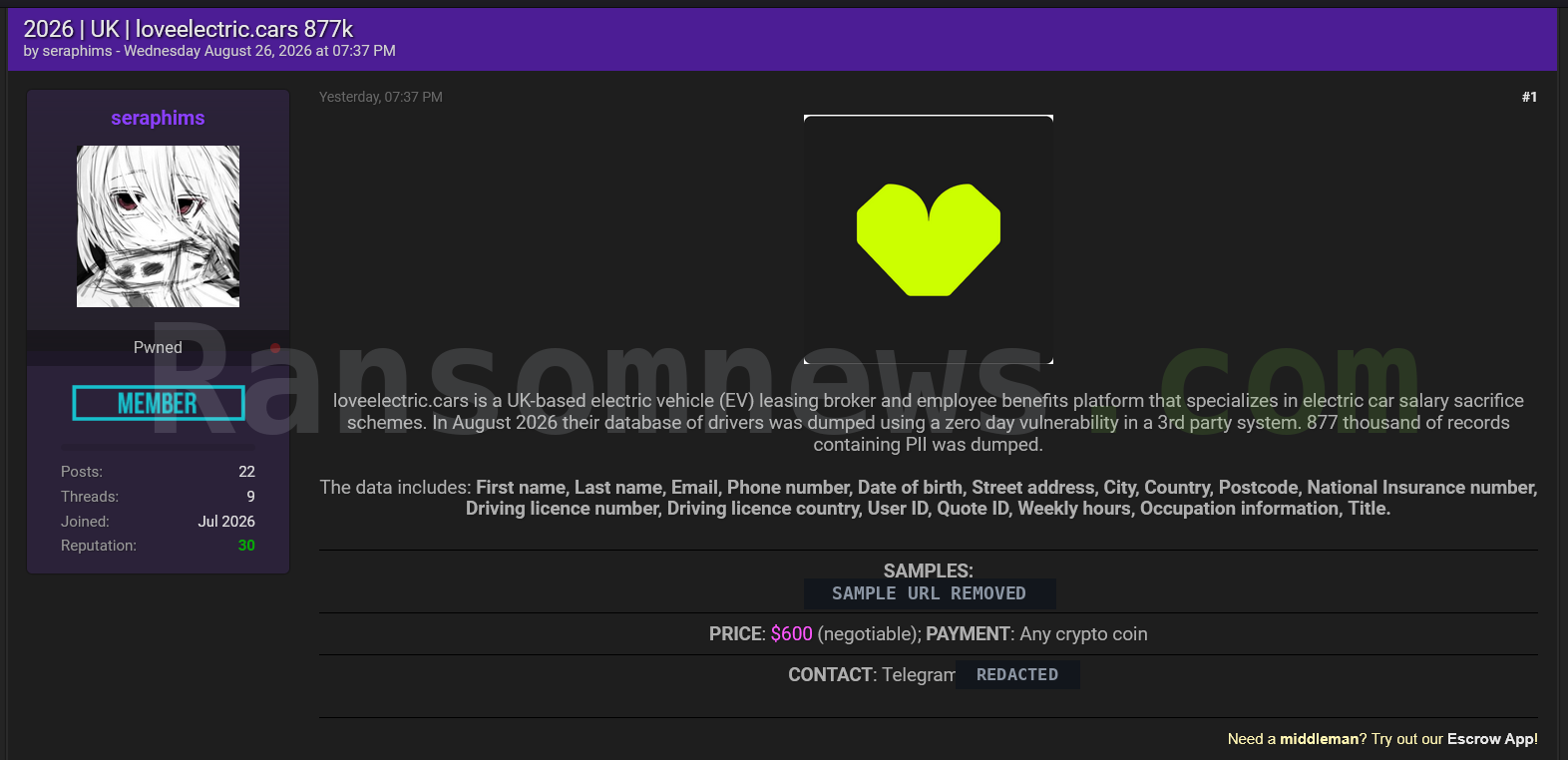
A forum seller wants $600 for what they say are 877,000 EV salary sacrifice driver records, and the 999-row sample published as proof holds up under structural testing in ways a fabricated file usually does not.
The Watch · Security desk
What happened
- A forum seller using the name seraphims offered 877,000 Love Electric driver records for $600 in cryptocurrency, price negotiable, in a listing posted on August 26.
- The free sample is a 999-row CSV with 24 columns, named in a way that indicates an export of a dbo.drivers table from a Microsoft SQL Server database.
- Ransomnews counted 731 primary drivers against exactly 731 distinct quote IDs, one primary per quote, with all 268 additional named drivers pointing at quotes present in the file.
- The consent flag governing National Insurance processing is populated for every one of the 731 primary drivers and empty for all 268 additional drivers, and NI numbers appear on primary rows only.
- Love Electric Financial Services Limited is an Edinburgh salary sacrifice administrator and FCA-regulated credit broker, listed at Companies House as active Scottish company SC374952.
Why it matters
- exposure The people at risk are exposed through a vendor their employer chose, and the broker holds the payroll-grade combination that makes employer-side impersonation workable rather than just a mailing list.
- cost At a fraction of a cent per record the buyer's economics survive even if the count is inflated, so a set priced this low circulates and gets recopied rather than being resold once to one party.
- decision Love Electric has to size this from its own tables and access logs; adopting the seller's total as the incident boundary means notifying the wrong population in one direction or the other.
- precedent Referential-integrity testing on a published sample is becoming the cheap first pass on any breach claim, because it settles provenance without waiting on the victim or touching its systems.
Fabricated breach databases usually fail on relationships rather than on fields, which is why Ransomnews went at the join columns before anything else [17]. Any generator can emit a plausible name, a postcode and a National Insurance number. Few reproduce the invariants an application enforced on the way in.
The driving licence field carries its own internal check. Of the 108 full-length licence numbers in the sample, Ransomnews reports 98.1% had a surname block matching the surname stored in the same record, 97.2% matched on first initial, and 78.7% encoded a date of birth matching the stored one [15]. That last figure is roughly 85 rows where two separately stored fields agree [18]. Only 108 of the 287 rows carrying a licence number were full length, 37.6% [23].
Sparseness pushes the same way. Around 71% of rows lack a name, address or city, 74% have no phone number, and 85% have no NI number [13]. The 147 NI numbers present reach a fifth of the 731 rows permitted to hold them, 20.1% [22]. Of those 147, only 53% match the HMRC format [16], so about 78 conform and 69 do not [19]. Licence numbers run to several lengths and phone numbers appear in three formats [16]. Synthetic sets are tidier than that.
The distribution fits a Scottish-registered administrator's employer base. Postcodes cluster on Edinburgh and central Scotland with records running into England, and dates of birth span 1946 to 1999, concentrated on people born in the 1970s and 1980s [14].
None of that validates 877,000. The examined sample is 0.114% of the claimed total, one row in 878 [20]. Public: the listing and the CSV. Seller's assertion: everything behind it. Love Electric had not commented when Security Affairs published [4], and Ransomnews itself flags the total as unverified [3].
Price frames the rest. $600 across 877,000 records works out at 0.068 cents each, about 1,461 records per dollar [21]. Nobody paying that audits a row count. The schema is what carries cost downstream: name, date of birth, address, postcode, NI number and licence number in one row [10], held by a salary sacrifice administrator because the scheme requires it to identify employees and support tax and insurance handling [12].
What to watch
- A statement from Love Electric, and whether it puts its own figure on the number of drivers involved.
- A full copy surfacing on the forum or a mirror, which would let anyone test the 877,000 claim against more than 999 rows.
- A repost or price cut on the listing, which would indicate the set has not moved at $600.
Clarity's read
What the record supports and how the coverage leans. The claims behind it follow.
Reality
- Evidence58
- Adoption22
- Hype gap+20
- Incentives62
- Confidence55
Claim ledger
Ranked by verification strength, evidence, and original report placement.
- [1]
A seller using the name "seraphims" claimed on August 26, on an English-language data-breach forum, to have obtained the driver database of Love Electric, a UK electric-vehicle salary sacrifice broker.
- [2]
The seller offered 877,000 records for $600 in cryptocurrency, with the price negotiable.
- [3]
Ransomnews researchers examined the 999-row sample published with the listing and found strong evidence it came from a genuine production database, while the claimed 877,000 records remain unverified.
- [4]
Love Electric had been contacted for comment at the time of publication.
- [5]
The 999 rows split into 731 primary drivers and 268 additional named drivers.
- [6]
There are exactly 731 distinct quote IDs in the sample, and every quote has exactly one primary driver, 731 out of 731.
- [7]
All 268 additional drivers reference a quote that exists in the file, with no orphans.
- [8]
The consent flag governing National Insurance processing is empty for precisely the 268 additional drivers and populated for every one of the 731 primary drivers, and National Insurance numbers appear on primary drivers only.
- [9]
The seller published a free sample as a 999-row CSV with 24 columns, named in a way that indicates an export of a dbo.drivers table from a Microsoft SQL Server database.
- [10]
Sample fields included names, email addresses, phone numbers, dates of birth, addresses, postcodes, National Insurance numbers, driving licence numbers, quote IDs and consent-related fields.
- [11]
Love Electric Financial Services Limited is an Edinburgh-based provider of EV salary sacrifice administration and credit broking, identified by Companies House as an active Scottish company under number SC374952 and operating as an FCA-regulated credit broker.
- [12]
Salary sacrifice arrangements require the broker to identify employees, process the scheme and support insurance and tax-related requirements, so the underlying records can include National Insurance numbers and driving licence information.
- [13]
Around 71% of rows lacked a name, address or city, 74% had no phone number and 85% had no National Insurance number; 147 records contained a National Insurance number and 287 contained a driving licence number.
- [14]
Postcodes clustered around Edinburgh and central Scotland with records extending into England, and dates of birth ranged from 1946 to 1999, concentrated around people born in the 1970s and 1980s.
- [15]
Of the 108 full-length driving licence numbers in the sample, 98.1% had a surname block matching the surname in the corresponding record, 97.2% had an initial matching the first name, and 78.7% contained a date-of-birth encoding that matched the stored date of birth.
- [16]
Licence numbers appeared in many different lengths, only 53% of the National Insurance numbers present matched the expected HMRC format, and phone numbers appeared in three different formats.
- [17]
Fabricated breach databases often fall apart when researchers examine the relationships between records; the constraints observed here are enforced by whatever application wrote the data and hold across all 999 rows without exception.
- [18]
The 78.7% date-of-birth encoding match rate covers about 85 of the 108 full-length licence numbers.
- [19]
If 53% of the 147 National Insurance numbers present match the HMRC format, about 78 conform and about 69 do not.
- [20]
The 999 examined rows are 0.114% of the claimed 877,000 records, or one row in 878.
- [21]
At $600 for 877,000 records, the asking price is 0.068 cents per record, about 1,461 records per dollar.
- [22]
The 147 National Insurance numbers in the sample cover 20.1% of the 731 primary-driver rows that are permitted to hold one.
- [23]
Only 108 of the 287 rows carrying a driving licence number held a full-length number, 37.6%.
Get this ledger inside ChatGPT. Ask about any of our stories and the answer brings its figure, each claim’s verdict and the sources. Free, no account.
Sources
1 independent publisher whose own reporting we read for this story.
- securityaffairs.comLove Electric Breach: 877,000 Driver Records Offered for $600
1 article · August 28, 2026
Topics and entities
Follow any of these and your For You feed starts watching them — no settings page required.
Topics
Entities
- Love Electric Financial Services LimitedFollow
- seraphimsFollow
- RansomnewsFollow
- Companies HouseFollow
- Financial Conduct AuthorityFollow
- HM Revenue and CustomsFollow
- Microsoft SQL Server (MSSQL)Follow
- Security AffairsFollow