Science1 publisher3 min readPublished
A LUCA made of rock and half a metabolism moves the origin-of-life target
Bill Martin's group argues in Science Advances that the last universal common ancestor was vent chemistry, not a cell, and that bacteria and archaea became alive separately.
The Scientist · Science desk
Drafted by a language model from the sources cited here and checked against its claim ledger before publication. How we use AISend a correction
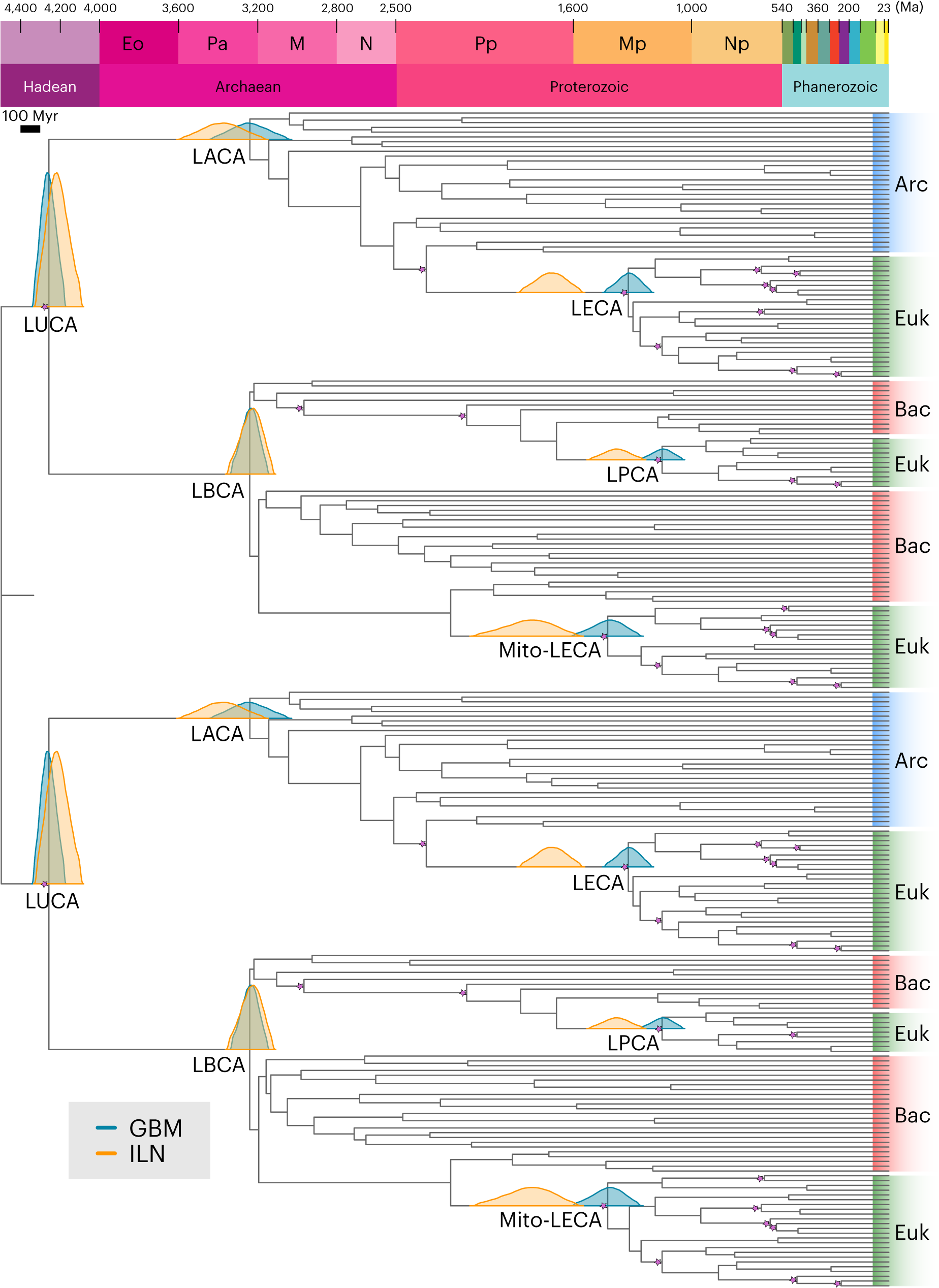
What happened
- Evolutionary biologist Bill Martin of Heinrich Heine University Duesseldorf and colleagues present evidence in a paper in Science Advances that life might have, in effect, begun twice.
- The team argues that the two earliest lineages of Darwin's tree of life sprang independently from a single source that was itself not yet truly alive.
- The last universal common ancestor (LUCA) is generally regarded as a kind of ur-organism: a primitive bacterium-like cell from which all life on Earth has descended.
- In the view of Martin and his colleagues, LUCA was not exactly biological but rather a chemical system formed in the unique environment created by hydrothermal vents.
- At deep-sea hydrothermal vents, a rich chemical brew warmed by volcanic activity spills out over the ocean floor; as a source of abundant energy and chemical ingredients, vents have long been leading candidates for life's earliest cradles, in contrast with Darwin's suggested warm little pond.
Compiled by The ScientistSomething wrong?How this is made
Why it matters
Bill Martin's group at Heinrich Heine University Duesseldorf has published evidence in Science Advances that the two oldest lineages of the tree of life descend independently from a single source that was not yet alive [1][2]. The consequence, if it survives scrutiny, is that origin-of-life research stops hunting for one event and starts explaining a chemistry productive enough to have made more than one.
The last universal common ancestor is usually drawn as an ur-organism, a primitive bacterium-like cell at the root of everything [3]. Martin and his colleagues instead describe a chemical system formed in the environment of hydrothermal vents, where a chemical brew warmed by volcanic activity spills across the seafloor [4][5]. Their LUCA had a primitive form of genetic encoding and metabolic reactions for harnessing energy [6], but the researchers say some of those reactions were catalysed by simple metallic elements in the vent minerals rather than by protein enzymes, as happens in every organism now [7]. Their phrase for it is part organic, part rock [7].
The method is phylogenetic reconstruction, a mathematical back-extrapolation from the genetics of living organisms, applied here to the metabolic networks of bacteria and archaea [11]. The differences the team finds run all the way down to the last bacterial and last archaeal common ancestors [12]. Metabolism is a cycle: an environmental energy source is converted into energy-rich compounds, those drive enzymatic steps, and a final set of reactions resets the network so it can run again [18]. In the reconstructed cycles of both ancestors, the team reports missing links, which implies LUCA lacked the enzymes for those steps [13]. Martin puts the shortfall bluntly: LUCA only had genes for about half of metabolism [14].
The load-bearing observation is not the gaps but what fills them. According to lead author Natalie Mrnjavac, there are cases where the ancestors of bacteria and of archaea independently evolved structurally distinct enzymes to catalyse the same essential metabolic reaction [15]. Two different protein solutions to one chemical problem is the signature you would expect if the problem was being solved after the split, in two places, by descendants of something that had been outsourcing the reaction to minerals [20]. Nick Lane of University College London, who was not involved, says there is truth in it [9]. The group's own 2016 work already pointed to a LUCA reliant on its environment; what was missing then, Mrnjavac says, was experimental data on the specific functions the environment could have promoted [10].
The obvious alternative is that the holes are artefacts. Absent enzymes may simply reflect methodological limits of phylogenetic reconstruction, which other groups have previously assumed to be the case [16]. Boston University biologist Daniel Segre raises a further alternative in the reporting, though the text available to us breaks off mid-question [17]. That distinction matters more than the headline: a reconstruction gap is cheap, and a non-homologous enzyme pair is not.
Watch whether independent reconstruction teams recover the same paired, structurally distinct enzymes for the same reactions, and whether bench work shows vent-mineral metals catalysing precisely the steps reported as missing, at rates that would keep a cycle turning [7][15]. Darwin's question dates to 1871 and concerns events around four billion years ago [19]; the useful test here is whether one specific list of reactions can be run on rock.