Invest1 distinct publisher3 min readPublished
Crude in the Strategic Petroleum Reserve is down to roughly 293 million barrels, and federal law halts routine drawdowns at 252.4 million. The gap between them is the whole tool.
The Investor · Invest desk

Compiled by The InvestorSomething wrong?How this is made
The operative number is neither the 293 million barrels of crude on hand nor the 70 million the Department of Energy calls the physical minimum. It is 40.6 million: the distance between today's inventory and the 252.4-million-barrel statutory stop written into the Energy Policy and Conservation Act [1]. Below that line, per Fortune's reading of the statute, a president cannot order a routine limited drawdown, and a release requires a severe national security declaration [6][7].
Set that headroom against the flow rate the reserve exists to deliver. At the emergency rate of about 4 million barrels a day, 40.6 million barrels lasts roughly ten days [2]. That rate is also the part Fortune says has already been surrendered: it places the loss of 4-million-barrel-a-day capability at the 300-million-barrel level, which the current crude volume sits about 7 million barrels beneath [8][4]. So the ten-day figure is generous. It prices a surge the hardware is described as no longer able to sustain.
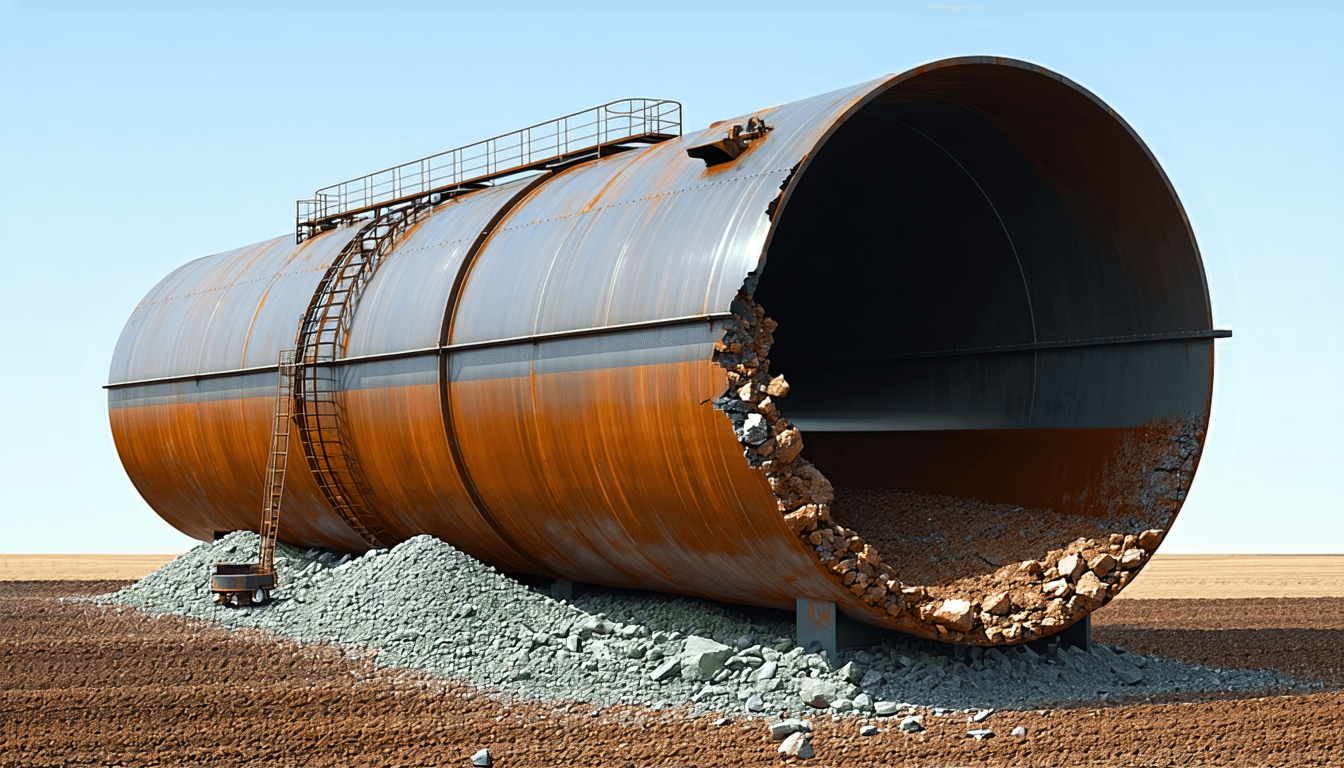
The 714 million barrels routinely quoted as capacity measures fluid, not oil. Because the caverns work by liquid displacement, they can never be drained; pull the fluid out without replacing it and the overburden crushes the salt dome inward [4]. The volume is therefore held permanently at 714 million barrels, of which about 41 percent is crude and the balance is heavy brine [2][3][3]. Capacity describes the hole in the ground, not what is in it.
Then there is the cost of using the thing at speed. As the oil layer thins, the emulsion of oil, water and solids that collects at the oil-brine boundary rises toward the ceiling intake, and fast pumping generates a suction vortex that pulls that sludge into the production stream, fouling piping and wrecking surface pumps [9]. Sustained drawdown also exhausts saturated brine and forces operators to inject raw fresh water, which dissolves the halite walls, widening the cavern and thinning the salt pillars between neighbouring domes [10]. The rock sits at 120 to 150 degrees Fahrenheit, so cooler injected water cycles it thermally until multi-ton blocks break from the roof and shear the steel extraction pipes hanging inside [11]. Every one of those is a bill that arrives after the release, paid by the operator, not by the market that got the barrels.
The two floors that bind are 2.4 million barrels apart: the practical operational floor of roughly 250 million, and the legal stop at 252.4 million [c5b][6][5]. They fail at effectively the same moment. There is no state of the world in which the reserve is legally free to run but physically constrained, or physically capable but legally blocked, which removes the usual argument that one of the two limits is merely paperwork.
One caution on the evidence. Fortune attributes the 70-million-barrel structural minimum to the Department of Energy, but the 250-million operational floor and the 300-million flow-rate breakpoint appear without a named agency source [5][14]. Those two unattributed numbers are doing most of the work in this account, and they are the ones a trader would most want confirmed.
Ranked by verification strength, evidence, and original report placement.
The SPR's crude oil volume currently stands at approximately 293 million barrels, with the remainder of the fluid being heavy salt brine.
According to the Department of Energy, the absolute physical minimum crude oil inventory is approximately 70 million barrels, the cushion required at the top of the caverns to keep extraction pipes submerged in oil rather than water.
Under the Energy Policy and Conservation Act, federal law places a strict statutory stop at 252.4 million barrels; below that level the President is prohibited from ordering routine, limited drawdowns.
The Strategic Petroleum Reserve spans 60 underground salt caverns across four storage sites in Texas and Louisiana.
The SPR system has a combined authorized capacity of 714 million barrels.
The caverns operate on a liquid displacement system and can never be left empty; if fluids were removed without replacement, the weight of the overlying earth would collapse the salt domes, so total fluid volume must be permanently maintained at 714 million barrels.
Follow any of these and your For You feed starts watching them — no settings page required.
Evidence-backed comparisons of source perspectives and observed adoption signals. Read the methodology
Which Builder, Operator, and Investor concerns the observed source mix emphasized—not a truth score.
Evidence, demonstrated adoption, hype gap, incentives, and confidence are assessed independently, each on its own current evidence. How these are measured.
Thin: one publisher, one attributed figure, unresolved internal conflicts
The cluster rests on a single article. Structural and statutory facts (60 caverns, 714 million barrels, EPCA's 252.4-million-barrel stop) are stated coherently and the headline arithmetic checks out, but only the 70-million-barrel physical minimum carries an agency attribution, the two operationally decisive thresholds are unattributed, the hazard mechanisms cite no study or incident, and the drawdown-rate figures inside the piece do not reconcile. No primary document, dataset, or named expert is available in the supplied material.
Real operational state, disclosed only second-hand
There is genuine real-world operating evidence here rather than a proposal: a stated current inventory level, a cycle history well beyond the original five-cycle design envelope, and a described present-day throttling of drawdown rates. But every one of these datapoints reaches the cluster through the same publisher, with no agency inventory series, operator statement, drawdown event, or inspection record to confirm that the constraints are being applied as described.
Overstated: dramatized thresholds outrun the sourcing
The core finding - roughly 40.6 million barrels of legally usable crude, about 5.7 percent of authorized capacity - is arithmetically sound and genuinely underappreciated. The framing around it is inflated: a Thermopylae narrative, a '300 million barrels' rallying number the reserve has already fallen below, catastrophic collapse and pipe-shearing scenarios with no cited precedent, and a ten-day runway that depends on an emergency pumping rate the same article declares unsafe. The unattributed 250-million-barrel 'practical floor' sitting 2.4 million barrels from the statutory number further suggests presentation is doing work that evidence is not.
No authorship or interest disclosure supplied
The supplied material contains no byline, author affiliation, contributor disclosure, sponsorship, or commercial relationship for the single source, and no vendor, operator, or trading interest is identifiable. Any judgment about incentive pressure would be inference rather than observation, so this dimension is left unmeasured.
Low: single-source cluster with internal inconsistencies
Confidence is limited by structure as much as by content. One publisher, one item, no corroboration, one agency attribution, arithmetic that is reliable only to the extent its single-sourced inputs are, and at least one internal contradiction in the drawdown-rate figures. The statutory and capacity spine of the story is likely robust; the operational thresholds and hazard mechanisms are not yet verifiable from this cluster.
invest
The SPR's floor may be geological, not political2 distinct publishers
invest
The SPR Falls Below 300 Million Barrels, And With It A Free Option You Were Holding1 distinct publisher
invest
Harvard's $2.2 billion SpaceX position is half its disclosed US equity book1 distinct publisher
invest
Hormuz stays shut, and Iran's reopening terms are all addressed to Washington1 distinct publisher
Distinct publishers with included, body-backed reporting in this cluster.