Invest1 publisher3 min readPublished
Top Latter-day Saints leader calls prediction markets gambling, siding with Utah against Trump
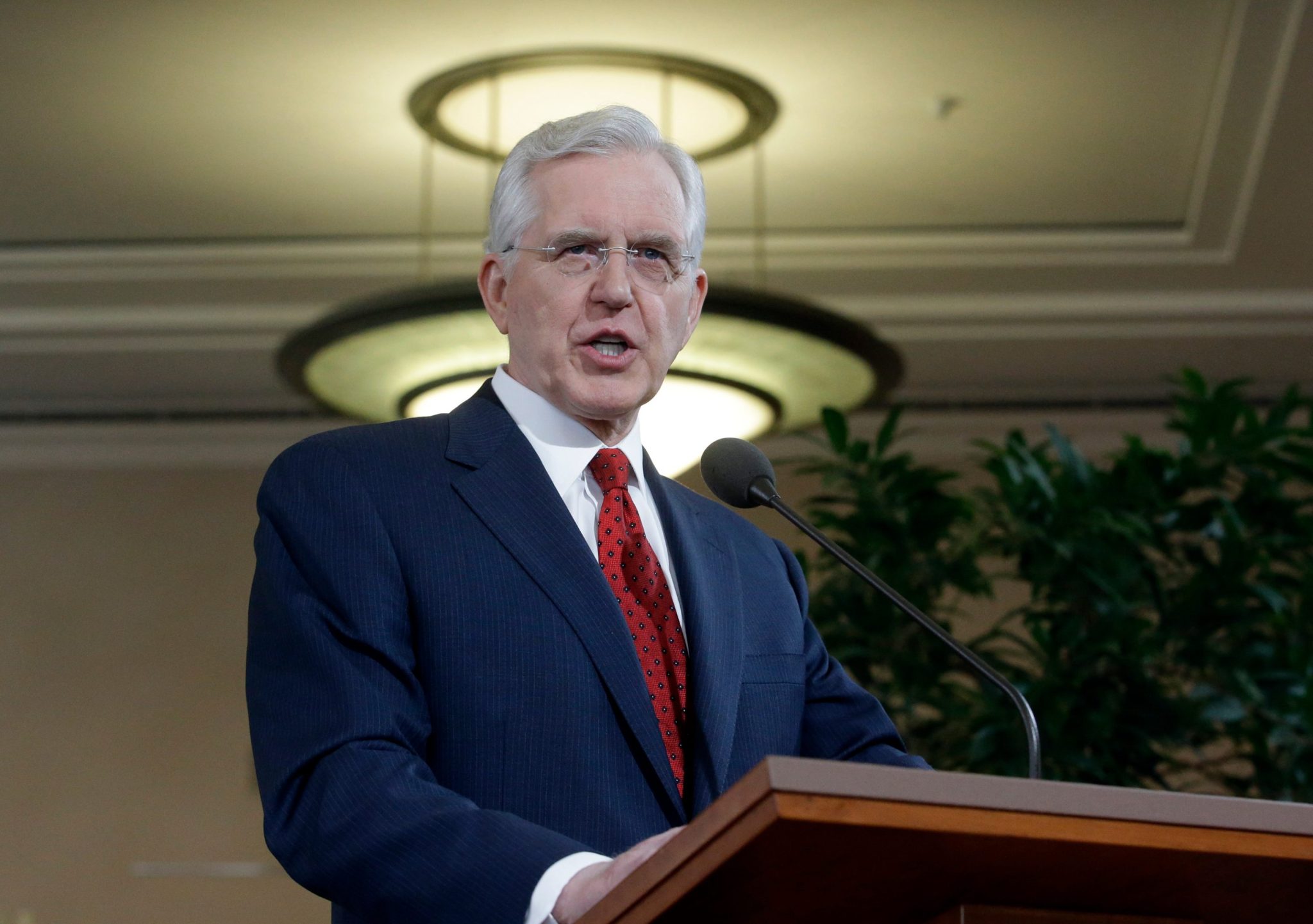
D. Todd Christofferson, one of the Latter-day Saints' three top leaders, called prediction markets gambling that yields "nothing of value." The speech sets the Utah-based church against the Trump administration's view that Kalshi and Polymarket are not gambling.
The Investor · Invest desk
Drafted by a language model from the sources cited here and checked against its claim ledger before publication. How we use AISend a correction
What happened
- A federal judge ruled in August that Utah officials can enforce the state's strict anti-gambling laws on prediction markets.
- Utah enacted legislation this year tightening its gambling laws, with language that would almost certainly apply to prediction markets.
- Utah has had no casinos, lotteries or betting racetracks for more than a century, a prohibition rooted in the ideals of Latter-day Saints members.
- Under President Dallin Oaks, top leader since last October, church leaders this year opposed abortion-rights ballot measures in Idaho and Nevada.
Compiled by The InvestorSomething wrong?How this is made
Why it matters
- decision A Utah Republican who sides with the administration on these platforms now does so in public opposition to one of the church's three top leaders.
- constraint To reopen Utah, Kalshi and Polymarket would have to undo a court ruling and a new statute while the church behind the state's gambling ban argues the other side.
- precedent If the church keeps its post-Proposition 8 method, more of its pressure on prediction markets will arrive as private lobbying, leaving less on the public record for the platforms to track.
Christofferson's sharpest line was about settlement. Prediction markets take wagers on events such as whether it will rain in Los Angeles or whether the United States will go to war [8]. "Or even, if you can imagine, the timing of the Second Coming," he said. "Where do you go to collect on that bet?" [9]
The rest of his case was moral. "For us as Latter-day Saints, overarching all other concerns is the fact that gambling is morally wrong. Gambling is built on the desire to obtain something for nothing," he said [3]. He aimed it at teenagers and young adults, saying betting on smartphones is taking time from their studies and relationships [2].
The report does not include Kalshi's or Polymarket's volumes or user counts in Utah, so the money at stake there cannot be sized from it. The legal side can be read. With a federal ruling and a new statute already favouring the state [5][6], a sermon changes little about whether the platforms can operate in Utah.
The speech changes who in Utah will argue the platforms' case, and that can go three ways. It may be moral cover for a result the state already has, and change nothing. The administration's position that these products are not gambling [4] may eventually win over state law, leaving the church's opinion relevant to Utah voters and irrelevant to the platforms' Utah business. Or the speech is the visible part of a campaign, the version I think most likely. Matthew Bowman, a professor of religion and history at Claremont Graduate University [15], said the church's approach to politics has become more calculated, pairing public statements with behind-the-scenes lobbying [12]. Oaks, a former Utah Supreme Court justice, has taken the church into more political questions since becoming its top leader [11]. The strongest case against my view is that Utah does not need a campaign, because its court and legislature have already delivered what one would ask for.
What the church is not doing is asking members to act. In 2008, over California's Proposition 8, leaders encouraged members to get directly involved, and Bowman said the more calculated approach followed the public blowback to that stance [13].
The view is wrong if Utah officials ease enforcement or side with the administration after the speech, or if church leaders say nothing more on prediction markets before the next twice-yearly general conference [1]. Other denominations hold the same line: the Southern Baptist Convention, the largest Protestant denomination in America, declared sports gambling inconsistent with biblical principle in 2025 [14]. "The rise of predictive markets, and the legalization of sports gambling, this is just really taking off all across the country," Bowman said [10].
What to watch
- Whether the August ruling that lets Utah enforce its gambling laws on prediction markets holds up if it is challenged further.
- Any Utah enforcement action against Kalshi or Polymarket under the gambling law enacted this year.
- Whether church leaders take a public position on prediction markets outside Utah, as they did on ballot measures in Idaho and Nevada this year.