Science1 distinct publisher3 min readPublished
The lives averted are measurable and concentrated in the Sun Belt, but they sit in a different ledger from the 4.5 billion tons of cooling emissions the UN expects to reach 7.2 billion within 25 years.
The Scientist · Science desk

Compiled by The ScientistSomething wrong?How this is made
Start with the denominator. Chen's team worked through 30 million US death records across eleven years, using county-level calculations for when heat becomes dangerous [3]. That is roughly 2.7 million deaths a year in the dataset [1]. Against it, 5,267 averted deaths a year [2] is about 0.19 percent of annual mortality, close to two in every thousand [2]. The two published figures are internally consistent: 5,267 times eleven is 57,937 [4]. An effect that small is only legible in a dataset that large, and it rests on the counterfactual. Death records and county heat thresholds cannot randomize who had a working air conditioner, so what is reported is the gap between observed mortality and modeled mortality without cooling, which is a modeled contrast rather than a measured one.
The lives and the tons do not belong to the same ledger. The deaths averted were counted in US counties [1], while the emissions projection is global and runs about 25 years out, from 4.5 billion tons to 7.2 billion [6], an increase of 2.7 billion tons, or roughly 60 percent [3]. At the far end, that 7.2 billion is close to what the United States and Europe emit today [8]. Dividing tons by lives would produce a ratio with no referent, because the emissions growth comes from everywhere cooling is spreading while the averted deaths were measured in one country.
The finding with the most operational content is the one about excess. Chen says the study found that using more cooling than needed does not save more lives while still worsening warming [11], and he places more than half the cases his team examined in the overuse category, pointing at offices, his own among them, cooled enough that workers wear sweaters in summer [14]. Many places use 75 degrees Fahrenheit, or 24 Celsius, as a reasonable limit [15]. A single number like that is a threshold standing in for a dose-response curve, and the curve, by county and by population, is what a facilities team or a utility planner would need to set policy on.
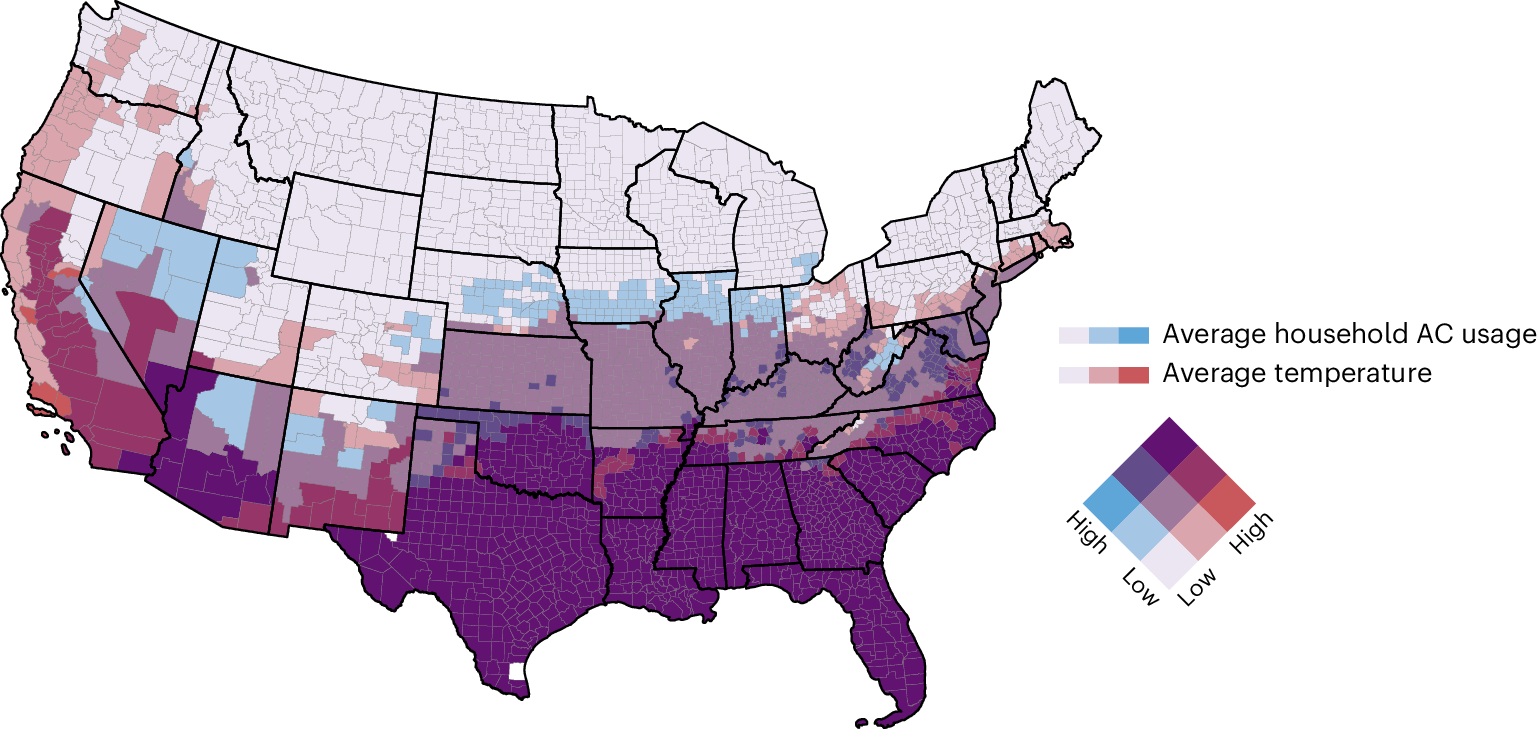
The geography of benefit is a snapshot rather than a fixed property. More than a dozen northern states, Washington through Maine, saved fewer than ten lives a year [5], while US cooling degree days are up 28 percent since 1990, with 2024 a record and 2026 on pace through May to pass it [16]. Europe's cooling degree days have more than doubled since 1990 and its air conditioning use is up 44 percent [17]. Northern counties are drifting toward the conditions under which the Sun Belt estimates were made.
What the mortality frame leaves out: the waste heat that cooling units push into city air, and the extra soot and smog from the added generation, both of which Chen raises [20]. Against UN estimates of roughly half a million heat deaths a year worldwide [19], the US result is a small and unusually well-measured corner of a much larger problem. My read, with its condition attached: take the 5,267 as a serious estimate of what cooling is worth in hot counties, and take the overuse share as the part that can be reduced without costing anyone a life.
Ranked by verification strength, evidence, and original report placement.
A study in Nature Health, reported Monday, found that air conditioning saved nearly 58,000 lives between 2010 and 2020 in the United States.
Kai Chen said the study concluded that the essential role of air conditioning saved on average 5,267 lives a year.
Because most electricity for cooling comes from burning fossil fuels, the UN projects heat-trapping gas emitted from air conditioning use will rise from 4.5 billion to 7.2 billion tons in the next 25 years or so.
The projected 7.2 billion tons is almost as much as the carbon pollution from the United States and Europe now.
Because of a global energy crunch that the report attributes to the war in Iran, eight countries (Bangladesh, Cambodia, Jordan, Malaysia, the Philippines, the Seychelles, Singapore and Sri Lanka) have limited how cool air conditioning can be in offices or mandated one day a week for public offices to switch it off, according to the IEA.
The most lives saved were in Arizona, Florida, Texas, Louisiana and southern parts of Nevada, Alabama and Mississippi.
Distinct publishers with included, body-backed reporting in this cluster.
phys.org
1 article · August 31, 2026
Follow any of these and your For You feed starts watching them — no settings page required.
science
Air conditioning cools the room by heating the street, and a UNSW physicist wants paint first1 distinct publisher
science
Solar got cheap in factories, not in subsidy bills, and a Hormuz shock tests the difference1 distinct publisher
product
US grid storage nears 52GW, and arbitrage is now writing the evening price curve1 distinct publisher
build
Shanghai AI Lab's 397B science agent shipped in July; the paper explaining it landed August 131 distinct publisher
Evidence-backed comparisons of source perspectives and observed adoption signals. Read the methodology
Which Builder, Operator, and Investor concerns the observed source mix emphasized—not a truth score.
Evidence, demonstrated adoption, hype gap, incentives, and confidence are assessed independently, each on its own current evidence. How these are measured.
One report, an unreachable paper
The design described would be strong evidence if we could open it: 30 million death records, eleven years, county-level thresholds for dangerous heat. But it reaches us second-hand through phys.org alone, the paper is never linked, and the publication line at the bottom of the story names a different study — Nori-Sarma et al on summer 2025 emergency department visits — which cannot be the source of a 2010-2020 mortality estimate. The surrounding figures are properly attributed to the IEA, UNEP and EIA, and equally unchecked here.
Cooling everywhere, limits in eight places
Split the question in two and it resolves cleanly. Cooling itself needs no adoption case — up 44 percent in Europe, tripled in India, more than doubled in Southeast Asia, with US cooling degree days at a record. The study's actual prescription, cooling only to the point where it saves lives, is barely deployed: eight countries capping office temperatures, mostly under energy-crunch pressure rather than health logic, plus an Indian proposal from 2025 and a 75-degree figure Chen offers about his own over-chilled office.
Precision outrunning provenance
The reporting is more disciplined than the topic invites — it says outright that extra cooling saves no extra lives, and it does not pretend the emissions are someone else's problem. What tips it slightly over is arithmetic and provenance: 5,267 carries four significant digits from a paper we cannot inspect, and it sits against roughly 2.7 million recorded deaths a year in the same dataset, about two in a thousand. An energy crunch attributed to a "war in Iran", stated once and never supported, should slow any reader down.
Author and advocates, no counterweight
Every named voice wants the same conclusion. The senior author explains his own study; UNEP's cooling-buildings lead and its chief heat officer make the equity case; the Global Cooling Pledge they belong to convenes in the very Singapore held up as the model, and the projections that frame the piece come from the IEA and UNEP themselves. Nobody from a utility, a grid operator or the equipment industry appears, and no outside epidemiologist is asked whether the number holds.
Plausible shape, unconfirmed digits
The direction is easy to believe and the geography is exactly where it should be — Arizona, Florida, Texas, Louisiana high, Washington to Maine in single digits. What we cannot stand behind is the specificity, because one publisher carries it, no one independent has checked it, and the story's own citation points at the wrong paper. Treat the pattern as solid and the digits as provisional.