Product1 publisher3 min readPublished
US grid storage nears 52GW, and arbitrage is now writing the evening price curve
Operators added 8.3GW in the first half of 2026 on a 43.6GW base. The build is driven by solar co-location economics, so industrial buyers need to model a different evening peak.
The Product Desk · Product desk
Drafted by a language model from the sources cited here and checked against its claim ledger before publication. How we use AISend a correction
What happened
- By the end of 2025 the US grid held 43.6 GW of operational utility-scale battery capacity.
- Operators expanded national capacity to nearly 52 GW by adding 8.3 GW during the first half of 2026.
- The expansion depends mostly on co-locating batteries with solar PV plants to capitalise on wholesale price arbitrage across major energy markets; the growth is described as driven by standard market arbitrage.
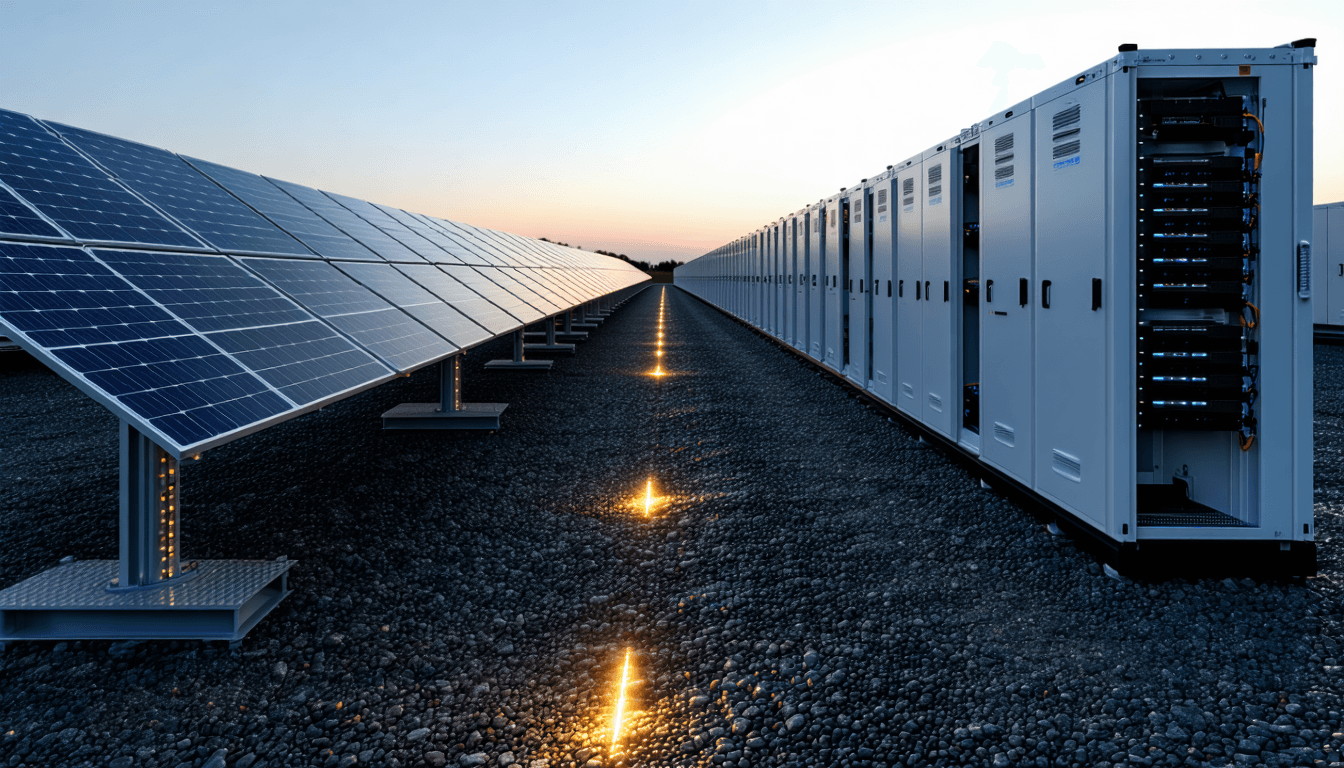
- Solar produces bursts of cheap electricity at midday while demand spikes after sunset; coupling batteries to solar PV farms lets operators absorb low-cost power at noon and sell it back at premium evening rates.
- California's Bellefield Solar and Energy Storage Farm went online in December 2025 with 500 MW of solar and 500 MW of storage; developers plan to double both capacities by November 2026, which would make it the largest power storage facility in the United States.
Compiled by The Product DeskSomething wrong?How this is made
Why it matters
US utility-scale battery capacity reached close to 52 GW after operators brought 8.3 GW online in the first half of 2026, on a base of 43.6 GW at the end of 2025 [1][2][1]. What matters is the driver: Interesting Engineering attributes the expansion mainly to co-locating batteries with solar PV plants in order to capture wholesale price arbitrage [3], which means the shape of the evening price curve in solar-heavy markets is increasingly set by asset owners chasing a spread rather than by a procurement target.
The mechanic is simple and it is the whole business case. Solar output floods the midday market at low prices, demand peaks after sunset, and a co-located battery absorbs cheap power at noon to sell into the evening premium [4]. That is a strategy that works against the conditions it depends on: each additional megawatt discharging into the evening peak is a megawatt pushing back on the spread that funded it [4]. For an industrial buyer, the practical consequence is that the evening block is no longer a reliable proxy for scarcity, and the midday trough is no longer a reliable proxy for cheap.
The scale is concentrated in specific assets. California's Bellefield Solar and Energy Storage Farm came online in December 2025 with 500 MW of solar paired with 500 MW of storage, and developers plan to double both by November 2026, which would make it the largest storage facility in the country [5]. Florida's Manatee Solar Energy Center pairs 75 MW of solar with 409 MW of storage, roughly five and a half times more discharge capacity than local solar capacity [6][2]. Nevada's Gemini Solar Hybrid has run since 2024 with 690 MW of PV and 380 MW of batteries [7].
Two caveats on reading those figures. They are power ratings, not energy ratings, and the source does not give duration [3] - a 400 MW battery that can hold that output for one hour and one that can hold it for four hear the same evening price signal and answer it very differently. And arbitrage is not the only revenue line: these assets also earn from fast-frequency response, voltage control and black-start services [8], so dispatch will not always follow the day-ahead spread.
The pipeline is larger than the installed base. Industry filings tracked by the EIA point to another 54 GW over roughly two and a half years, split as 14 GW in the second half of 2026, 26 GW in 2027 and 14 GW in 2028 [9], which would put the fleet near 106 GW by the end of 2028 [4]. The source is explicit that these are operator intentions rather than commitments, exposed to supply chain problems, permitting and interconnection queues [10][11], with interconnection and congestion already cited as live constraints [12].
Watch the second half of 2026 first. Delivering 14 GW would be about 1.7 times the 8.3 GW that landed in the first half [5], and 2027's stated 26 GW is more than three times the first-half figure [6]; if those numbers slip, the evening flattening slows with them. Watch whether Bellefield's doubling hits November 2026 [5]. And for anyone buying industrial power, watch how quickly hedge counterparties reprice the evening block against midday, because the arbitrage fleet is the party on the other side of that trade.