Science1 publisher2 min readPublished
Juice gains 3.5 km/s from an Earth flyby after a single course correction
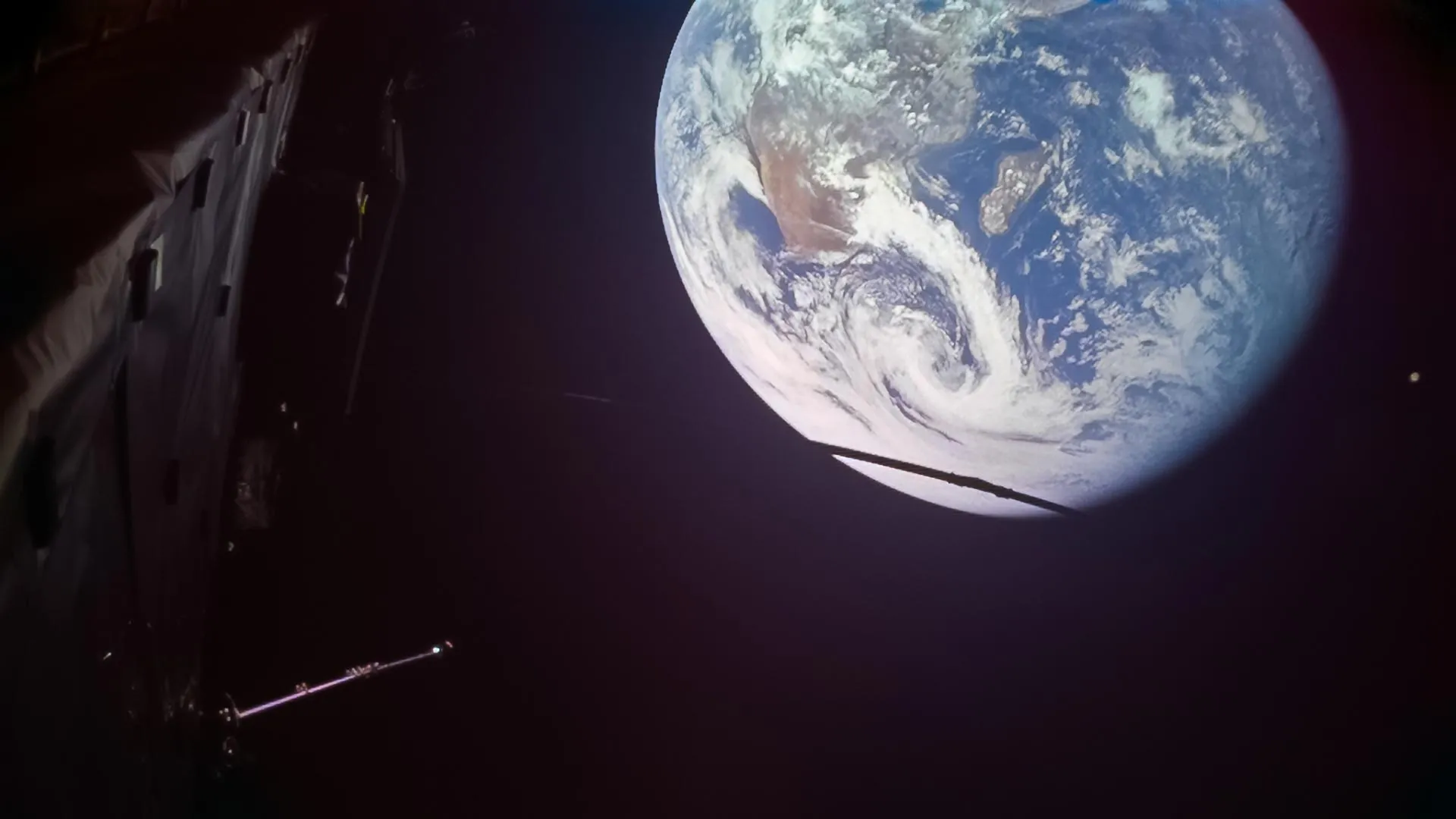
ESA's Juice spacecraft gained 3.5 km/s and turned 20 degrees passing Earth on 28 September, using one of six reserved course-correction slots to line up. Its operations team says the propellant it did not burn will go to observing Jupiter's icy moons.
The Scientist · Science desk
Drafted by a language model from the sources cited here and checked against its claim ledger before publication. How we use AISend a correction
What happened
- Closest approach came at 11:45 UTC, 8,640 km above the Indian Ocean, as Juice's onboard monitoring cameras took a sequence of images.
- Controllers have tracked Juice intensively since 17 August and will continue through 10 October, a 54-day watch around the encounter.
- The pass was the third chance to test Juice's 10 science instruments on a real target, after the 2024 lunar-Earth flyby and 2025 observations of comet 3I/ATLAS.
- While Juice was in Earth's shadow and running on battery power alone, the team had to ration instrument time, project scientist Claire Vallat said.
Compiled by The ScientistSomething wrong?How this is made
Why it matters
- decision Any calibration deferred during the Earth pass now has to compete for the few remaining cruise windows before Jupiter.
- constraint A clean Earth pass is limited evidence for the moon tour, since ESA calls this encounter relatively simple next to 35 flybys of Ganymede, Callisto and Europa.
- capability Instrument teams now have in-flight readings from Earth and the Moon to refine the tools that will later analyse the Jupiter data.
Five of the six correction slots ESA set aside for the four-week approach went unused [1]. Controllers did make one burn, and it was small. Its job was to put Juice on the exact approach needed to get the full benefit of Earth's gravity [3].
Angela Dietz, Juice's spacecraft operations manager, said: "The flyby required ultra-precise navigation in real time. Thanks to our very careful planning, we used only a small amount of the propellant reserved for this flyby." [6]
The correction count is a fair measure of how accurate the approach was. The thing it doesn't tell you is how much fuel that accuracy saved. ESA did not publish the size of the burn or the propellant it used, and the release does not say which reference frame the 3.5 km/s gain is measured in [2][3]. "Very little fuel" is the agency's own phrase for the pass [1].
The instrument work was the more interesting experiment, because the team had to choose what to test. Claire Vallat, the project scientist who led that effort, said: "Juice's journey to Jupiter provides only a few opportunities to calibrate and validate the instruments under well-understood environmental conditions." [10] ESA's operations and science teams spent months with the outside groups responsible for the instruments, working out when each could run on the spacecraft's limited resources [9]. Vallat said the rule for this pass was explicit: "During this flyby, calibration activities were prioritized based on their relevance to preparing the instruments for their work at Jupiter, while also considering whether an opportunity is unique or can be scheduled later in the journey." [12]
ESA calls the Earth pass an important rehearsal [15]. I'd read it as one that went well. Its evidence covers cruise navigation and calibration. Planning for how the instruments will run during the Europa flybys alone started roughly a decade ago, and it goes on until Juice passes Europa in the early 2030s [14].
What to watch
- A propellant figure from ESA for the single correction burn; without it, the margin carried to Jupiter cannot be sized.
- Calibration results from the 10 instruments, and where tests dropped during the battery-only shadow period are rescheduled on the cruise.