Invest1 publisher2 min readPublished
JPMorgan routes nearly all of $320bn in 2035 robotaxi revenue through Tesla's own fleet
JPMorgan lifted its Tesla price target from $145 to $475 while moving the stock only to neutral. Its $320 billion robotaxi projection for 2035 runs almost entirely through cars Tesla builds and owns itself.
The Investor · Invest desk
What happened
- JPMorgan moved Tesla from underweight to neutral in June 2026 and raised its price target to $475 a share from $145, an increase of 227%, according to Cryptobriefing's account of the note.
- Lead analyst Rajat Gupta projects roughly $320 billion of robotaxi revenue by 2035, with nearly all of it flowing through Tesla's directly owned fleet instead of a peer-to-peer network of owners' cars.
- Tesla's autonomous ride-hailing service launched in Austin in June 2025 and now also operates in Dallas, Houston and the Bay Area.
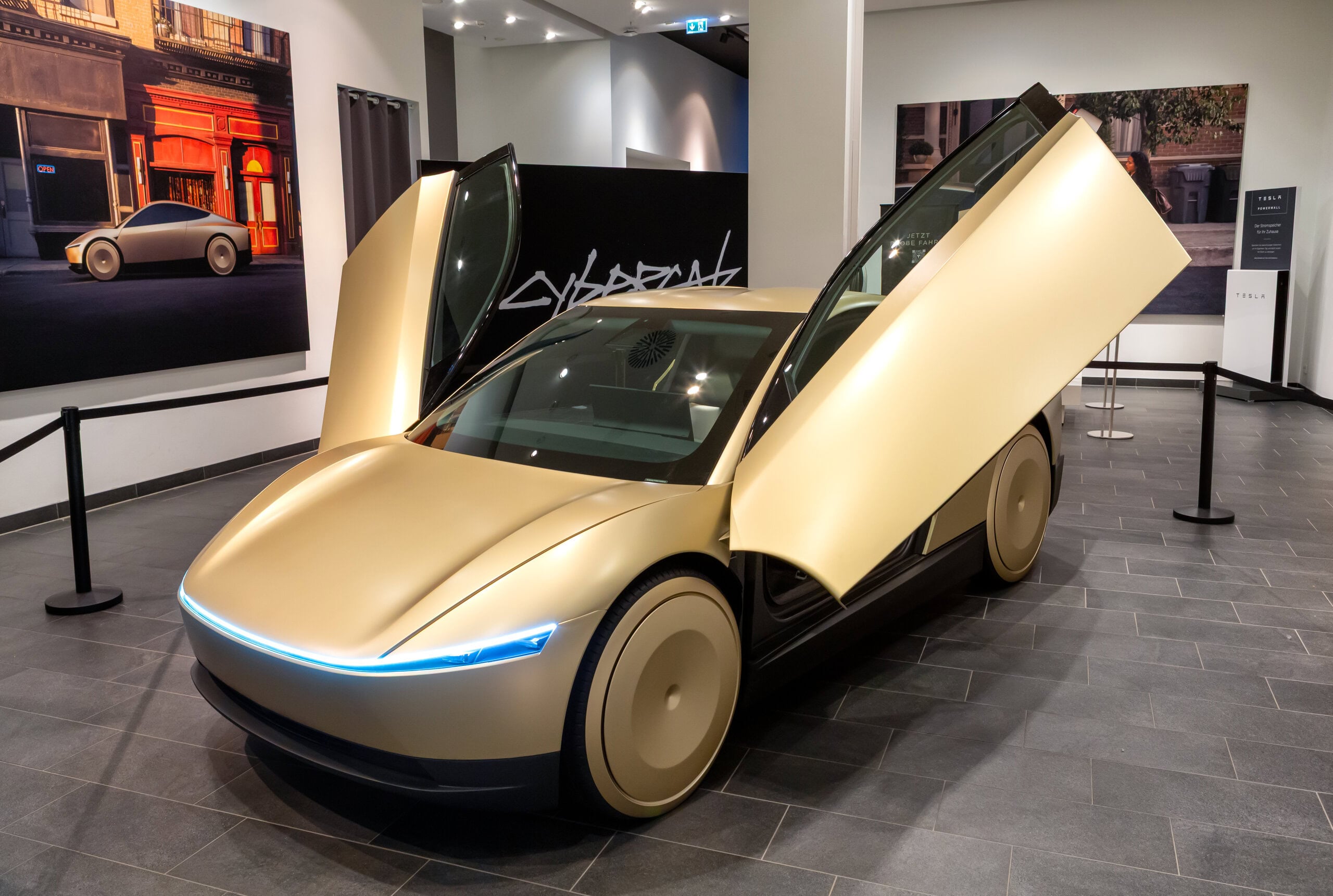
- Tesla is prioritising its purpose-built Cybercab platform for the service instead of putting existing Model Y vehicles on the road.
- The bank expects Tesla's total revenue to reach about $203 billion by 2030, with half of that growth coming from robotaxi operations and the Optimus humanoid robot programme.
Compiled by The InvestorSomething wrong?How this is made
Why it matters
- constraint An owner hoping to rent out a Model Y has no revenue channel inside the bank's 2035 model, because the projection routes the fares through vehicles Tesla owns.
- cost A captive fleet means Tesla funds, maintains and insures the cars that earn the fares, so the $320 billion arrives attached to vehicles Tesla has to build first.
- decision Choosing Cybercab commits Tesla to manufacturing its own supply, and the cars already sold to customers stay a source of driving data.
- contradiction The same note that carries the $320 billion figure declines to call the stock cheap at current levels, so the projection is not a recommendation to buy it.
JPMorgan has robotaxi revenue at roughly $320 billion in 2035 [3] and total company revenue at about $203 billion in 2030 [5]. One line item, five years further out, is about 1.6 times everything the bank expects Tesla to sell in 2030 [15].
That line item only works if someone owns the cars. JPMorgan's stated reason for putting the fleet inside Tesla is vertical integration: the company builds the cars, writes the software and collects the fares [10]. The bank lists what central ownership buys, which is control of maintenance schedules, vehicle cleanliness, insurance costs and the customer experience end to end [9]. Tesla also keeps the fare, the software margin and the data [9]. Under that assumption the vehicles earning the fares are Tesla's own assets, and Tesla pays for them [18].
Around 9 million Tesla vehicles have contributed roughly 10 billion cumulative miles of Full Self-Driving data [8], an average of about 1,100 miles per car [16]. That installed base is what the peer-to-peer story needed. In the bank's model those cars are a training input, and the fleet capacity comes from Cybercab [7].
Zero owner-supplied revenue is JPMorgan's channel assumption [4], not a Tesla policy announcement, and a bank can put a channel at zero and be wrong about it. One thing would prove this reading wrong: Tesla opening owner-supplied cars in Austin, Dallas, Houston or the Bay Area [6] with a published take rate. Then 9 million vehicles already on the road become fleet capacity.
The rating stops short of underwriting the $320 billion. Cryptobriefing, which reported the note, says the $475 target implies meaningful appreciation while also implying the stock is not a screaming bargain at current levels [14]. Cryptobriefing did not report the price Tesla traded at before the upgrade, so the implied upside cannot be recomputed. JPMorgan flagged regulatory approval as a city-by-city, state-by-state grind, and safety validation for fully autonomous vehicles without human supervision as ongoing [11]. It also raised the question of whether a camera and AI stack can match the safety record of Waymo's lidar, radar and camera combination [12]. Waymo has run commercial robotaxi service for years, Amazon-backed Zoox is testing purpose-built vehicles, and Baidu's Apollo Go and Pony.ai are scaling in China [13].
What to watch
- Whether JPMorgan's next Tesla note moves off neutral, and whether the $320 billion 2035 robotaxi figure survives the revision.
- Whether launches after Austin, Dallas, Houston and the Bay Area run on Cybercab units or on existing Model Ys.
- Any published safety comparison between Tesla's camera-based stack and Waymo's lidar, radar and camera combination.