Product1 publisher3 min readPublished
Uber made driverless the default in Dubai, not the option
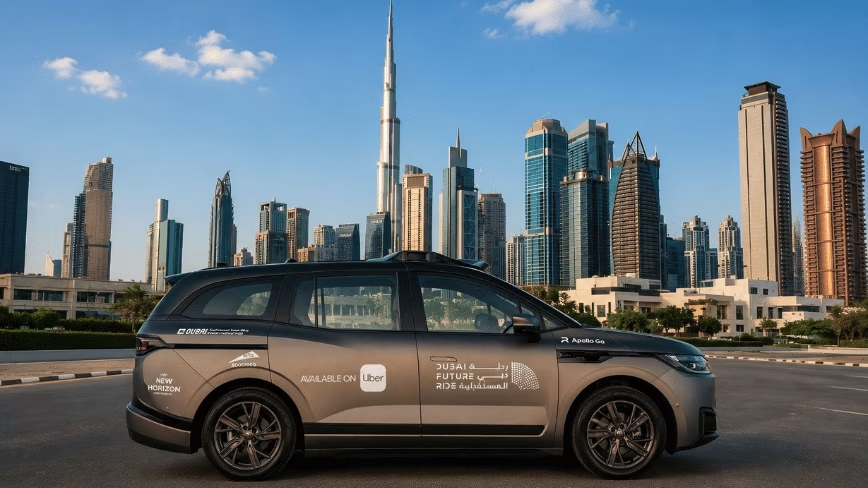
Standard UberX and Uber Comfort riders in two Dubai districts can now be matched with an empty Baidu Apollo Go car. The "Autonomous" button raises the odds; it is not the gate.
The Product Desk · Product desk
Drafted by a language model from the sources cited here and checked against its claim ledger before publication. How we use AISend a correction
What happened
- Uber has put Baidu's driverless robotaxis on its app in Dubai; booking an UberX or an Uber Comfort there may match the rider with an Apollo Go vehicle that has nobody in it, without the rider having asked for one.
- A dedicated "Autonomous" option raises the odds for anyone who wants a driverless car on purpose, but it is not the only way into the back seat of an empty vehicle.
- The service went live on Thursday and covers select locations in Umm Suqeim and Jumeirah, two coastal districts, rather than the city as a whole.
- Uber supplies the demand and the app, Baidu supplies the vehicles and the autonomy stack, and a third party called New Horizon Luxury Transport owns and operates the fleet on the ground; none of the three is doing all of it.
- Neither company said how many cars are on the road, and neither disclosed what a ride costs or whether a driverless trip prices the same as one with a human at the wheel.
Compiled by The Product DeskSomething wrong?How this is made
Why it matters
Uber has begun matching riders who book a standard UberX or Uber Comfort in two Dubai districts with Baidu Apollo Go vehicles that have nobody in them [1][3]. The interesting decision here is not the autonomy stack, it is the consent design: driverless is the default state of the ride pool, and the rider who wanted a human and did not think to check is the one who finds out.
There is an opt-in. Uber offers a dedicated "Autonomous" option that raises the odds of getting a driverless car on purpose [2]. But by the publisher's account it is a preference multiplier rather than a gate, and a rider who never touches it can still be assigned an empty vehicle [1][2]. That is a different product than an autonomous tier you have to select, and it distributes the novelty risk to people who did not choose it.
Two things a rider would need to evaluate that trade are missing. Neither company disclosed how many cars are operating, and neither said what a ride costs or whether a driverless trip prices the same as one with a human at the wheel [5]. Price is the ordinary mechanism for signalling a different product; withholding it means the default is invisible in the fare as well as in the booking flow.
The reassurance underneath is thin in the same way. The cars are Apollo Go's sixth-generation RT6, built for driverless operation, carrying up to three passengers, with more than 30 sensors processed onboard in real time according to Baidu [9]. Baidu says Apollo Go has run in 28 cities and covered more than 350 million autonomous kilometres, more than 240 million of them fully driverless, and calls the safety record outstanding without publishing the incident data; no outside party has audited the figures [10]. Uber says every autonomous vehicle on its network must meet its own safety guidelines, which it has not published in full [11].
Uber's own week shows the choice was a choice. On Wednesday it launched its first European autonomous rides in Zagreb with Pony.ai and the Croatian operator Verne, with a safety driver on board [6]. A day later, the same platform launched in Dubai with nobody in the front seat [1]. Uber drew no comparison, and neither release mentions the other [7]. Zagreb covers key areas of the capital including the city centre, and Uber said coverage would widen [8]; Dubai starts smaller, in select locations in Umm Suqeim and Jumeirah, and starts emptier [3].
Responsibility is split three ways. Uber supplies the demand and the app, Baidu the vehicles and the autonomy stack, and New Horizon Luxury Transport owns and operates the fleet on the ground, with none of the three doing all of it [4]. That is the model Uber has been assembling since it agreed in July to end Waymo exclusivity in Austin and Atlanta; it now says it works with more than 30 AV partners and calls the result a hybrid network [13]. The release calls Dubai the launchpad for scaling thousands of Apollo Go vehicles across Uber's network, which is an ambition rather than today's fleet [14]. Uber says it completes millions of autonomous trips a year against more than 79 billion trips since 2010 [15].
Watch whether the "Autonomous" toggle ever gains an opposite: a durable setting for riders who want a driver. Watch whether Uber publishes a fare comparison, a car count, or the safety guidelines it says partners must meet [5][11]. And watch whether Zagreb's safety drivers come out, which would tell you the Dubai default was the template rather than a local permission [6].