Science1 publisher3 min readPublished
Silver nanoparticles cut DNA with 8-base sticky ends, and the ligation math changes
A Nagoya University team reports DNA assembly two to five times more efficient than restriction enzymes plus T4 ligase, mostly by recovering more product and leaving longer overhangs.
The Scientist · Science desk
Drafted by a language model from the sources cited here and checked against its claim ledger before publication. How we use AISend a correction
What happened
- Researchers in Japan developed a method using silver nanoparticles to cut and reconnect DNA at targeted sites; the work was reported by Nagoya University on August 19, 2026.
- The findings were published in Nucleic Acids Research.
- The technique produced DNA assembly efficiencies two to five times higher than those achieved with conventional restriction enzyme methods.
- Standard methods for assembling long DNA molecules typically use restriction enzymes to make cuts and T4 DNA ligase to connect the resulting fragments.
- Restriction enzymes can only recognize and cut certain DNA sequences, and they tend to produce relatively short sticky ends, which can reduce joining efficiency.
Compiled by The ScientistSomething wrong?How this is made
Why it matters
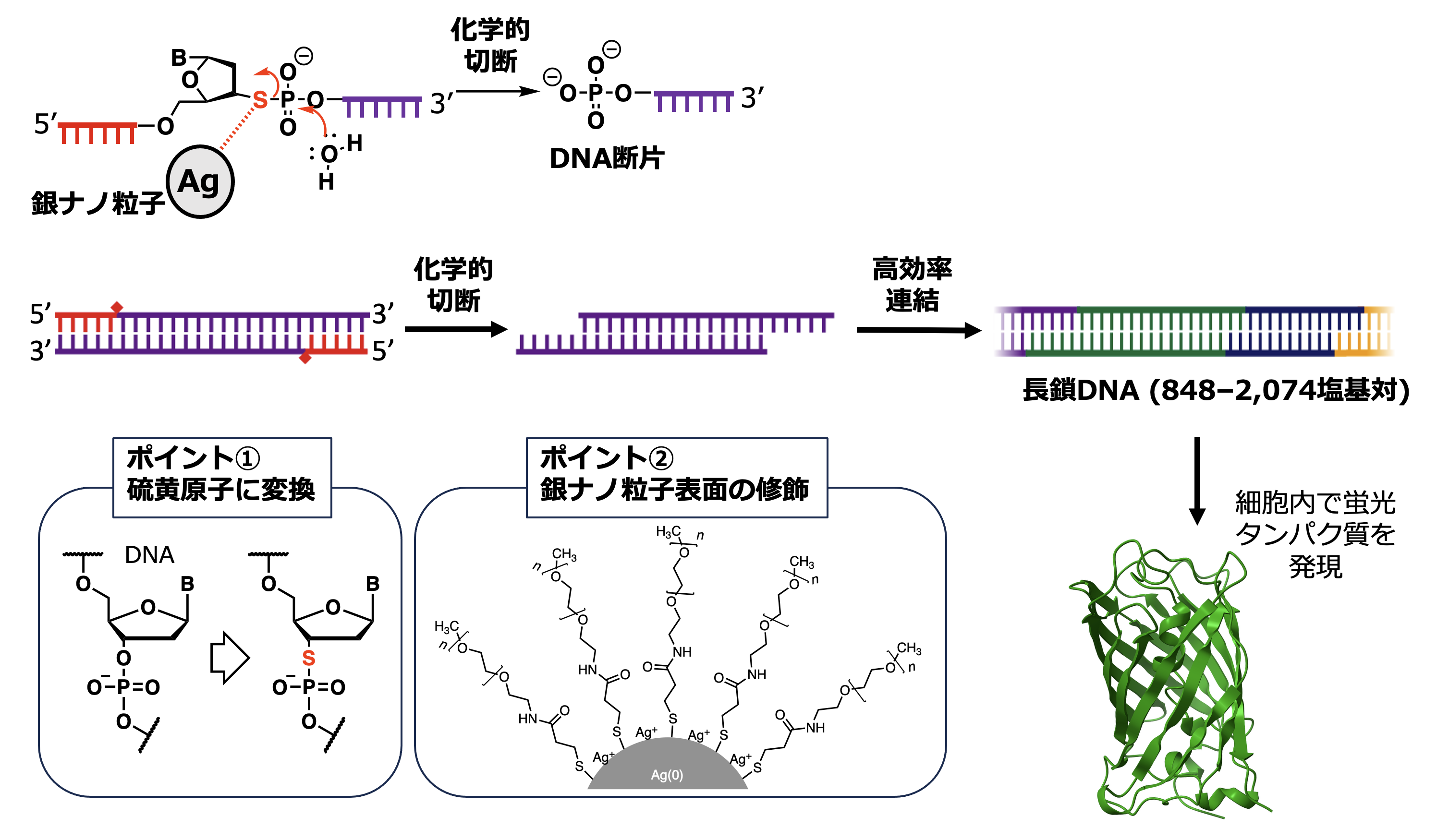
Researchers at Nagoya University and Gifu University report that silver nanoparticles can cut chemically modified DNA at defined sites and leave overhangs long enough to raise fragment-joining efficiency two to five times above conventional restriction enzyme methods, in work published in Nucleic Acids Research [1][2][3]. That matters because assembly efficiency, not cutting, is what caps how large a construct a lab can build in a reasonable number of rounds.
The standard route uses restriction enzymes to cut and T4 DNA ligase to join [4]. Restriction enzymes only recognise certain sequences, and the sticky ends they leave are relatively short, which drags on joining efficiency [5]. The team led by Professor Hiroshi Abe and Assistant Professor Masahito Inagaki, with Professor Natsuhisa Oka at Gifu University, went looking for a chemical cut instead [6].
They went back to a reaction reported between 1990 and 1992, in which silver ions cleave 3'-thiol-modified DNA at specific sites [7]. The cut site is therefore set by where the thiol modification sits in the strand, not by a recognition sequence. The original chemistry had a fatal yield problem: silver ions also bound nonspecifically and caused precipitation, and only about 14 percent of the DNA came back [8].
Swapping ions for nanoparticles fixed the recovery problem in two ways. Nanoparticles can be spun out of the mixture by centrifugation [9], and unwanted fragments stayed stuck to the particle surfaces while the fragments carrying sticky ends stayed in solution, which the group describes as a built-in purification step [11]. Recovery went from 14 percent to 98 percent, a sevenfold change [11][12].
The temperature numbers are where the practicality argument sits. Bare nanoparticles cleaved about 50 percent of the DNA at 70C and close to 100 percent at 95C within two hours, temperatures that damage long DNA [10]. Coating the particles with polyethylene glycol raised cleavage from 36 percent to 92 percent at 37C, but that run took 31 hours [13]. Inagaki, the study's first author, says optimised conditions reached above 91 percent cleavage at 50C within one to two hours [14].
On the assembly side, the nanoparticles produced 8-base sticky ends, which the authors say are hard to generate with conventional restriction enzymes, and T4 ligase joined those fragments about twice as efficiently as the traditional route [15]. The fivefold figure is the top of the reported two-to-five-times range [3]; the source material available here is cut off before it specifies which overhang length delivers it, so treat the 2x at 8 bases as the number that is actually pinned to a length.
Two things are worth watching. First, the full paper's overhang-length series: if efficiency scales cleanly from 8 bases upward, the fivefold claim becomes a design parameter rather than a headline. Second, whether the 50C, one-to-two-hour window holds on the long DNA molecules this is meant to serve, since the whole reason for the PEG coat was that hot cleavage damages exactly those substrates [10][13]. Nagoya's stated targets are gene therapies, cancer vaccines, engineered drugs and advanced crops [16], none of which has yet been shown built this way.