Science1 publisher3 min readPublished
Tamil Nadu sinks 8,500 reef modules to slow the erosion of Kariyachalli Island
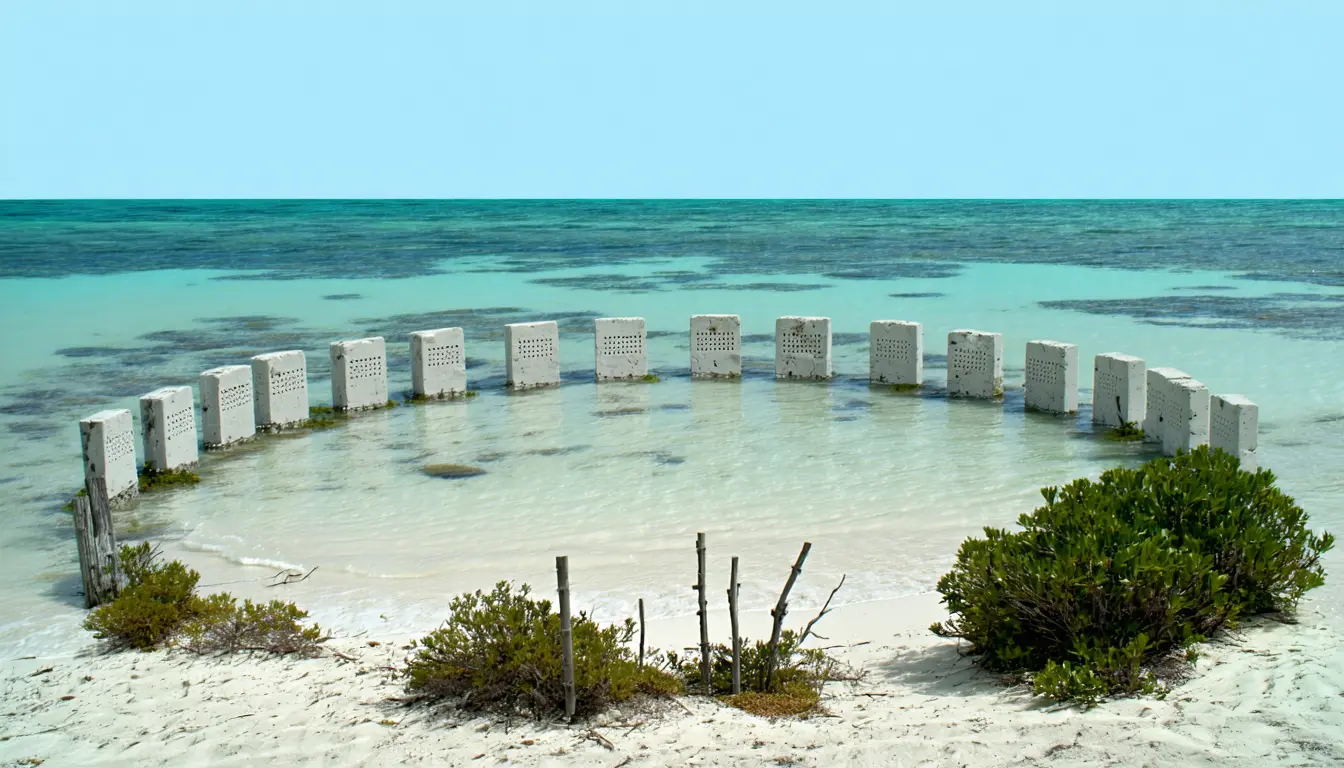
Tamil Nadu is lowering about 8,500 artificial reef modules around Kariyachalli, an island that has shrunk from 20.85 to 3.14 hectares since 1969. The evidence that the method works comes from one nearby island whose recovery was reported without figures, so Kariyachalli's own shoreline is the real test.
The Scientist · Science desk
What happened
- Reef cover around Kariyachalli fell from roughly 500 hectares in 2005 to 197 hectares in 2021.
- The restoration, which also transplants corals and replants seagrass meadows, is part of a $4.79 million state conservation program.
- Each module weighs several tonnes and was sited using seabed, current and wave data, to break incoming waves and give corals new surfaces to colonise.
- A severe bleaching event in 2024 killed large numbers of corals across the region.
- On nearby Vaan Island, about 10,000 artificial reef modules helped recover part of the island's lost landmass.
Compiled by The ScientistSomething wrong?How this is made
Why it matters
- precedent Officials moved to Kariyachalli on the strength of Vaan's reported result, so a measured outcome here will likely set the case for or against repeating the method elsewhere in the 21-island chain.
- exposure The corals and seagrass meant to hold sediment can die in a single hot season; only the wave-breaking role of the modules is independent of that risk.
- constraint Whether the modules slow erosion cannot be judged until the post-deployment monitoring, at least four years long, produces shoreline data.
The government figures put the loss at 17.71 hectares since 1969 [1], or 84.9% of the island [2]. The reef that shelters it lost about 61% of its cover between 2005 and 2021 [3]. Coral mining in the 1960s and 1970s severely damaged the reefs around these islands. Pollution, overfishing and bleaching from warming seas have added to the pressure since [6].
The projection that Kariyachalli could vanish by 2036 assumes erosion is left unchecked [3]. That curve is the closest thing this project has to a control. If the modules work, the island's shrinkage should flatten against its own record since 1969. "If you are not able to provide that resilience, you are absolutely at the mercy of vulnerabilities of storm surges, cyclonic storms or sea-level rise and also erosion," Supriya Sahu, a senior state official, told AFP [11].
Kariyachalli is one of 21 islands in its chain [2], and the method was tried on a neighbour first. "Vaan Island restoration results were very promising," said wildlife warden Akhil Thampi, who gave those results as the reason the program moved on to Kariyachalli [19]. Kariyachalli is getting about 85% as many modules as Vaan did [4]. The report does not say how much land Vaan regained, or how the approach compares on cost with a seawall. No untreated island is known to have been measured over the same years. Without a comparison island, the share of recovery due to the modules is unknown.
Shingle Island has the one result with a comparison built in. There, transplanted corals came through the 2024 bleaching better than older colonies [18]. Scientists are also searching for naturally heat-resistant species [16]. K. Diraviya Raj, an associate professor at the Suganthi Devadason Marine Research Institute, argued that the worsening outlook makes intervention more necessary [21]. "What we are doing is restoring corals to keep the biomass intact," he said. "So, in a way, corals will adapt themselves for this deteriorating scenario of changing climatic conditions and will survive to form the future reef." [15]
The argument that reefs protect this coast goes back to 2004. More than 8,000 people died in Tamil Nadu in the Indian Ocean tsunami, and marine scientists, Raj among them, say the Gulf of Mannar's islands and reefs prevented a much larger disaster [12]. "This was because these tiny islands, seagrass and coral beds absorb the impact," Raj said [13].
Spread across the modules alone, the program budget comes to at most about $564 a module [5]. That ceiling assumes nothing went on corals, seagrass or monitoring. The project also pays local residents [22]. Devkani, a 47-year-old saltpan worker, travels 25 minutes by boat from the mainland to prepare seagrass frames [20]. "We had to take out loans earlier at high interest rates to make ends meet during lean months at saltpans," she told AFP. "But this year because of this sea-based work, we didn't have to." [20]
What to watch
- Shoreline area figures from Kariyachalli's monitoring once deployment ends, set against the island's shrinkage record since 1969.
- A published hectare figure for Vaan Island's recovery, ideally alongside an untreated island measured over the same years.
- How transplanted corals at Kariyachalli and Shingle Island fare in the next marine heat wave.