Science1 distinct publisher3 min readPublished
The detection landed in the December 2024 window that two earlier papers predicted, and it landed at all because the companion is heavier than the models said; one more epoch on the far side would close a century-old case.
The Scientist · Science desk

Compiled by The ScientistSomething wrong?How this is made
Consider what the detection actually turned on. Montarges expected to fail. "Honestly, I thought we did not have the sensitivity to detect Betelgeuse B as it was predicted," he says, and the image exists because the companion is more massive, and therefore brighter, than the models had it [6]. The prior figure was roughly one solar mass; the observations put it at about two to three [7], a revision of a factor of two to three [14]. That puts the earlier failures in a different light: they were tests against a fainter object than the one that is apparently there.
The other constraint was geometry. Two papers published in 2024 predicted that the companion would reach its greatest apparent separation from the supergiant in December 2024 [4]; the team took that date, observed with SPHERE on the VLT in the Atacama, and recorded light from the companion itself rather than an indirect signature [8]. Several months of processing followed [5]. That is why roughly a hundred years of watching produced suspicion and not a picture [3]. For most of the orbit, a faint star sits projected against a naked-eye supergiant [17].
What the release does not give is an orbital period, which is the number you would want in order to test the companion against the brightness variation that ESO says it could help explain [12]. An inference is available, and it is only an inference: if maximum separation fell in December 2024 and the team expects the candidate on the far side about a year after the August 2026 announcement [10], the gap between opposite extremes is near 33 months, implying an orbit of roughly five and a half years [16]. Observing windows rather than orbital mechanics may set that schedule, so treat it as arithmetic, not a result.
Two different brightness phenomena are in play. The Great Dimming, which set off talk of an imminent explosion, was attributed by a Montarges-led VLT study to dust blocking part of the star [11]. The companion is offered against the longer-running variability that motivated the hypothesis a century ago in the first place [3][12].
For supernova modelling, the useful quantity is the mass, and the mass is loose. Two to three solar masses is a range half again as wide as its own floor [7], and the release commits only to the companion possibly influencing the future explosion [12]: no separation, no period, no interaction described. Note also that about 20 months separate the observation from the announcement [15], of which the release accounts for several months of analysis. The confirmation test is cheap and specific, one epoch on the other side of the star [10], and Gemini North already had a possible direct detection [9]. The standard for this class of result is a sequence of independent looks, and the sequence is one look short.
Ranked by verification strength, evidence, and original report placement.
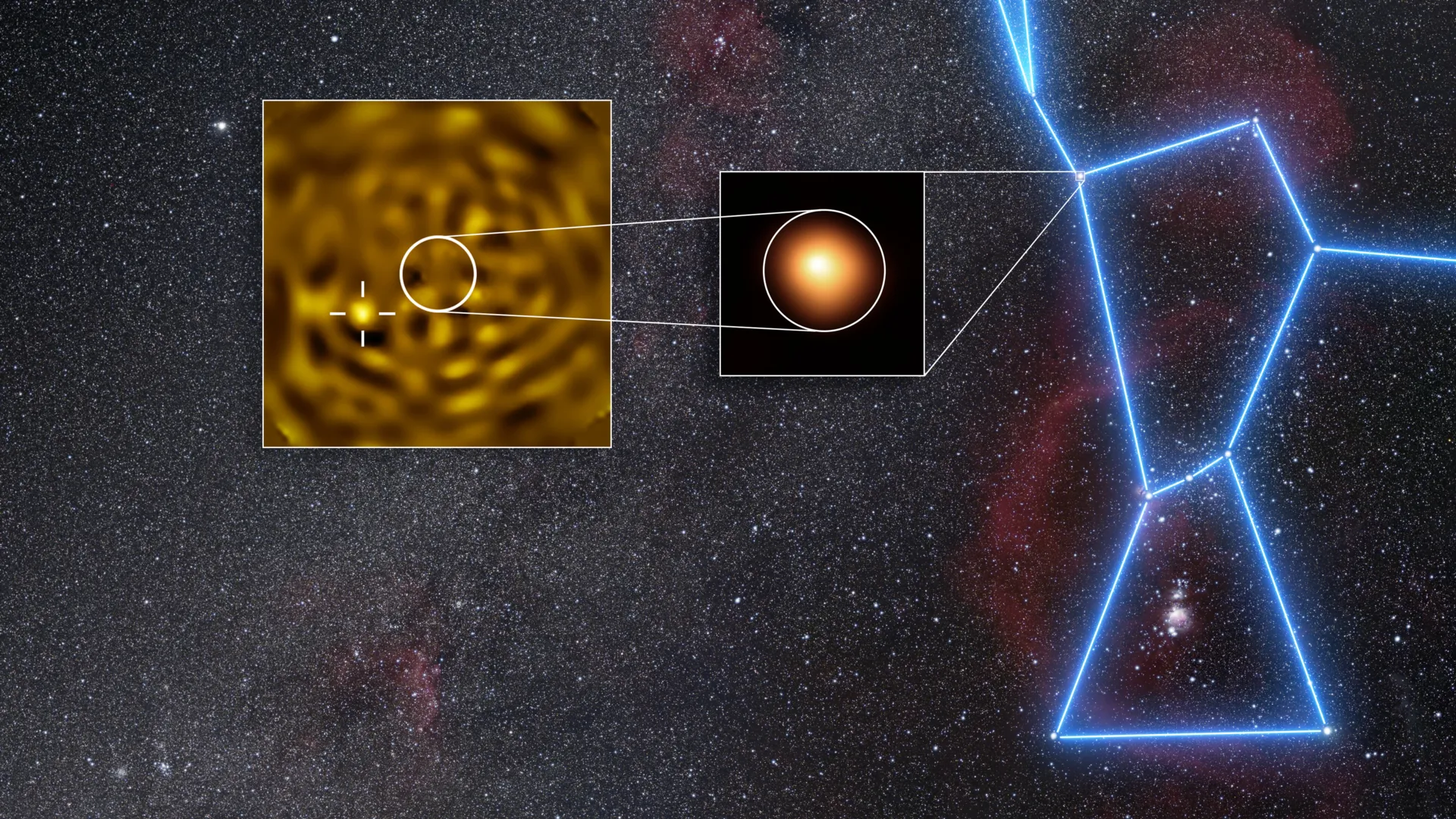
ESO announced on 27 August 2026 that a team led by French astronomer Miguel Montarges used ESO's Very Large Telescope to capture the clearest image so far of what is believed to be Betelgeuse B, a star orbiting the red supergiant Betelgeuse.
Montarges is an astronomer at the Observatoire de Paris - PSL, France, and lead author of the study published in Astronomy & Astrophysics; he called the result "the conclusion of a century-long quest".
The researchers directly imaged Betelgeuse B, meaning they detected light coming from the companion itself, using the SPHERE instrument on ESO's VLT in Chile's Atacama Desert.
The possibility that Betelgeuse has a companion was first raised roughly a century ago as a potential explanation for some of its changes in brightness, and despite decades of observations astronomers had been unable to clearly detect such a star.
Two studies published in 2024 predicted where the suspected companion should be and indicated that Betelgeuse B would reach its greatest apparent separation from Betelgeuse in December 2024, giving astronomers their best opportunity to see it.
Montarges and colleagues observed Betelgeuse with ESO's VLT in December 2024, then spent several months processing and analysing the observations.
Distinct publishers with included, body-backed reporting in this cluster.
1 article · August 27, 2026
Follow any of these and your For You feed starts watching them — no settings page required.
science
Betelgeuse's 2,200-day cycle finally has a candidate object, found where models said to look1 distinct publisher
science
The Whippet: a black hole shredded a massive star, and fast helium turned up months later1 distinct publisher
science
A star with an 8.7-year orbit turns black hole spin into an observing schedule5 distinct publishers
science
JWST's hidden low-mass stars push early galaxy masses up by 3 to 4 times1 distinct publisher
Evidence-backed comparisons of source perspectives and observed adoption signals. Read the methodology
Which Builder, Operator, and Investor concerns the observed source mix emphasized—not a truth score.
Evidence, demonstrated adoption, hype gap, incentives, and confidence are assessed independently, each on its own current evidence. How these are measured.
Peer-reviewed direct imaging, single-source relay, confirmation epoch pending
The core detection is a direct image from a named instrument (SPHERE on the VLT) tied to a paper in Astronomy & Astrophysics with a full author list, and it lands inside a window predicted independently by two 2024 papers, which is strong internal evidence. It is discounted because the cluster contains exactly one publisher relaying one institutional release, the object is still formally a candidate, no separation, contrast, or period figures are published, and the authors themselves require another epoch before calling it certain.
One publication and prior hints; no confirming epoch or independent replication yet
Observable uptake is limited to the announcement and its journal paper, plus disclosed reuse of exoplanet post-processing on an evolved star. Community engagement predates the result via the two 2024 prediction papers and a possible earlier Gemini North direct detection, but no independent team has confirmed this image and the authors' own follow-up epoch has not been taken, so measured adoption stays low.
Headline certainty runs modestly ahead of candidate status
Framing such as 'Astronomers spot Betelgeuse's hidden companion' and 'the conclusion of a century-long quest', together with supernova-influence language, overshoots what is established: the paper title says 'candidate companion', the authors need another epoch on the far side of the star, and any effect on Betelgeuse's evolution or supernova is explicitly an open question. The gap is moderate rather than large because the source does disclose the candidate status and the pending observation in plain terms.
Institutional release from the facility owner, relayed without outside comment
The narrative originates with ESO, which owns the telescope and instrument credited with the result, and quotes come only from the lead author and a co-author from the same institution; both parties benefit from a headline discovery attributed to their facility and pipelines. The relaying outlet adds no independent expert. Incentive pressure is partly offset by the paper's peer-reviewed venue and the authors' own explicit caveat about needing another epoch.
Coherent, well-specified single account with no cross-source check
Internal consistency is high: dates, instrument, institutions, mass revision, and caveats all hang together and the finding is testable against a stated prediction. Confidence is held mid-range because everything rests on one publisher relaying one release, quantitative orbital and photometric details are missing, and the central object remains a candidate until the next epoch.