Loading today’s stories
Science1 distinct publisher3 min readUpdated
JWST's hidden low-mass stars push early galaxy masses up by 3 to 4 times
A Nature Astronomy study of nine ancient galaxies finds faint stars that spectra had missed. The correction runs the wrong way for anyone hoping to explain away impossibly early giants.
The Scientist · Science desk
What happened
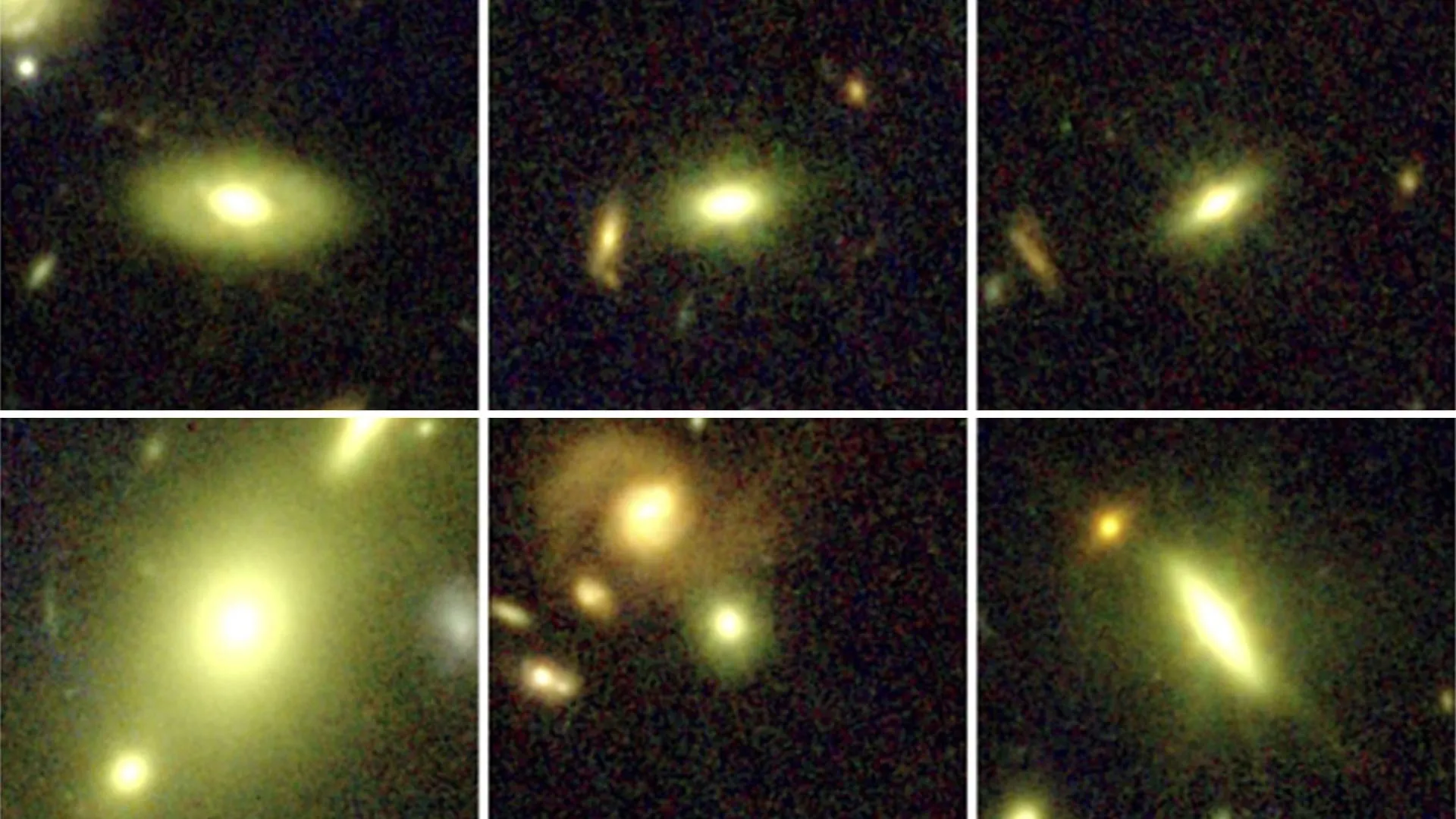
- Researchers examined nine massive, mature galaxies that stopped producing new stars billions of years ago, combining JWST observations of the distant universe with earlier ground-based data from the Very Large Telescope.
- A previously unseen population of small, faint stars could make some of these early massive galaxies three to four times more massive than previous estimates.
- The findings were published in Nature Astronomy by an international team that included Penn State researchers; lead author is Chloe Cheng, a recent doctoral graduate of Leiden University.
- Joel Leja, associate professor of astronomy and astrophysics at Penn State and coauthor, said the galaxies are "more massive than we expected -- like a lot more massive, they have three or four times more mass than we expected."
- Large, luminous stars dominate a galaxy's light while smaller stars are far dimmer and much harder to identify; the team's models show a far more numerous population of low-mass stars concealed by the rare bright stars.
Compiled by The ScientistSomething wrong?How this is made
Why it matters
The correction only runs in one direction, and that is what makes it awkward. Faint low-mass stars add mass without adding much light, and bright stars dominate the spectrum that observers actually record [5]. A method blind to the faint population therefore undercounts mass; it cannot overcount it. With the light held fixed, a mass revised up by three to four times is a mass-to-light ratio revised up by the same three to four times [14]. In the units the field works in, that is roughly 0.48 to 0.60 dex added to the stellar mass [15], and it lands on the objects that were already hardest to fit.
That is why this reads as a deepening rather than a resolution. JWST has repeatedly turned up unexpectedly massive and mature galaxies not long after the Big Bang, and those finds already strained galaxy formation models [10]. Penn State, which announced the work on 22 August 2026 [17], is explicit that the new numbers make the mature-galaxy problem harder rather than easier [9]. Joel Leja of Penn State, a coauthor, puts the size of it plainly: the galaxies are "more massive than we expected -- like a lot more massive, they have three or four times more mass than we expected" [4].
The assumption being broken matters more than the multiplier. Mass estimates at these distances have leaned on the idea that stars form in roughly similar proportions everywhere, and the team says that no longer holds [6]. The excess of low-mass stars is reported as strongest in the most massive early galaxies, and weaker in smaller systems such as the Milky Way [7]. A correction that scales with galaxy mass does not simply shift a catalogue up; it bends the shape of the high-redshift stellar mass function, so the massive end moves further than the rest [16].
Then there is the sample. This is nine galaxies, all of them quiescent systems that stopped making stars billions of years ago, measured by combining JWST spectra with earlier Very Large Telescope data [1], and it is the first time anyone has reliably split faint from bright stellar populations at such distances [13]. Martje Slob of Leiden University, a coauthor, says the measurement needed a telescope able to magnify very distant galaxies, spectra of exceptional quality, and new analysis techniques to pull out the signatures of hidden low-mass stars [12]. Those are selection conditions, not incidental details: the nine were reachable because their spectra were unusually good. Whether the same multiplier applies to star-forming galaxies at similar epochs is untested here.
The planet-formation line in the release sits downstream of all of this. If early massive galaxies really were stuffed with low-mass stars, planets around such stars would have been more common early on than assumed [11], but that conclusion inherits every uncertainty in the stellar population fit rather than standing on its own evidence. The load-bearing result is narrower and more inconvenient: the masses in the high-redshift catalogues carry an unmeasured multiplier that appears to grow with mass, calibrated so far on nine well-behaved objects [2].
Loading topic controls
Loading related stories