Science1 publisher3 min readPublished
A Vermont catfish cancer turns out to be contagious, not pollution damage
Whole-genome sequencing of brown bullheads from Lake Memphremagog found tumors that are clones of each other, not of their hosts. It is the fourth transmissible cancer known.
The Scientist · Science desk
Drafted by a language model from the sources cited here and checked against its claim ledger before publication. How we use AISend a correction
What happened
- For more than a decade, anglers on Lake Memphremagog, which straddles the Quebec-Vermont border, have been catching brown bullhead catfish marked with distinctive black lesions.
- In 2019, scientists from the U.S. Geological Survey (USGS) and the Vermont Fish and Wildlife Department confirmed the lesions were malignant melanoma.
- Scientists first documented cases in 2012, and the most likely explanation at the time seemed to be environmental factors.
- The year before the first documented cases, Hurricane Irene had caused devastating flooding across Vermont, raising the possibility that the bullhead's habitat had been tainted by pollutants stirred up during the hurricane.
- Pollution seemed a more likely culprit than ultraviolet exposure, the leading cause of human melanoma, because the brown bullhead is a benthic (bottom-dwelling) fish that feeds at night.
Compiled by The ScientistSomething wrong?How this is made
Why it matters
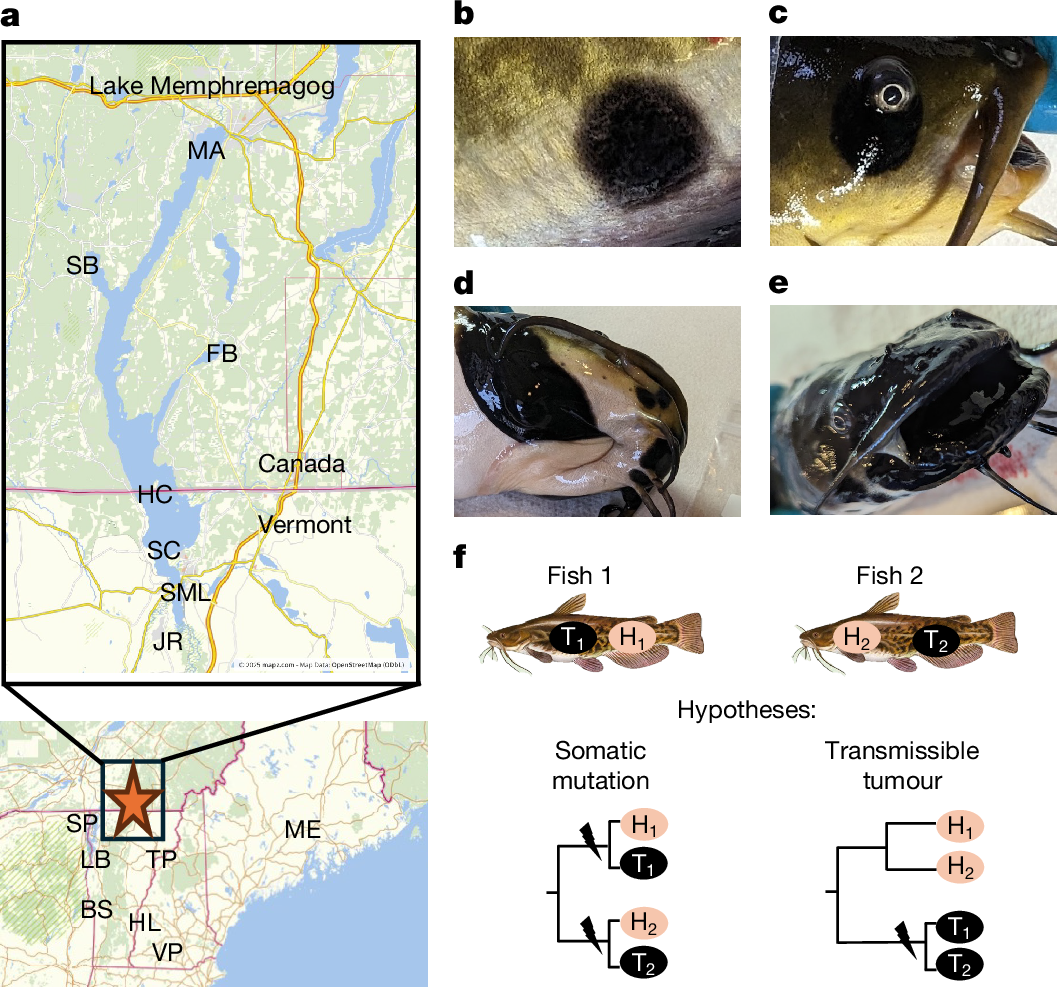
Anglers on Lake Memphremagog, which straddles the Quebec-Vermont border, have been catching brown bullhead catfish marked with black lesions for more than a decade, and in 2019 scientists from the U.S. Geological Survey and the Vermont Fish and Wildlife Department confirmed the lesions were malignant melanoma [1][2]. Whole-genome sequencing has now produced an explanation, and it is not the one the agencies had spent a decade testing: writing at phys.org, the University of Vermont genomics and data scientist who led the analysis reports that the tumors are clones of one another, spreading from fish to fish [9][10].
The environmental case had looked strong. Cases were first documented in 2012, the year after Hurricane Irene caused devastating flooding across Vermont, which made pollutants stirred up by the storm the obvious suspect [3][4]. Ultraviolet light, the leading cause of human melanoma, was a poor fit, because the brown bullhead is a bottom-dwelling fish that feeds at night [5]. Cancer-causing microbes in the waterways were the other candidate. According to the author, a decade of research produced no evidence for either hypothesis [6].
The sequencing was designed to answer a different question: why some fish had melanoma and others did not. The team sequenced DNA from more than 80 brown bullheads, diseased and healthy, caught in 2023, plus fish collected by Vermont Fish and Wildlife in 2019, and sequenced both tumor and healthy tissue from the diseased animals [7][8]. The expectation was that each tumor would be most closely related to its own host. Instead, tumors from different fish resembled each other more than they resembled their hosts, and in some cases were more genetically similar to healthy fish from other bodies of water [9]. The tumors shared an overwhelming number of variants absent from the host fish [10]. The author says the analysis was checked and rechecked in the expectation of finding an error [11].
That makes brown bullhead transmissible melanoma, or BBTM, the fourth transmissible cancer known, alongside those in dogs, Tasmanian devils and bivalves [12][13].
The design detail is the part fisheries biologists should take from this. The signal only appeared because the study sequenced healthy tissue from the same fish and compared across water bodies; a tumor-only panel would have shown a cancer and nothing about its origin. A cluster of lesions in one lake reads naturally as a contamination signal, and here the same cluster was the footprint of a lineage moving between hosts, with no pollutant required.
The history suggests it was never confined to one lake. In 1852 Henry David Thoreau described bullhead catfish with black velvety patches in a Massachusetts river [14]. Sixty years later the zoologist Raymond Osburn investigated Thoreau's report and similar accounts across New England, grew bullhead tumor cells in a lab, and successfully transferred them into a healthy bullhead [15]. The author is explicit that there is no way to confirm those cases were the same disease [16]. An angler in Cape Cod put the surveillance problem to the researcher plainly: "No one looks for those fish" [17].
Watch for the peer-reviewed version, which will need to report how many of the 80-plus fish carried tumors and how the clone phylogeny was built; the phys.org account does not [18]. Watch for BBTM in bullheads outside Memphremagog, and for work on how the lineage evades host immune defenses, which the author names as her research interest [19].