Product1 publisher3 min readPublished
Hungary is sinking two barges to keep Paks running. The fuel is fine; the river is not
Budapest's escalation from dumped rock to scuttled barges to a submerged dam shows what a 2,000 MW nuclear plant actually depends on: water level.
The Product Desk · Product desk
Drafted by a language model from the sources cited here and checked against its claim ledger before publication. How we use AISend a correction
What happened
- Hungary's Prime Minister declared that authorities will begin a controlled sinking of two barges to raise the water level so that the Paks nuclear plant can continue to work at reduced capacity.
- The two barges to be sunk are 260 feet (80 metres) long.
- The barge sinking is a short-term arrangement until a more permanent construction, a riverbed sill much like a submerged dam at the bottom of the river channel, is completed in the coming weeks to manage water flow in the receding river and keep a steady flow into the plant.
- The Paks plant has four Soviet-built VVER-440 pressurised water reactors with a combined capacity of 2,000 megawatts.
- Paks is Hungary's sole nuclear facility and is responsible for up to 50 percent of national electricity generation.
Compiled by The Product DeskSomething wrong?How this is made
Why it matters
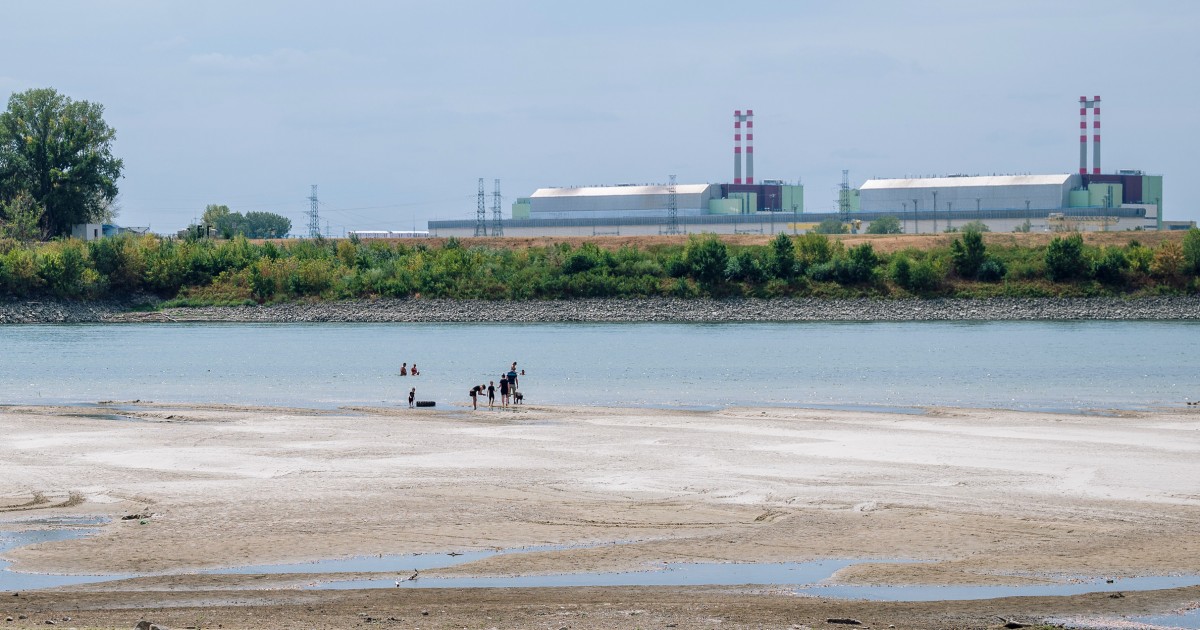
Hungary's prime minister has said authorities will begin a controlled sinking of two barges in the Danube to raise the water level enough for the Paks nuclear plant to keep operating at reduced capacity, according to Interesting Engineering [1]. The barges are 260 feet, or 80 metres, long, and the measure is a stopgap until a permanent structure to manage flow in the receding river is finished in the coming weeks [2][3].
Paks runs four Soviet-built VVER-440 pressurised water reactors with a combined capacity of 2,000 MW [4]. It is Hungary's only nuclear facility and accounts for up to 50 percent of national electricity generation [5]. In response to low water, the government cut output to 25 percent [6]. On the plant's nameplate figure, that is roughly 500 MW available and about 1,500 MW withheld [1].
The interesting part is the escalation ladder. First, thousands of cubic metres of rock were dumped into the river to slow the flow and raise the level, which did not work [7]. Now come the barges [1]. The longer-term fix is a riverbed sill, effectively a submerged dam across the channel, intended to hold a steady flow to the plant intake; media reports cited by the publication put the resulting gain at up to three feet, or one metre [3][8]. That is the whole engineering problem stated plainly: a metre of water standing between a 2,000 MW asset and zero.
Nothing here is a fuel problem or a turbine problem. The reactors are fuelled, the plant is staffed, the grid wants the power, and the binding constraint is the hydrology of a river that the plant was sited on decades ago. Thermal generators of every kind buy fuel supply on contracts and maintain turbines on schedules, but the cooling water arrives on terms nobody negotiates.
The regional record from this summer makes the same point in different registers. Romania shut its Cernavoda plant after the Danube hit a 90-year low, and attempts to redirect water were not enough to meet the reactor's cooling needs [9]. In France, Gravelines draws from the North Sea through a dedicated channel system; water temperature was a concern during the heatwaves, but what actually forced three reactors offline at once was a swarm of jellyfish blocking the water inlets [10]. Volume, temperature and biology are three separate failure modes on the same input. The Rhine, Danube, Po and Loire have all recorded historic lows this year, with flow rates down to a fraction of normal and knock-on effects on irrigation, transport, drinking water and power output [11]. Interesting Engineering attributes the pattern of extreme European summers to human-induced climate change [12].
Three things to watch. Whether the sunken barges hold the level long enough to bridge to the sill, given that the rock dumping did not [7][1]. Whether the finished sill delivers the claimed metre, because that number is currently a media figure rather than a measured one [8]. And whether the 25 percent restriction is lifted or becomes a seasonal expectation, which is the difference between an incident and a new operating envelope [6]. For anyone modelling supply in a market where a single site carries up to half of generation, the derated case is now the planning case, not the tail [5].