Science1 publisher2 min readPublished
Scripps Research engineers a protein that dampens TLR4 from inside the cell membrane
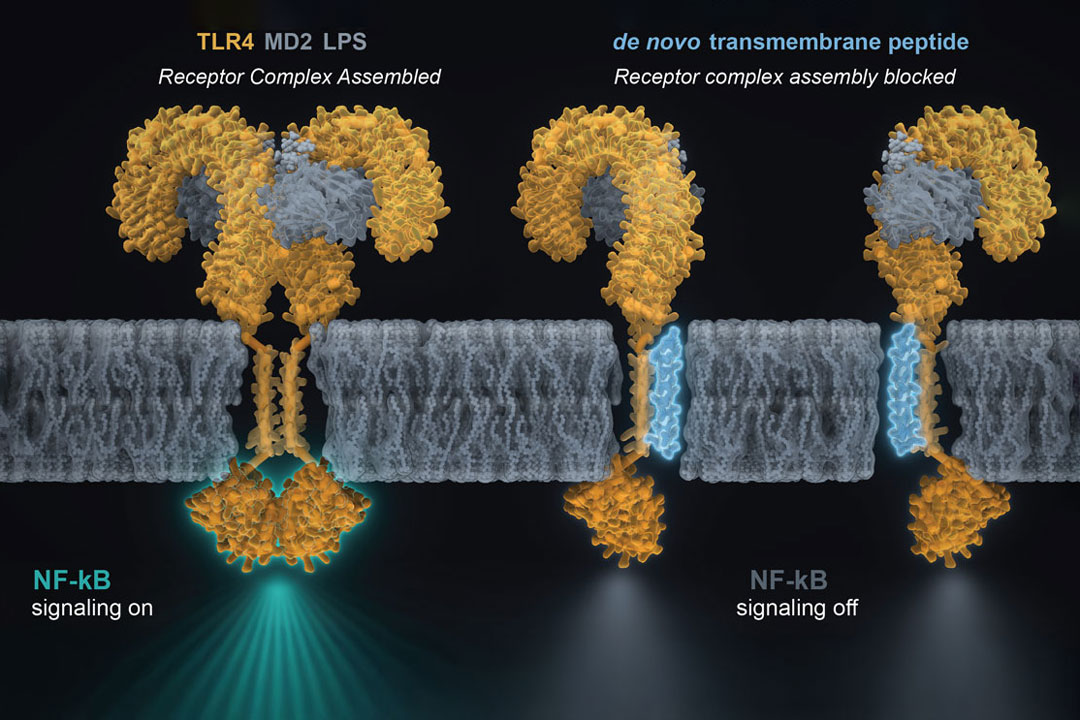
Scripps Research built a synthetic protein that binds TLR4 inside the cell membrane and lowers its inflammatory signaling. No FDA-approved drug specifically blocks the receptor, whose membrane-spanning region was long treated as a passive anchor.
The Scientist · Science desk
What happened
- Overactivity of TLR4 is linked to inflammatory disorders including sepsis, arthritis and inflammatory bowel disease, which has made it an attractive drug target for years.
- A fragment of TLR4's membrane-spanning region, placed in cultured human cells, lowered NF-kB signaling, one of the inflammatory pathways the receptor switches on.
- A Scripps screening method that lights up when two tagged proteins sit close confirmed the fragments latch onto full-length TLR4 inside the membrane.
- The findings appear in a study in the Proceedings of the National Academy of Sciences.
Compiled by The ScientistSomething wrong?How this is made
Why it matters
- capability The method gives other labs a way to design and test binders for proteins embedded in membranes, a target class conventional drug discovery has largely avoided.
- precedent If the membrane segment helps decide whether TLR4 fires, it becomes a design target for anti-inflammatory drugs, a route earlier TLR4 efforts did not take.
- constraint Because TLR4 is essential for fighting infection, any drug that blocks it has to lower inflammation without leaving patients open to bacteria.
TLR4 has three working parts [6]. A region outside the cell detects bacteria, a region inside the cell relays the alarm, and a short segment threads through the fatty membrane between them. That middle segment was treated as a passive structural anchor, the piece holding the receptor in place while the two ends handle the signaling [9].
"People assumed that the regions of TLR4 exposed outside and inside the cell were the main signaling drivers, but we showed that the membrane-spanning region is also critical for this function," said Colleen Maillie, the study's first author and a research project analyst at Scripps Research [8][9].
Working there means working in a part of the cell most drug design avoids. The membrane is built from two tight layers of oily molecules, which gives it chemistry unlike the watery spaces where most proteins sit, and the rules for how proteins fold inside it are still unclear [19].
The signaling TLR4 controls is not a simple switch. When the outer region grabs a bacterial molecule, the receptor pairs into dimers, and those dimers sometimes, but not always, turn on inflammation [12]. TLR4 also answers some nonbacterial molecules tied to tissue damage [13].
To design a protein that binds the membrane segment more tightly, the team started with computer programs that generate three-dimensional blueprints of protein structures [17]. "Scientists have been using computers to help design proteins for decades," said Marco Mravic, a co-senior author [10][18].
The receptor is worth the trouble because it cuts both ways. "It may be activated by adjuvants in vaccines to improve immune responses or inhibited to suppress inflammation, making it both a sensor and a dial to tune innate immunity," said Andrew Ward, the other co-senior author [10][11].
Every experiment here runs in cultured human cells [14], an early stage that does not show whether binding the membrane segment eases inflammation in an animal or a person.
What to watch
- Whether other labs adopt the Mravic-lab light screen and design tools to drug other membrane-buried targets.
- Binding affinity and selectivity data for the final designed protein, which the study does not report.
- Independent replication of the claim that TLR4's transmembrane region actively drives signaling, not just anchors the receptor.