ProductNot yet confirmed elsewhere1 publisher2 min readPublished
Ikea asked Xbox for the controller CAD files. The nine-piece answer is mostly storage
Ikea's nine-piece Yxstaby range came out of an unplanned meeting in Milan and two years of joint work. The result is less about Xbox styling than about storage.
The Product Desk
What happened
- Ikea showed a nine-piece gaming range called Yxstaby, developed with Xbox, at Gamescom in Cologne.
- WIRED reports the project began at Milan Design Week in 2024, when the two design teams happened to be in the city at the same time.
- Ikea's Brannboll gaming collection, built without sharp edges, RGB lighting or a black palette, was the icebreaker at that meeting.
- Xbox designers handed Ikea designer David Wahl the controller's original 3D design files to work from.
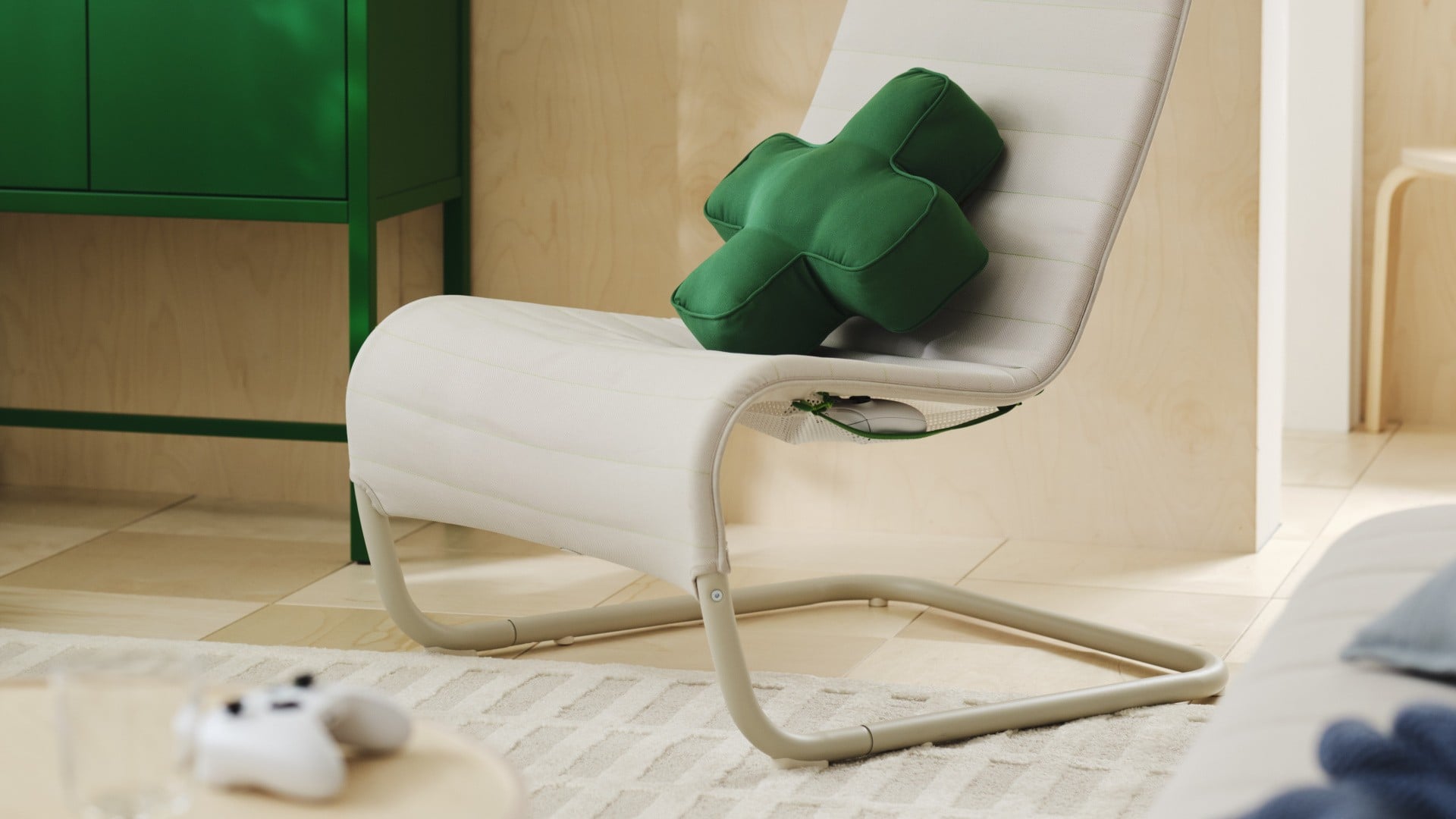
- The range leans on storage: a wheeled table that charges controllers behind sliding doors, a lidded toolbox, a chair with a controller pocket, and a rollable stand for a 55-inch TV.
Why it matters
- constraint Faithful copying was ruled out from the start: the grip texture that makes a thumbstick controllable under a thumb is exactly what makes it unsittable, so the shape had to be softened while...
- decision By building on the Nilserik, Ikea confined the new engineering to the shell and inherited the moving parts, which is why a novelty seat could reach a launch collection rather than a concept photo.
- capability Cutting the base off a stool design and keeping the seat gave the range a second saleable object, a serving platter, from one piece of geometry.
- precedent A platform holder releasing source device geometry to a furniture partner resets what the next licensee asks for, and what a refusal will look like.
David Wahl's route into the brief is the part of this process worth studying. He told WIRED he had been exploring keyboard chairs before working backwards to what a player is actually holding, which is the input device, and noticing that a moving control stick already has the profile of a stool [3]. The sitting problem was then settled by prototyping rather than by argument: cork, wood, a lot of 3D printing, and a run of different base radii, including a fully round one that Wahl says was very unstable [6]. Carl Ledbetter's verdict after that work was that the stool is comfortable and accommodates more than one playing posture [12].
The division of labour is what makes the range legible. Philip Dilé told WIRED that Ikea knows a great deal about life at home but wanted partners who understand how people play [9]. That maps cleanly onto the output. Ikea supplied concealment and castors; Xbox supplied posture. When the prototype reached a joint workshop, Ledbetter's questions were scale, ergonomics, and whether the thing could move and swivel [11]. Those are use-context questions a furniture team would reach late, if it reached them at all.
Two years is the price of that. WIRED dates the range two years on from the Milan meeting [13], which across nine pieces works out at roughly one piece every eleven weeks, research included [21]. That is slow, and the slowness shows in what the pieces do rather than how they look: four of the seven items WIRED describes are about putting hardware away, and only three quote Xbox forms directly [16].
The account has edges. WIRED describes seven of the nine pieces; two go unmentioned [18], and there is no price, launch date, or market anywhere in it [22]. Wahl also brought a 25-year-old all-night queue for the first Xbox to the table [20], which is a good detail and also a reminder of how the asset transfer happened. One designer with a personal stake asked, and the files moved. Nothing in the reporting suggests a repeatable mechanism sat behind that ask, and the star piece's engineering did not come from the partnership either. The thumbstick stool is a shell and a stance on an existing Ikea product [4]. What the two years bought was the confidence to know which shell was worth making.
What to watch
- Prices, launch dates and markets for the Yxstaby pieces, none of which appear in the WIRED account.
- Whether the shipped thumbstick stool keeps the swivel and adjustable height Ledbetter was asking about at prototype stage.
- Whether Xbox releases device CAD to other licensees, or Ikea runs the same co-design play with a different hardware maker.
Clarity's read
What the record supports and how the coverage leans. The claims behind it follow.
Reality
- Evidence58
- Adoption20
- Hype gap+22
- Incentives72
- Confidence55
Claim ledger
Ranked by verification strength, evidence, and original report placement.
- [1]
The Yxstaby range includes a side table on wheels that stores and charges controllers behind sliding doors, a toolbox whose lid doubles as a laptop stand, a gaming lounge chair with a webbed pocket underneath for controllers, and a rollable TV stand for sets up to 55 inches with a split-level shelf for consoles.
- [2]
Overtly Xbox-inspired pieces include a green gaming D-pad cushion and a D-pad controller platter that was originally designed as a stool; Ikea head of design Johan Ejdemo removed the base and decided the seat would work as a plate or tray.
- [3]
Wahl: "I was exploring keyboard chairs, but then it hit me: What is it that you're actually using when you're playing? The input devices... you have buttons and the control stick, and the control stick is moving. And, hey, it looks like a stool. What if you could enlarge it and actually sit on it?"
ReportedSupportedSource: David Wahl to WIRED3 sources— create a free account to open themView cited source - [4]
The foundation of the thumbstick stool was the Nilserik, an existing Ikea extending office stool with a rounded base, whose function inspired Wahl's starting point.
ReportedSupportedSource: David Wahl to WIRED3 sources— create a free account to open themView cited source - [5]
Wahl says the thumbstick is designed for maximum grip when controlling a game and is not suitable to sit on, being "kind of aggressive and sharp", so the first task was making it comfortable while keeping the iconic shape recognisable.
ReportedSupportedSource: David Wahl to WIRED3 sources— create a free account to open themView cited source - [6]
Ikea prototyped the stool in materials including cork and wood, did a lot of 3D printing with different versions of the base's radius, and produced one completely round base that was very unstable.
ReportedSupportedSource: David Wahl to WIRED3 sources— create a free account to open themView cited source - [7]
According to WIRED, the range came about not through whiteboard marketing brainstorms but through a meeting between the Xbox and Ikea design teams at Milan Design Week in 2024.
- [8]
Ikea product design developer Philip Dilé used the company's Brännboll gaming collection, which stepped away from sharp edges, RGB lighting and a black colour palette, as an icebreaker with the Xbox team in Milan.
ReportedSupportedSource: Philip Dilé to WIRED2 sources— create a free account to open themView cited source - [9]
Dilé: "We were exploring gaming, so we wanted to team up with experts who really understand how people play. We know a lot about life at home, but we wanted to specifically understand how you design for gamers."
ReportedSupportedSource: Philip Dilé to WIRED2 sources— create a free account to open themView cited source - [10]
At an early workshop with the Xbox team, the console designers were immediately attached to the thumbstick stool prototype and wanted it in the collection.
- [11]
Ledbetter: "It was totally immediate... it became not a question of if we should do it, how do we do it in a compelling way? What's the right scale? What are the ergonomics? Can it move and swivel around?"
ReportedSupportedSource: Carl Ledbetter to WIRED2 sources— create a free account to open themView cited source - [12]
Ledbetter said of the thumbstick stool: "Oh my, this is very comfortable... It feels good, and it can accommodate multiple playing postures."
ReportedSupportedSource: Carl Ledbetter to WIRED2 sources— create a free account to open themView cited source - [13]
WIRED describes the Yxstaby range as arriving two years on from the Milan meeting.
- [14]
Ikea revealed a nine-piece gaming range called Yxstaby, made with Xbox, at Gamescom in Cologne, Germany.
- [15]
Carl Ledbetter is head of Xbox devices design and was part of the Xbox team in Milan.
- [16]
Of the seven Yxstaby pieces WIRED describes, four exist to store or hide hardware (wheeled charging table, toolbox, chair pocket, TV stand shelf) and three quote Xbox forms (D-pad cushion, D-pad platter, thumbstick stool).
- [17]
Ikea designer David Wahl persuaded the Xbox designers to hand over the controller's original 3D design files so he could manipulate them and iterate on ideas.
- [18]
WIRED describes seven of the nine Yxstaby pieces; two are not identified.
- [19]
WIRED calls the thumbstick stool the star of the Yxstaby collection.
- [20]
Wahl queued all night 25 years ago to get one of the first Xbox consoles.
- [21]
Nine pieces across a two-year programme is one piece roughly every eleven to twelve weeks.
- [22]
WIRED's account of the Yxstaby range gives no prices, launch dates or markets.
Sources
1 independent publisher whose own reporting we read for this story.
- wired.comHow Ikea Turned a Controller Thumbstick Into the Star of Its Xbox Gaming Range
1 article · August 26, 2026
Topics and entities
Follow any of these and your For You feed starts watching them — no settings page required.