Science1 publisher3 min readPublished
Half a gram of Bennu puts its birthplace at the solar system's water-ice line
An ETH Zurich lab measured iron, titanium and chromium in its share of the OSIRIS-REx return and found the same dust reservoir that produced Ryugu and the rare CI meteorites, a composition matching neither the inner nor the outer solar system.
The Scientist · Science desk
What happened
- Maria Schoenbaechler's isotope geochemistry laboratory at ETH Zurich measured iron, titanium and chromium isotopes in its half gram of Bennu material and published the results in Science Advances.
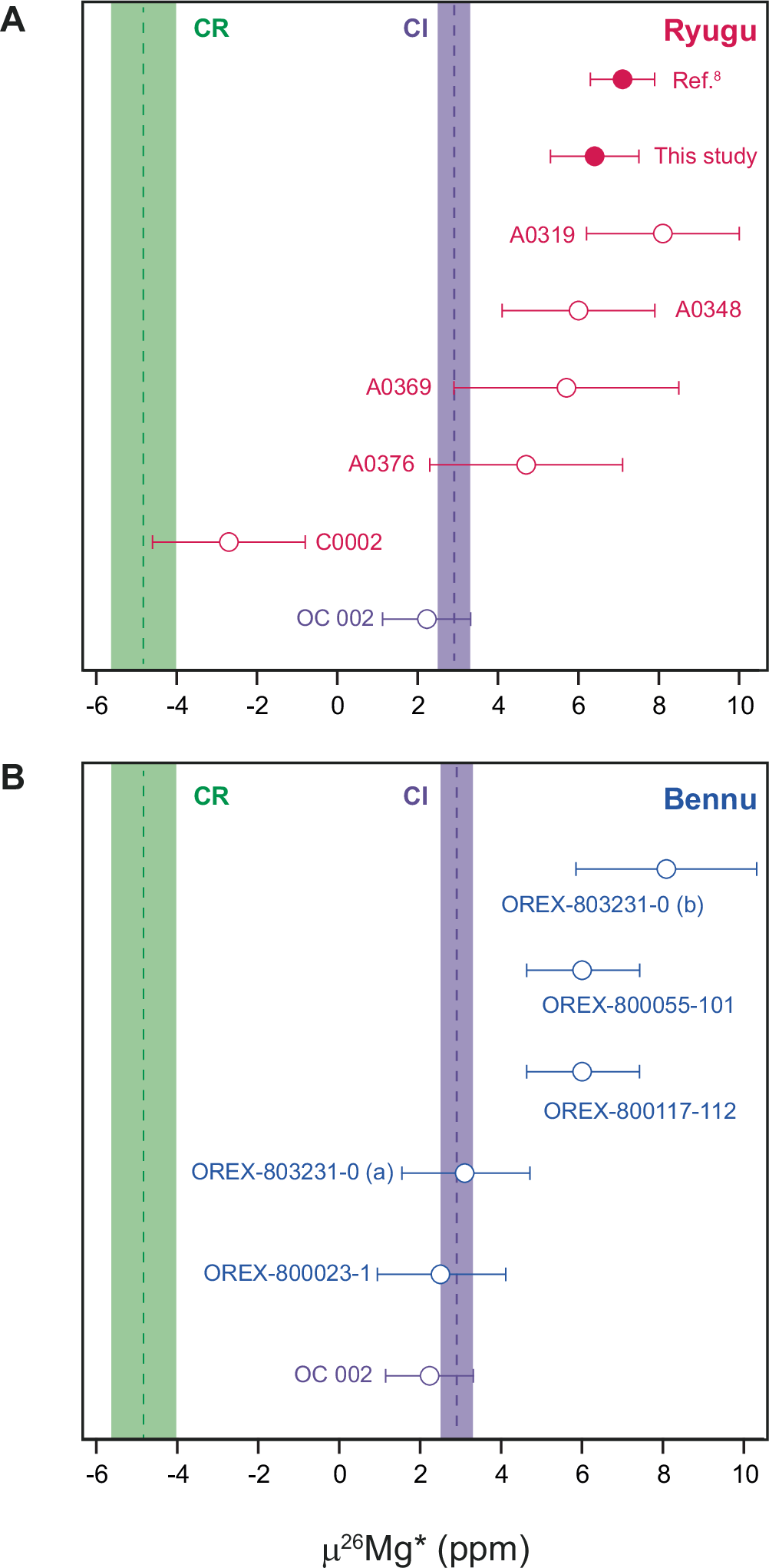
- The three elements give Bennu a fingerprint similar to the asteroid Ryugu and to the CI meteorites, indicating that all three formed from the same reservoir of cosmic dust.
- The data contradict two earlier assumptions about the asteroid: that bodies like Bennu formed in the outer solar system, possibly where comets formed, and that Bennu formed relatively late.
Compiled by The ScientistSomething wrong?How this is made
Why it matters
- capability A fingerprint that sits apart from every other measured asteroid group, meteorite class and planet gives curators a chemical test for whether a newly recovered carbon-rich stone belongs to this family.
- decision Formation models that seeded CI-type bodies out among the comets, or built them late, now have to reproduce a composition that matches neither the inner nor the outer solar system.
- constraint Replication costs material that cannot be resupplied: every independent check on this result spends more of a 120-gram total, and no second capsule is coming back from Bennu.
Iron, titanium and chromium isotopes identify a source, not a location. Isotopes are atoms of one element with slightly different masses, and their relative abundances make a fingerprint that researchers use to work out where a body came from and, to some extent, how old it is [7]. Measured that way, Bennu's grains resemble Ryugu's and those of the CI meteorites [9], a class of primitive, carbon-rich rocks that turn up only very rarely on Earth [10].
The composition is what the ETH group calls hybrid. "Bennu is a hybrid: the material does not clearly match either the inner or the outer solar system," Schoenbaechler said [14]. From there the authors argue for formation close to the water-ice line, the boundary where water vapour freezes, and they place the mixing of inner and outer material there 4.5 billion years ago, with ice binding the finest dust particles together [13].
Jupiter enters the argument as the proposed cause of that mixing. In the scenario the authors set out, the gas giant formed within a million years of the sun [15] and then worked as a bridge pillar in the disk, blocking most coarse material while fine dust from various regions flowed around it and mixed evenly in the transition zone near the ice boundary, where the precursors of all three bodies took shape [16]. The same picture handles the water: ice nearby evaporated, and some of the vapour condensed again in the region where Bennu was assembling [17]. It also accounts for how closely Bennu's chemistry tracks the sun's, because the fine dust orbiting the young star was thoroughly mixed [18].
The measurements pin down kinship and homogeneity. Titanium and iron are distributed uniformly through the material [8], and the fingerprint sits well away from other known asteroids, meteorite groups and planets [11]. From that evidence, the authors infer the formation site and Jupiter's part in it.
NASA could reach the asteroid because it comes close. Bennu circles the sun in 1.2 years [1] and passes within around 300,000 kilometres of Earth every six years [2], five orbits between approaches [2]. The container that came down in the Utah desert on Sept. 23 held around 120 grams [3]. ETH's share was half a gram [4], roughly 0.4 percent of the total, about one part in 240 [1].
Schoenbaechler's claim for that half gram is specific. "Bennu may offer our best glimpse of the original mix of chemical elements from which the terrestrial planets were ultimately built," she said [19]. The case for it rests on the asteroid being almost unaltered: the material dates from the birth of the solar system around 4.5 billion years ago and has hardly changed since [20]. It is also rich in water and organic material, which the ETH account offers as a line on how the young Earth acquired both [21].
What to watch
- Whether other laboratories measuring different elements in the same 120 grams reproduce the grouping of Bennu with Ryugu and the CI meteorites.
- Whether dynamical models can put an early Jupiter and the water-ice line where this composition requires them to have been.
- Whether a newly recovered carbon-rich meteorite falls inside the Bennu-Ryugu-CI fingerprint, testing the claim that the three are a family.