ProductNot yet confirmed elsewhere1 publisher2 min readPublished Updated
Google gives ChromeOS a 2034 end date in favor of Android Googlebooks
Google will end ChromeOS support by 2034 and convert many existing Chromebooks into Googlebooks, its new Android-based laptops. For schools running Chromebook fleets, the next refresh becomes a move onto Google's Android and Gemini platform before that deadline.
The Product Desk
Exposure map. Existing ChromeOS models: many converted to Googlebooks; ChromeOS support ends entirely by 2034. Android: rebuilt around AI, Gemini a cursor gesture away. Googlebooks: native Android apps, tight Android phone connectivity. Google: pivots to a platform more under its control.
- constraint Existing ChromeOS models Google will convert many to Googlebooks and end support for ChromeOS entirely by 2034, claim 1
- decision Android Google rebuilds it around AI, with Gemini features a quick cursor gesture away on Googlebooks, claim 3
- capability Googlebooks Native Android app support and tight connectivity with Android phones, claim 2
- decision Google Pivots to a platform more directly under its control, claim 11
| Who | How | Kind | Claim |
|---|---|---|---|
| Existing ChromeOS models | Google will convert many to Googlebooks and end support for ChromeOS entirely by 2034 | constraint | 1 |
| Android | Google rebuilds it around AI, with Gemini features a quick cursor gesture away on Googlebooks | decision | 3 |
| Googlebooks | Native Android app support and tight connectivity with Android phones | capability | 2 |
| Pivots to a platform more directly under its control | decision | 11 |
What happened
- Googlebooks are part of Google's push to rebuild Android around AI, with Gemini features a quick cursor gesture away.
- Googlebooks will include a desktop-class Chrome browser, though Fast Company says the emphasis is now on running Android apps and using AI.
- Chromebooks remain popular in the education sector, according to Fast Company's report on the change.
- ChromeOS added Android apps in 2016 and Linux apps in 2018, additions Fast Company says made setup more of an ordeal and security harder to maintain.
Why it matters
- exposure Converted school fleets put Gemini within a cursor gesture of every student, on a platform Fast Company describes as more directly under Google's control, so district AI-use rules now reach the laptop itself.
- cost Models Google leaves off its conversion list become replacement hardware that school budgets have to cover before ChromeOS support ends.
- capability Chromebooks that convert pick up native Android apps and tight pairing with Android phones on hardware schools already own.
A student's Chromebook cracks during third period. Since the first models shipped in 2011, the fix has been a spare machine: the student signs in on it and picks up where the old one left off [5]. Those early laptops had minimal storage and could not run regular desktop software, so the work lived off the device [5]. We think that swap, more than any feature on a spec sheet, is what school IT departments have been buying.
Google's new pitch uses different words. According to Fast Company, Google's announcement post for Googlebooks does not use the words "speed," "simplicity" or "security" once [7]. In 2009 Google led with them. "Speed, simplicity and security are the key aspects of Google Chrome OS," the company wrote [8], in a passage that ends, "It should just work." [12]
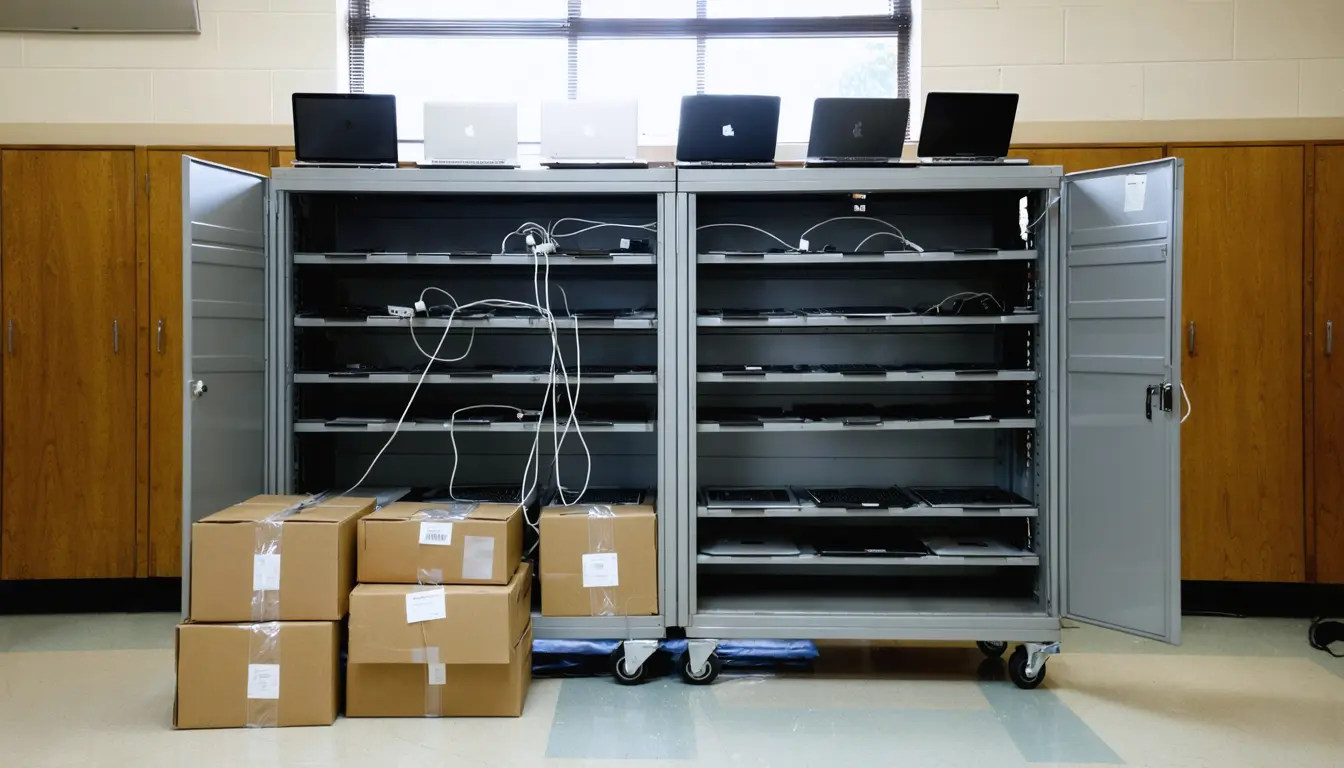
A 2034 cutoff gives ChromeOS a 25-year life from its 2009 introduction [9][13]. Google says it will convert many existing models to Googlebooks [1]. Fast Company's report does not say which models convert or on what schedule. "Many" leaves room for models that do not, and in a school fleet those become replacement hardware before support ends.
Googlebooks keep a desktop-class Chrome [4], so browser-only work is the part we'd expect to carry over. Anything a class has installed beyond the browser needs checking.
Our recommendation is to treat any Chromebook bought from here on as a Googlebook purchase, and to get the reseller to confirm in writing that the model converts. The tradeoff is that the answer may not exist yet. Holding orders until it does pushes refresh work closer to the 2034 deadline [1].
For the fleet already deployed, sort each model on two questions: whether Google converts it, and whether the work on it needs anything beyond Chrome.
- Converts, browser-only: the light case. Pilot one classroom on the Googlebook build. - Converts, app-dependent: test every installed app the class relies on against a Googlebook before switching. - Does not convert, browser-only: a hardware line in the budget, timed to the normal refresh cycle. - Does not convert, app-dependent: the real migration, and the first one to scope.
What to watch
- Google's list of which existing Chromebook models convert to Googlebooks, and the dates for each.
- Admin console controls for Gemini on managed education Googlebooks, including whether districts can switch it off.
- Whether Linux app and Steam support carry over from ChromeOS to Googlebooks.
Clarity's read
What the record supports and how the coverage leans. The claims behind it follow.
Reality
- Evidence35
- Adoption
- Insufficient
- Hype gap
- Insufficient
- Incentives55
- Confidence40
Claim ledger
Ranked by verification strength, evidence, and original report placement.
- [1]
Google plans to phase out ChromeOS; Google says it will convert many existing models to Googlebooks and will end support for ChromeOS entirely by 2034.
- [2]
Googlebooks are Google's new platform of Android-based laptops, with native Android app support and tight connectivity with Android phones.
- [3]
Googlebooks extend Google's efforts to rebuild Android around AI, with Gemini features a quick cursor gesture away.
- [4]
Googlebooks will include a desktop-class version of Chrome, but the emphasis now is on running Android apps and using AI.
- [5]
The first Chromebooks arrived in 2011; they had minimal internal storage and could not run regular desktop software, and a user who lost one could set up a new one and pick up where they left off.
- [6]
Google brought Android apps to Chrome OS in 2016 and Linux app support in 2018, and added Steam support; Fast Company says these additions added complexity, demanded more storage, made setup more of an ordeal and made security a bigger challenge.
- [7]
Google's announcement post for Googlebooks does not mention the words 'speed,' 'simplicity,' or 'security' even once.
- [8]
"Speed, simplicity and security are the key aspects of Google Chrome OS."
ReportedSupportedSource: Google, writing about the ChromeOS project in 2009, as quoted by Fast CompanyView cited source - [9]
Google introduced ChromeOS in 2009 as a lightweight platform for the web.
- [10]
Chromebooks remain popular in the education sector.
- [11]
Google is pivoting to a platform more directly under its control.
- [12]
"It should just work."
ReportedSupportedSource: Google, 2009 ChromeOS description, as quoted by Fast CompanyView cited source - [13]
ChromeOS will have had a 25-year life from its 2009 introduction to the 2034 end of support.
Sources
1 independent publisher whose own reporting we read for this story.
- fastcompany.comGooglebooks mark the end of the old Google
1 article · October 10, 2026
Topics and entities
Follow any of these and your For You feed starts watching them — no settings page required.