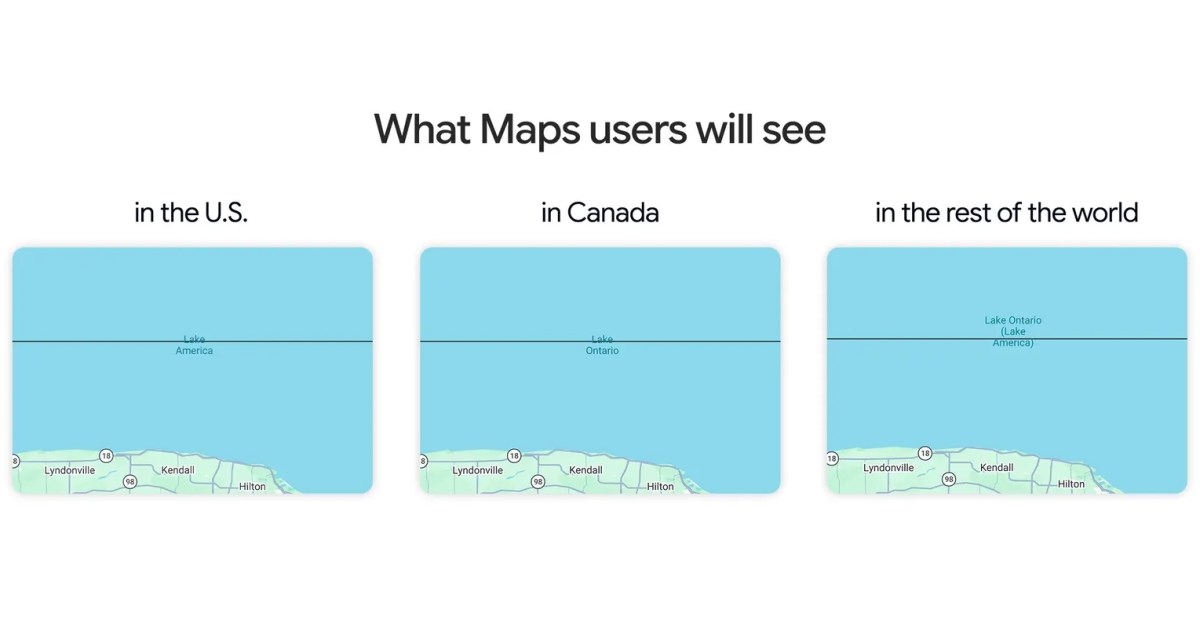
Google Maps renders Lake Ontario under three names depending on the viewer's country
An executive order moved a US government database entry on August 27. Google's map label followed within days, and the place names in any embedded map are now a per-jurisdiction variable your product inherits.
The Product Desk
What happened
- Google Maps now labels Lake Ontario as "Lake America" for users located in the United States, following an executive order late last week.
- In a brief blog post, Google confirmed that users in Canada continue to see only "Lake Ontario" while users elsewhere in the world are shown "Lake Ontario (Lake America)".
- The change traces to the US GNIS entry, updated as of August 27 by the Department of the Interior after Trump's order, which Google's naming policy follows.
- Canada says it will not update the name, with Prime Minister Mark Carney noting it is more than 400 years old and derives from the Wendat word Ontari'io.
Why it matters
- constraint A label that changes with the requester's location breaks the assumption that map output is deterministic, so cached tiles and visual regression snapshots now depend on where the CI runner sits.
- decision Because Google follows the local gazetteer, the next disputed name arrives by database edit rather than by product decision, so the only choice left to teams is what their own copy and stored records say.
- exposure Products that surface Google place reviews are exposed to review-bombing of the lake for as long as the limit Google eventually applied to Gulf of America stays off this one.
- contradiction With MapQuest refusing and Apple holding back, a multi-provider product can no longer assume its two base maps agree on a name, which makes provider choice an editorial position rather than a procurement one.
A sales engineer in Buffalo shares her screen with a customer in Mississauga, and the two of them are looking at different names for the same water [4][1]. Each map is rendering the name that its side of the border keeps on file, which is what Google says its policy does [2].
The pipeline is short, and it does not pass through anybody's product team. The Department of the Interior updated the US GNIS entry on August 27 [3], and 9to5Google reported the US label live on August 30 [11], so roughly three days separated a government database field from the string on the tile [14]. One lake now carries three distinct renderings in circulation: "Lake America" inside the US, "Lake Ontario" inside Canada, and a parenthetical "Lake Ontario (Lake America)" for everyone else. Three strings, one water body [12]. A VPN moves you between them [7].
Teams tend to treat the base map as infrastructure, on the level of a font stack or a timezone table, something that is either up or down. That framing no longer holds: the map is now a rendering of one government's position that varies with the viewer's apparent location. Two of the three variants exist because Google chose them, since no gazetteer edit produces a parenthesis around a disputed name on its own [1].
The provider layer is not converging either. MapQuest said flatly that it will not rename the lake, and instead built a generator that lets users invent their own names for it [6]. Apple Maps was not showing the new name as of the report [5], a change of tempo from February 2025, when Apple followed Google to "Gulf of America" within a day or two [10].
The forcing function is a two-by-two, and it applies to your product rather than to Google's. First axis: does the disputed name appear only inside the embedded base map, or also in copy you own, in address validation, in stored user records? Second axis: are your users and your staff inside one jurisdiction, or on both sides of the line? Base map only, single jurisdiction, and there is nothing to do. Base map only, cross-border, and it is a caption problem: help-centre images and support macros have to say the label depends on where the reader sits. Your own copy, single jurisdiction, and it is a style-guide entry, decided once, by someone whose name is on it. Your own copy, cross-border, and you are in the expensive quadrant, because the name is stored data and someone has to rule on whether a saved record keeps the string it was written with or re-renders for whoever opens it.
The question worth answering is which place names in your product come from a gazetteer you do not control, and who can edit that gazetteer without filing anything with you. Google's own record suggests the list is longer than most teams assume: this is the second time it has cited the same local-government-data policy to move a name a neighbouring country disputes, and Canada has said it is not moving [13][8].
What to watch
- Whether Google applies to Lake America the new-review limit it eventually placed on Gulf of America.
- Whether Apple Maps adopts the GNIS name, and how that timing compares with its one-to-two-day turnaround in February 2025.
- Whether Canada's refusal to change the entry pushes Google to document how it handles two gazetteers disagreeing over one shared water body.
Clarity's read
What the record supports and how the coverage leans. The claims behind it follow.
Reality
- Evidence82
- Adoption70
- Hype gap+10
- Incentives60
- Confidence76
Perspective Coverage
18 publishers- Builder
- Builder 18%
- Operator
- Operator 55%
- Investor
- Investor 27%
Claim ledger
Ranked by verification strength, evidence, and original report placement.
- [1]
Google confirmed in a brief blog post that users in Canada will continue to see only "Lake Ontario" while users in other parts of the world will see "Lake Ontario (Lake America)".
- [2]
Google cites a policy under which it updates location names based on local government data, and referred to the same policy in February 2025 when it updated Maps to show "Gulf of America".
- [3]
The name in the US GNIS was updated as of August 27 by the Department of the Interior following Trump's order.
- [4]
Following an executive order late the previous week, Google Maps updated its label for Lake Ontario to "Lake America" for users located within the United States.
- [5]
Apple Maps was not yet showing the new name at the time of the report.
- [6]
MapQuest directly said it will not change the name, and instead built a name generator that allows users to create their own new names for the lake, mocking the change.
- [7]
The differing names can also be seen using a VPN.
- [8]
Canada has confirmed it will not update the name from "Lake Ontario", with Prime Minister Mark Carney stating the name is more than 400 years old, predating both the Confederation of Canada and the US Declaration of Independence, and that it comes from the Wendat word Ontari'io, meaning "the lake is beautiful, the lake is big".
- [9]
Steep backlash pushed Google to limit new reviews of "Gulf of America" in 2025, but 9to5Google observed in testing that the same limitation had not yet been placed on "Lake America".
- [10]
Apple changed its label to "Gulf of America" within a day or two of Google in February.
- [11]
The 9to5Google report describing the live US "Lake America" label was published on August 30.
- [12]
One water body currently renders as three distinct label strings depending on the viewer's location: "Lake America", "Lake Ontario", and "Lake Ontario (Lake America)".
- [13]
This is the second occasion on which Google has cited its local-government-data policy to change a disputed place name in Maps, after "Gulf of America" in February 2025.
- [14]
About three days separated the August 27 GNIS update and the August 30 report of the label appearing in US Google Maps.
Get this ledger inside ChatGPT. Ask about any of our stories and the answer brings its figure, each claim’s verdict and the sources. Free, no account.
Sources
17 independent publishers whose own reporting we read for this story.
- 9to5google.comGoogle Maps has renamed ‘Lake America’ for users in the US
3 articles · September 1, 2026
- 9to5mac.comApple Maps still shows Lake Ontario as Google Maps changes name
2 articles · August 31, 2026
- androidauthority.comLake Ontario is now 'Lake America' on Google Maps, but not for everyone - Android Authority
1 article · August 31, 2026
- arstechnica.comGoogle Maps renames "Lake Ontario" to "Lake America" even faster than US government
2 articles · August 31, 2026
- digitaltrends.comGoogle Maps has another “America” on the map, and Canadians aren't amused - Digital Trends
1 article · August 31, 2026
- fastcompany.comMapQuest isn’t renaming Lake Ontario, despite Trump’s executive order. And it’s surging in the App Store
1 article · August 31, 2026
- gizmodo.comGoogle Caves to Trump Again, Renames Lake Ontario
2 articles · August 31, 2026
- latimes.comMapquest takes stand over Trump's 'Lake America.' Also, still exists - Los Angeles Times
1 article · August 31, 2026
- macrumors.comGoogle Maps Showing 'Lake America' in U.S., Apple Maps Yet to Follow
3 articles · August 31, 2026
- mashable.comGoogle changes 'Lake Ontario' to 'Lake America' in Search, Google Maps | Mashable
1 article · August 30, 2026
- pcmag.comMapQuest Sticks With Lake Ontario, Sees Surge in App Downloads | PCMag
1 article · August 31, 2026
- pocket-lint.comMapQuest just beat Google Maps for a really weird reason
1 article · August 31, 2026
- techcrunch.comMapQuest’s app surges to No. 1 in Navigation after refusing to rename Lake Ontario
3 articles · September 2, 2026
- techradar.com'Beyond ridiculous': if you're seeing Lake Ontario renamed as Lake America on Google Maps, here's why | TechRadar
1 article · August 31, 2026
- thenextweb.comGoogle Maps relabels Lake Ontario as Lake America for US users
1 article · August 30, 2026
- tomsguide.comMapQuest is suddenly No. 4 in the Apple App Store — here's why | Tom's Guide
1 article · September 1, 2026
- uk.pcmag.comMapQuest Sticks With Lake Ontario, Sees Surge in App Downloads
1 article · August 31, 2026
- wired.comGoogle Maps Now Shows ‘Lake America’ Instead of Lake Ontario
2 articles · August 30, 2026
Topics and entities
Follow any of these and your For You feed starts watching them — no settings page required.
Topics
- Geographic Naming DisputesFollow
- EU Digital Services ActFollow
- Digital map localizationFollow
- App store rankingsFollow
- US-Canada trade disputeFollow
Entities
- Sensor TowerFollow
- GoogleFollow
- U.S. Department of the InteriorFollow
- Mark CarneyFollow
- Doug BergerFollow
- OpenStreetMapFollow
- Google MapsFollow
- MapQuestFollow
- Donald TrumpFollow
- US Geographic Names Information SystemFollow
- Apple MapsFollow
- WazeFollow
- System1Follow