Science1 publisher3 min readPublished
A freeze-dried starch cylinder turns pink as cream crackers lose their crispness
Chemists at the University of Sao Paulo report that a cobalt chloride cryogel tracks moisture inside a packet and the texture loss that follows, and that it goes back to blue when the air dries. The adviser says the cobalt is toxic.
The Scientist · Science desk
What happened
- A group at the Sao Carlos Institute of Chemistry at the University of Sao Paulo built a biodegradable starch sensor that changes colour when moisture gets into food packaging.
- Cobalt chloride in the starch cryogel takes the material from blue to pink as moisture rises inside the pack, and back to blue again as the moisture falls.
- The team says the readout can be judged by eye or with a cellphone camera, without complex equipment, by either a manufacturer or a shopper.
- The work appeared in June in Food Chemistry, with Livia Yumi Nakashima as first author.
Compiled by The ScientistSomething wrong?How this is made
Why it matters
- constraint Maniglia says the cobalt makes the sensor toxic and rules out direct food contact, so this cannot be printed into existing film. A pack would have to carry the cylinder in a separate space that stays dry-side of the biscuit.
- capability Crispness becomes something a person can check through the wrapper, on the shelf or in a warehouse aisle, without a moisture meter or a texture analyser.
- decision A packaging team piloting this has to pick between the cobalt formulation, which has the cracker texture data behind it, and the fruit-pigment route the same group is now developing for meat.
Cobalt chloride is blue when dry and pink once it has taken up water vapour, because hydration changes the salt's chemical structure and with it its colour [7]. The new part is what the salt sits in. The group at the Sao Carlos Institute of Chemistry froze a starch gel and freeze-dried it, so the pores left by the ice survive into the finished solid [9]. Bianca Maniglia, a professor at IQSC-USP and the research adviser, said the starch gel is frozen and then freeze-dried, and that during dehydration the frozen water is removed by sublimation, passing straight from solid to vapour; taking out the aqueous phase preserves the porous structure formed during freezing, leaving a material with a high capacity for interacting with the environment [9][14].
That porosity is the sensitivity argument. "What set this study apart was having a larger surface area for the sensor, making it highly sensitive and allowing us to observe different humidity conditions inside the packaging," Maniglia said [8]. A small cylinder placed near the crackers shifts among shades of blue and pink within a few seconds [7].
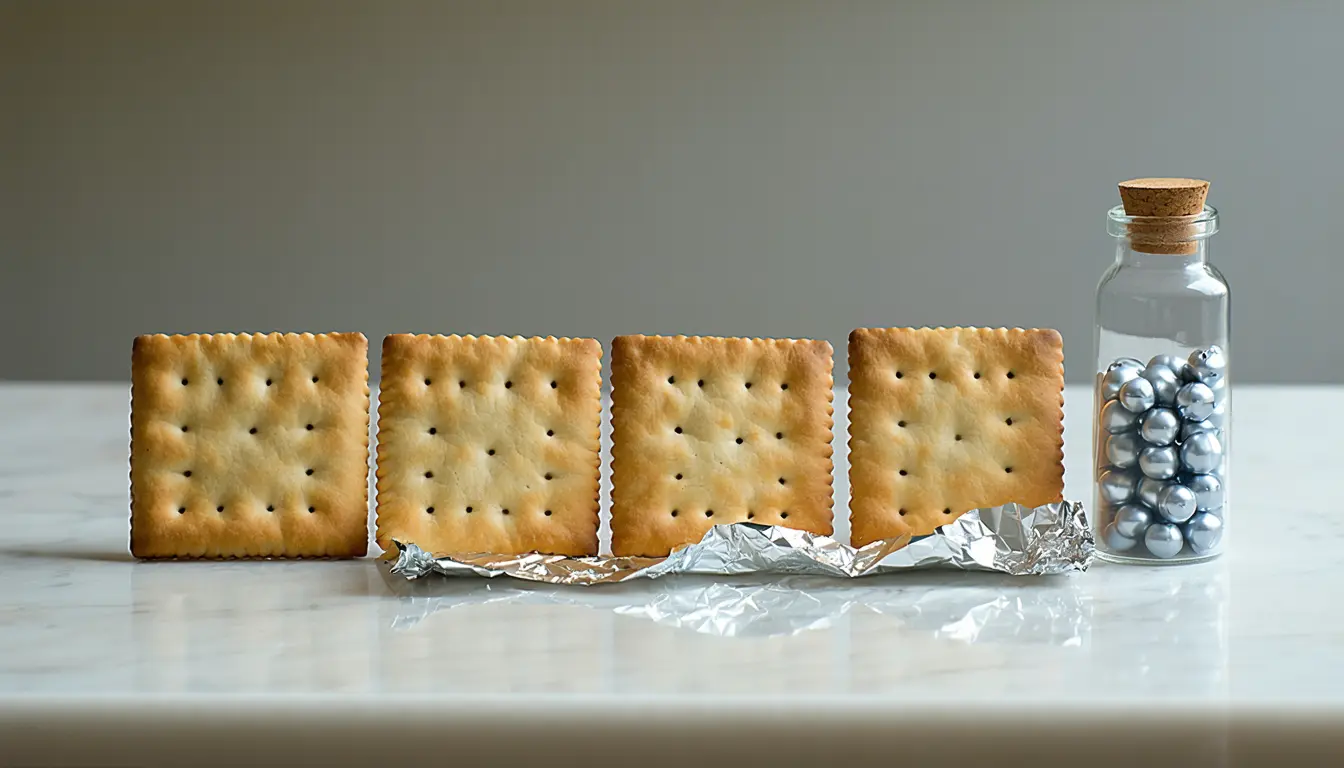
Cream crackers were the test food because they take up moisture readily and go soft when stored badly [5]. The colour change tracked rising moisture, and the moisture was strongly correlated with measured texture loss [6]. The report describes that correlation as strong without giving a coefficient or the number of cracker samples [16]. Crackers are also the only food in the result, so the link between the indicator and staleness is not established for anything else yet [17]; the researchers expect eventual use across various products [15].
Reversibility cuts two ways. Because the colour returns to blue as moisture falls, the cylinder reports the humidity present at the moment someone looks at it, and does not hold a record of a damp spell that has since passed [18]. A shopper deciding whether a packet is crisp gets an answer. A warehouse trying to reconstruct a bad week in transit does not.
Then there is the cobalt. "For commercial use, conventional packaging would need to be redesigned because, for now, the presence of cobalt chloride makes the sensor toxic, and therefore it can't come into direct contact with food," Maniglia said [10]. The team coated the cylinder with the same material used on the Brazilian kitchen weather rooster ornaments that gave Maniglia the idea [11].
The next candidate chemistry drops cobalt entirely. The group is evaluating bioactive compounds from fruit, including jabuticaba peel [12]. "These natural pigments are sensitive to pH variations, exhibiting color changes that can be used as visual indicators, in addition to possessing antioxidant activity," Maniglia said [13]. Those pigments are aimed at a different question, the spoilage of meat, and the cracker texture correlation published in Food Chemistry in June was measured with the cobalt version [13][3].
What to watch
- Whether the colour-to-texture correlation repeats in a second moisture-sensitive food, with the coefficient and sample count reported.
- Whether the jabuticaba-peel pigment version produces a published correlation with meat spoilage markers, which would remove the cobalt question.
- Whether any food regulator will clear a cobalt chloride indicator held inside a pack but off the food, since that is the redesign Maniglia says commercial use requires.