Product6 publishers3 min readPublished
Two accounts of the EU Kids Act draft disagree about what under-13s may access
Von der Leyen announced a ban on social media for under-13s and one-hour parent-run accounts for 13- to 15-year-olds. WIRED and a draft seen by the Financial Times describe the youngest tier differently, and the text is years from force.
The Product Desk · Product desk
What happened
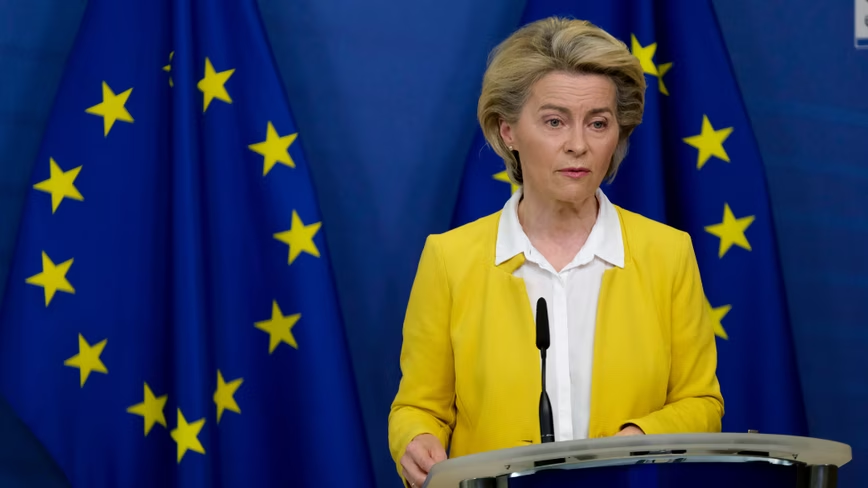
- Ursula von der Leyen used Wednesday's State of the Union speech to announce a total ban on social media for children under 13 across EU member states.
- WIRED reported that 13- to 15-year-olds would get no personal accounts and instead use mini accounts set up and supervised by a parent, with limited features, for one hour a day.
- Platforms would carry safe design obligations for users up to 18, with addictive design to be addressed further in the Digital Fairness Act in the autumn.
- The Next Web reported the law would require strict age checks on social media, video platforms, app stores, online games, AI companions and chatbots.
- MacRumors reported that failing to comply could bring fines of up to 6 percent of a company's global annual revenue.
Compiled by The Product DeskSomething wrong?How this is made
Why it matters
- contradiction WIRED describes a flat wall for under-13s while MacRumors, reading the Financial Times draft, describes supervised access, so a team that starts building this quarter can pick the wrong flow and find out in 2029.
- decision Age assurance becomes a vendor question for every consumer product with a signup form: wire into the Commission's official app or defend your own checks to a regulator.
- constraint Parental controls detailed enough to satisfy the rule can put the teenager off using the product at all, which limits how much the parent view can be allowed to show.
- precedent With two governments against age-based bans and Parliament having asked for 16, the age threshold is the parameter most likely to move, and anything hard-coded to 13 will be rewritten.
In Australia, children have widely got around that country's under-16 ban on social media [18]. Every tier of the EU proposal rests on knowing how old a user is. Joanna Conway, digital regulation partner at the law firm Norton Rose Fulbright, told WIRED: "A key issue is how to carry out the age checks and it's not straightforward" [17].
The two published descriptions of the under-13 tier ask a product team for different things. WIRED described a total ban [1]. MacRumors, working from a draft proposal seen by the Financial Times, described under-13s being allowed access with supervision from a parent [6]. One of those is a rejection at the door. The other is a two-party flow in which an adult authenticates, is verified as an adult, and provisions an account for someone who cannot hold one alone.
The hour is the tightest number in the reporting and the least corroborated. WIRED gives 13- to 15-year-olds one hour a day on a parent-supervised mini account with limited features [3]. The MacRumors account of the draft mentions time limits without a figure [6]. A daily cap of that kind needs session accounting that survives a reinstall and a second device.
Arnav Joshi, a technology lawyer at Ashurst Perkins Coie, told WIRED that "Cleaning up that mess, getting everyone on the same page, then running through the EU legislative process" will probably take until 2029 [14]. Set against the mid-September 2026 reporting [25], that is roughly three years [26]. Joshi also said companies will welcome the clarity and simplicity of a single set of EU-wide rules [15]. Seventeen of the 27 member states are already negotiating or preparing their own legislation on minors online [19]. Ten are not [20].
Joshi, who advises global technology companies on children's online safety, said parental monitoring could be problematic, warning that "anything that has deep dive, God-mode style parental access can have a bit of a chilling effect on how children actually use that service and could have issues in terms of their own right to privacy" [16]. He said the tiered approach is designed to placate judicial challenges by being proportionate, and that "the EU law, by not introducing a blanket ban, is perhaps even a little bit more permissive than others" [23]. France's top court struck down a national under-15 ban last month because it infringed on freedom of expression [21].
The useful split for a roadmap is whether a requirement depends on knowing a user's age. Age checks, the under-13 gate and the hourly cap all do, and the draft would require affected companies to verify age with an official app [12]. Brussels said that app was ready in April; it uses zero-knowledge proofs, so a user can prove an age without handing over identity documents [13]. Switching off infinite scrolling and artificial notifications depends on none of that [9], and neither does dropping chatbot designs that encourage unhealthy emotional attachments [11]. Those two can ship before the age line settles, and they are what the draft means when it says "technology companies bear primary responsibility for making their products safe" [10].
What to watch
- Whether the published Kids Act text keeps the 13 and 15 thresholds, and whether it names an hour for the teen tier.
- Whether opposition from Estonia and Belgium, and Parliament's earlier call for 16, moves the age line during negotiation.
- Whether the Commission's over-18 verification app is extended to lower age groups, as the EU says it can be.