Science1 publisher3 min readPublished
An orbiting atom interferometer spent 280 days comparing how two rubidium isotopes fall
A team led by Mingsheng Zhan compared the freefall of two rubidium isotopes aboard the China Space Station. The 2.8 x 10^-8 uncertainty they report is the best any quantum test has managed. It is also well short of what macroscopic experiments already do.
The Scientist · Science desk
What happened
- A team led by Mingsheng Zhan used the cold atom interferometer on the China Space Station's High Microgravity Level Research Rack to compare the freefall of clouds of billions of 85Rb and 87Rb atoms.
- The run lasted 280 days and produced more than 9,700 pairs of interference fringes, giving a test result of around -2.7 x 10^-7 after error corrections, with a quoted uncertainty of 2.8 x 10^-8.
- Tests of the same principle using macroscopic bodies have already reached the 10^-13 level on Earth and 10^-15 in space, and both new experiments probe the quantum regime instead.
Compiled by The ScientistSomething wrong?How this is made
Why it matters
- capability A proposal for a dedicated orbital interferometer no longer rests on engineering estimates. The hardware has flown on a crewed station and returned fringes, which is what Zhan points to before he points to the number.
- constraint The new figure only constrains violations that are specific to quantum matter. Anyone arguing for new physics from it still has to explain why experiments five to seven orders of magnitude tighter, using macroscopic masses, saw nothing.
- precedent Because resolution improves with the square of freefall time, the route to the 10^-17 target runs through duration, and the next thing such groups will ask for is a platform that supplies permanent microgravity.
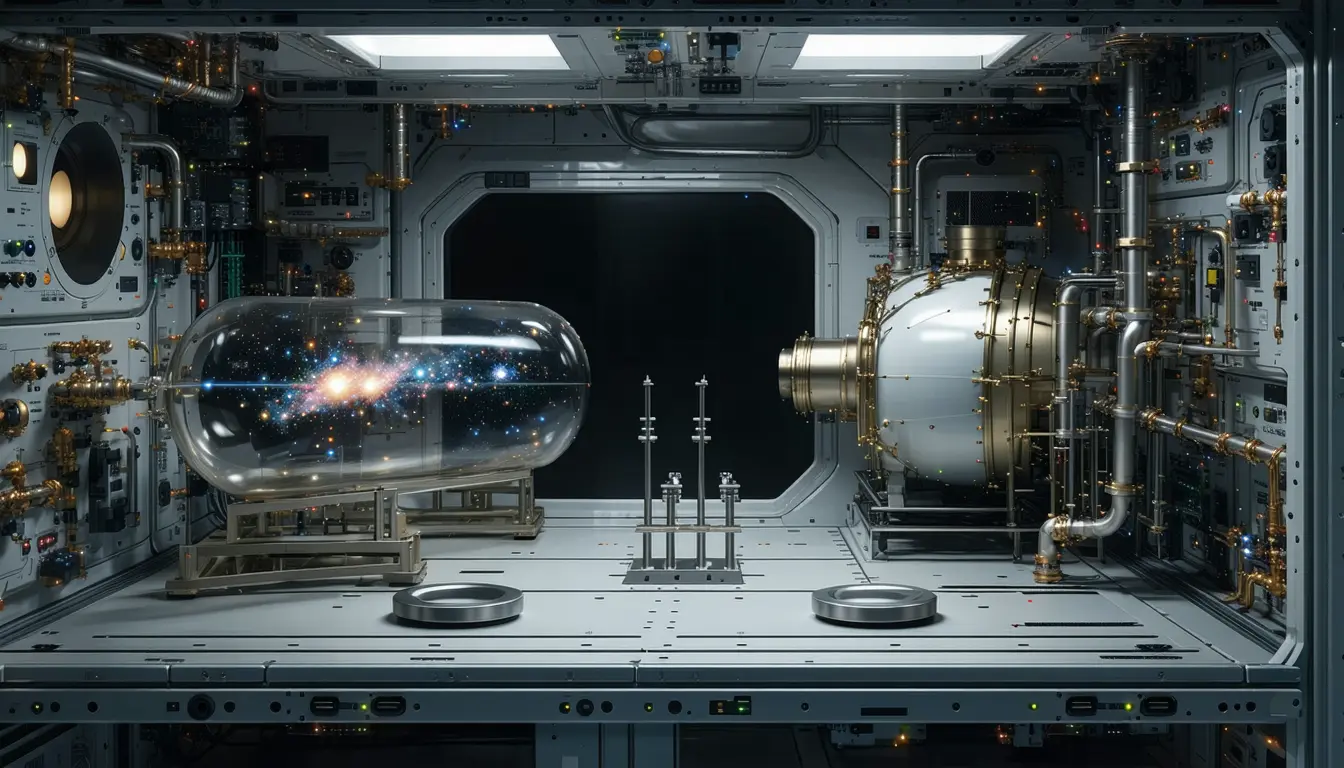
Both isotope clouds sit in the same instrument. The interferometer on the station's High Microgravity Level Research Rack holds clouds of billions of 85Rb and 87Rb atoms, probed with counterpropagating Raman lasers reflected off a piezo tilt mirror [9]. The team excited and detected the fluorescence of the two isotopes sequentially, at slightly different times, which gave two sets of symmetric interference images [10]. Taking the differential phase of those sets, after suppressing the station's residual acceleration and the effects of vibration, leaves the difference in acceleration between the isotopes along the falling direction [11].
Statistics accumulated slowly. More than 9,700 fringe pairs across 280 days of operation [12] averages about 35 pairs a day [16]. The gain from orbit is per shot, not per day: Earth's gravity holds the interference time to a few seconds and microgravity stretches it to minutes [5], and the resolution of such a test scales as the inverse square of that time [6]. Going from about 2 seconds to about 120 seconds is a factor of 60 in time and 3,600 in resolution [19].
The new quantum uncertainty is roughly 280,000 times coarser than the best ground-based macroscopic figure and about 10 million times coarser than the best space-based one [17], [4]. Any model that predicts a composition-dependent violation large enough for those experiments to see has already been tested against them. What the station measurement adds is a constraint in the quantum regime [20], where the macroscopic tests say nothing directly, and a violation there would have to be enormous to show up at 2.8 x 10^-8 [1].
The laboratory result is a separate confirmation. A group working in Israel, Germany and the UK measured an object's quantum phase in freefall and found the equivalence principle holding there too [2]. Physics World reports the two experiments as independent tests, and the 2.8 x 10^-8 figure belongs to the space-station measurement alone [1].
Physics World gives the uncertainty as 2.8 x 10^-8 and the test result as around -2.7 x 10^-7 [1], which puts the central value about ten times the quoted uncertainty [18]. Read literally, those two numbers describe a nonzero violation at high significance; read as an inconsistency in exponents, they describe a null. The error budget in the Science Advances paper [8] is where that gets settled.
Zhan said of the work, "We believe that our technique will have a significant impact" [13], and put the hardware first: it demonstrates "that an integrated interferometer meeting the requirements of in-orbit operation is possible" [14]. The precision the field is aiming at, 10^-17 or better, needs still longer interference times, and that means a permanent microgravity environment [7].
What to watch
- The error budget in the Science Advances paper: whether the -2.7 x 10^-7 central value is consistent with zero once all systematics are quoted.
- Whether the Israel-Germany-UK freefall phase measurement is published with a numerical violation bound that can be compared with the orbital result.
- Whether any group commits funding to a dedicated free-flying interferometer targeting 10^-17, which needs interference times well beyond minutes.