Science1 publisher2 min readPublished
Hafnium oxide holds intrinsic antiferroelectric order in films 0.6 nanometers thick
Nebraska physicists report in Science that hafnium oxide is intrinsically antiferroelectric, holding that order in films 0.6 nanometers thick. The lead-free compound, common in electronics, gains a firmer claim on capacitor, memory and cooling uses, so far on evidence from single-crystal films.
The Scientist · Science desk
What happened
- University of Nebraska-Lincoln physicists Xiaoshan Xu, Alexei Gruverman and Evgeny Tsymbal report in Science that hafnium oxide is inherently antiferroelectric.
- The work addresses a long dispute over whether hafnia's observed antiferroelectric behavior is genuine or an artifact of trapped or redistributed electrical charge.
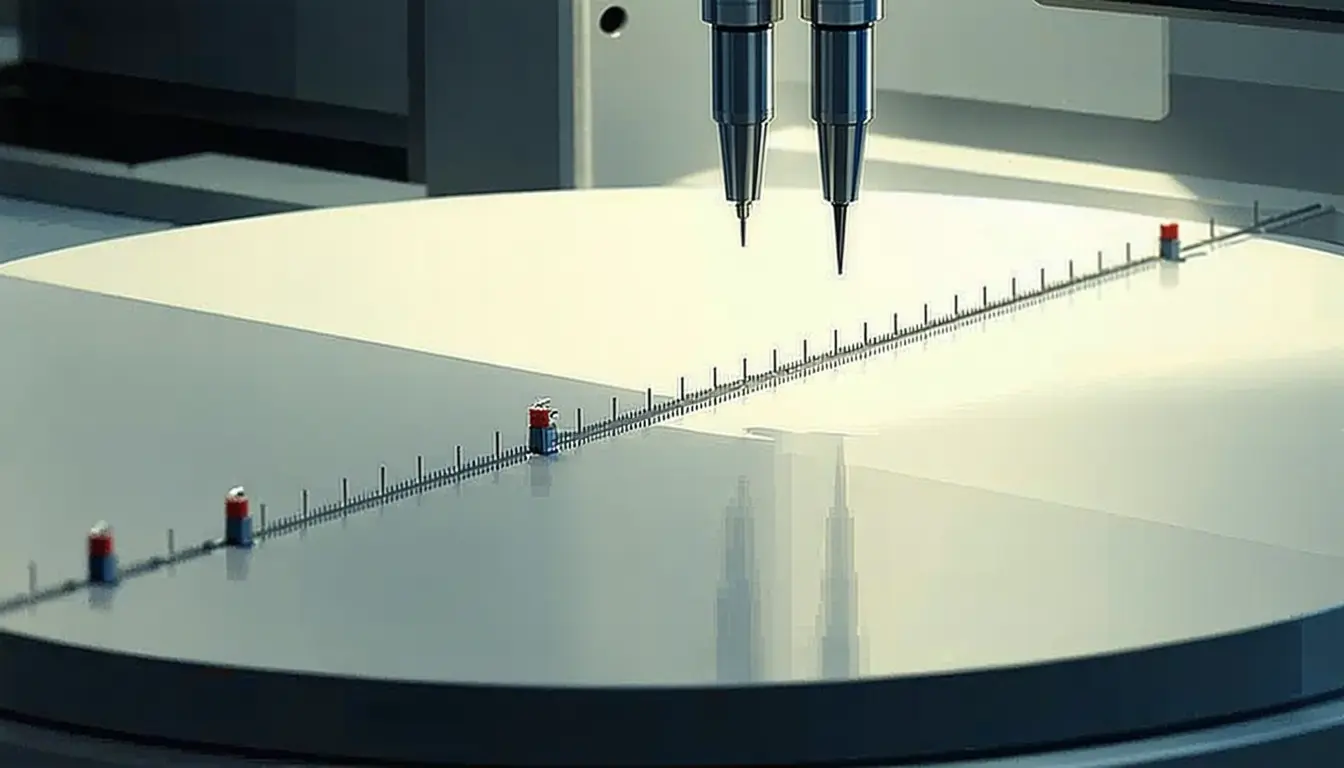
- Xu grew ultrathin hafnia by pulsed laser deposition on a crystal that compressed it, stabilizing the atomic arrangement behind the antiferroelectric order.
- Against the expectation that such order fades in thinner films, the antiferroelectric structure grew more stable as the films thinned, down to 0.6 nanometers.
- The films remained stable at temperatures up to 850 degrees Celsius.
Compiled by The ScientistSomething wrong?How this is made
Why it matters
- capability Engineers wanting antiferroelectric capacitors or solid-state coolers get a candidate without the lead that restricts most intrinsic antiferroelectrics, in a compound modern electronics already uses.
- decision Groups designing with hafnia's double loop can treat it as a crystal property to tune through substrate compression and film thickness.
- precedent If hafnia is accepted as a prototype, a lead-free compound from mainstream electronics becomes the reference material new antiferroelectrics are compared against.
The dispute over hafnia turned on how to read its electrical behavior, because trapped or redistributed charge was the rival explanation for it [3]. In a true antiferroelectric, neighboring polarizations point in opposite directions and largely cancel. An applied voltage switches the material into a polarized state that lasts until the charge is removed [15].
Gruverman's checks went past the electrical loop. Using scanning probe microscopy and integral electrical measurements, he confirmed that the film switches between antipolar and polar states [8]. He reported all three signatures of antiferroelectricity: the double hysteresis loop, antiparallel sublattices of neighboring dipoles, and interphase boundaries between regions of different polarization [9].
I'd weight the last two more heavily. They are observations of how the dipoles are arranged, and the charge-trapping account was offered to explain the electrical behavior [3].
Tsymbal singled out the thinnest films. "What is remarkable in this work is that even in the monolayer crystal, you can sustain antiferroelectricity, and even enhance it, fairly efficiently," he said [12]. He also tied the result to crystal quality. "We demonstrated that if you grow a very high-quality monocrystalline, then you indeed will get the intrinsic property of antiferroelectricity," he said [11].
The thing this doesn't tell you is how well a hafnia capacitor, memory cell or cooler would perform. The university's account of the paper does not include energy-density, endurance or temperature-change figures.
Lead is the practical reason engineers care. Many intrinsically antiferroelectric materials contain it, and that limits their use [2]. Hafnia is a tough, heat-resistant compound already used widely in modern electronics [16]. The university's account lists high-performance capacitors, compact solid-state cooling less reliant on harmful refrigerants, and computers with more energy-efficient memory as possible future uses [13]. Xu made the compatibility case directly. "Not only have we discovered this new material with inherent antiferroelectricity, but the material is already compatible with the modern electronics we already have, including our cellphones and computers," he said [4].
The paper also proposes hafnia as a prototype antiferroelectric, a reference material for the class. The grounds are compositional: its positive and negative atoms are separated by neutral atoms, matching the classical definition [10]. Gruverman went further. "I think this is a turning point," he said [14].
What to watch
- Whether independent groups find the same three signatures in hafnia films grown by other deposition methods or on other substrates, outside high-quality single crystals.
- Whether the antiferroelectric order keeps strengthening below 0.6 nanometers or the thinning trend reverses.