Leadership1 publisherNot yet confirmed elsewhere2 min readPublished
Developers count 76% of London office bike racks empty as Khan plans looser rules
London Property Alliance research found 76% of cycle parking in 21 London office buildings empty at peak, backing Sadiq Khan's plan to cut rack rules. The draft would free basement floorspace for other uses, though the evidence for it comes from the developers who pay to build those floors.
The Board Room · Leadership desk
Drafted by a language model from the sources cited here and checked against its claim ledger before publication. How we use AISend a correction
What happened
- The LPA says the use it observed justifies one long-stay bike space per 433 sqm of office, against one per 75 sqm under the 2021 London Plan.
- Sadiq Khan's draft London Plan cuts the assumed share of office staff who cycle to work from 19% to 10%, while the LPA counted 6.5%.
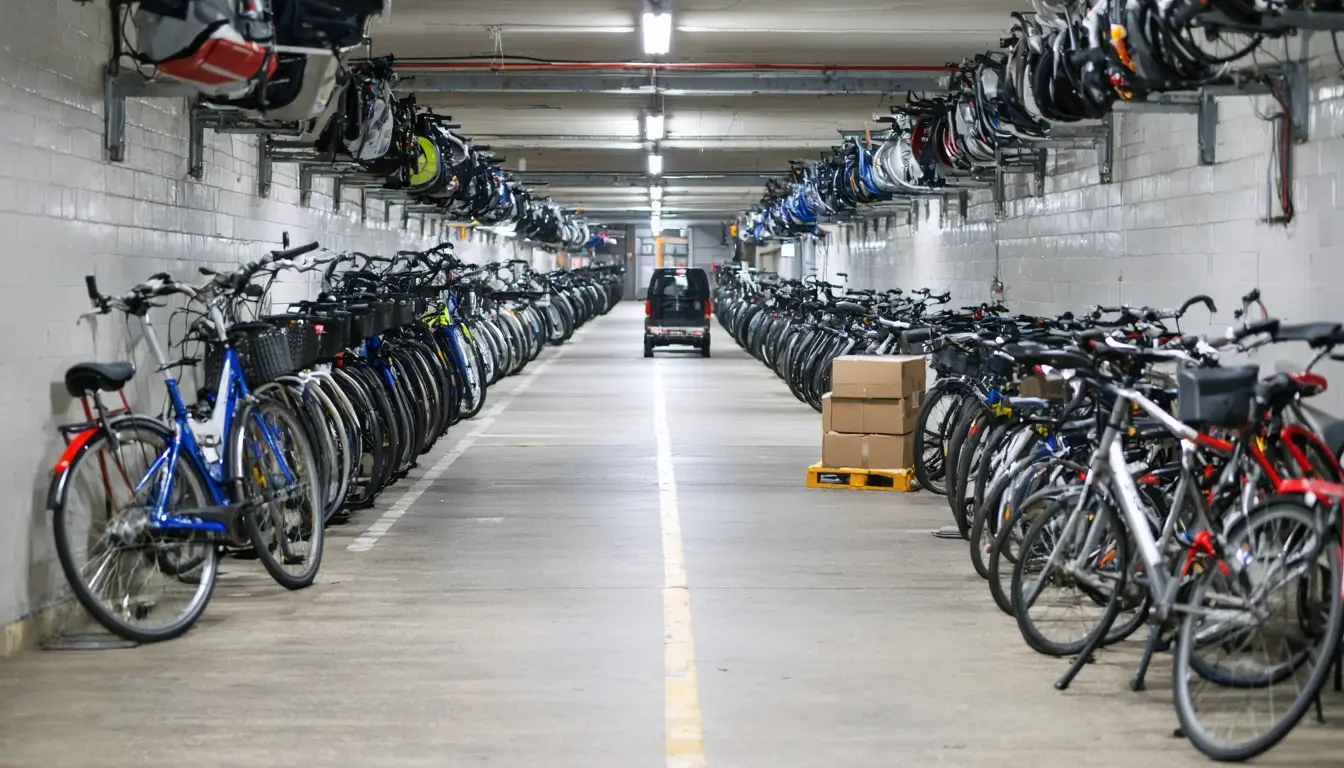
- Most office cycle parking is in basements, which the LPA says are among the most expensive and carbon-intensive parts of a building to develop.
- Developers blame hire e-bikes for the empty racks, and Lime says its trips into the Square Mile rose nearly 50% last year.
Compiled by The Board RoomSomething wrong?How this is made
Why it matters
- cost Developers would spend less on the costliest floors of a building, and staff who still ride their own bikes in would pay for it in fewer racks.
- decision A tenant whose staff cycle well above the 6.5% rate the LPA observed would find a building sized to that average short of racks, so workforce mix becomes a leasing question.
- constraint Commuters who switch to hire e-bikes still need somewhere to park, and Lime says the streets already lack space; cutting office racks leaves the street to absorb that demand.
A skeptic would say the party that gains from a lower requirement picked the 21 buildings and did the counting [6]. The London Property Alliance represents hundreds of developers in the City and central London [5], and its members pay to build the basements in question [10]. The objection is fair. Even so, the gap is wide. Observed cycling would have to rise about 2.9 times before the existing London Plan's assumption matched what the LPA saw [20].
Applied to a 10,000 sqm office, the LPA's ratio gives about 23 long-stay spaces where the 2021 plan requires about 133 [23]. That is a cut of roughly 83% [22]. It sits close to the 84% surplus the LPA says these buildings would carry if they met the 2021 standard in full [7].
Khan's draft lands between the current rule and the developers' number. Its cycling assumption is just over half the current one [24] and still 3.5 percentage points above what the LPA counted [21]. Developers called it a step in the right direction [18]. Charles Begley, chief executive of the LPA, said: "Moving towards staff-based requirements and allowing more flexible provision should reduce cost and wasted space without weakening facilities for cyclists." [19]
Developers want the freed space for gyms and spas [13]. Stuart Lipton, a London-based property developer, told the Financial Times the space could be better used: "You can have a spa, education, cooking experience, games and other things" [12]. Simon Swietochowski, vice chair of the City Property Association, said: "A well-intentioned policy designed to support sustainable travel before the dawn of hire-bikes and dockless e-bikes has inadvertently led to large swathes of unused cycle storage space in London's office buildings." [11]
The hire operators see the parking question differently. Lime's chief executive, Wayne Ting, has asked policymakers and developers for more bike parking in central London [15]. Responding to complaints that hire bikes are turning streets into an obstacle course, he said: "We can always do a better job to ensure our bikes don't block the streets - but we don't have enough spaces in the city to park our bikes on the street." [14]
In my view the survey is strong enough to support the direction of the change and too narrow to settle the final ratio. City AM's report does not say when the counts were taken or when the draft would take effect. Until it does take effect, the existing London Plan and its 19% assumption apply [16]. Developers drawing up schemes this year have to choose which of the two ratios to design the basement around.
What to watch
- Whether the adopted London Plan keeps the 10% cycling assumption or moves closer to the 6.5% the LPA observed.
- Any independent count of office cycle parking use beyond the LPA's 21 buildings.
- Whether new City and Canary Wharf schemes put gyms or spas into basement space once staff-based rules apply.