BuildNot yet confirmed elsewhere1 publisher2 min readPublished
Google AI Overviews climb from 26% to 90% of DemandSphere's tracked branded searches in September
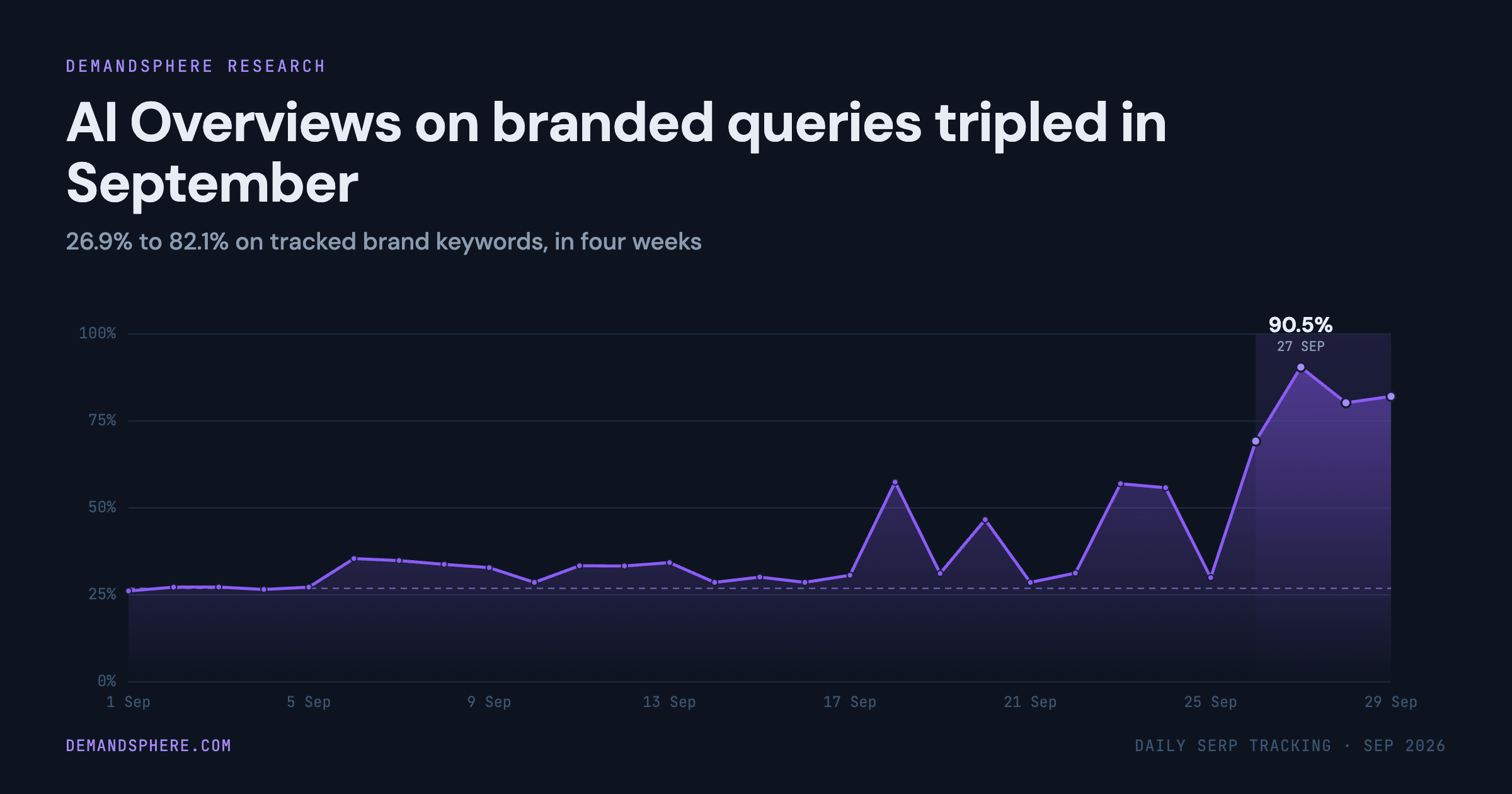
Google showed AI Overviews on 90.48% of DemandSphere's tracked branded keywords on September 27, up from 26.12% on September 1. The count records only whether a summary appears, so teams must check its wording and citations before reading anything into traffic.
The Engineer · Build desk
What happened
- Search Engine Land reported the same finding on October 1 and noted that Google had not publicly announced any change behind the increase.
- The share eased after the peak but stayed high, at 80.23% on September 28 and 82.06% on September 29.
- The branded set spans company, product and service names plus navigational searches, queries the source describes as often high-intent.
- An Overview can appear on a brand's query without citing the brand at all, or can answer it from third-party sources.
Compiled by The EngineerSomething wrong?How this is made
Why it matters
- constraint A position-one organic ranking for a brand's own page leaves the generated layer unmeasured on most of the panel's brand queries, so rank reports alone undercount what searchers are shown.
- exposure By the source's argument, third-party pages cited in an Overview can shape a high-intent brand search before the searcher reaches the company's own site.
- decision Any claim of lost traffic from this curve has to wait for a join against the brand's own click data, since the panel does not measure clicks, conversions or citations.
DemandSphere's counter is a yes-or-no check. For each tracked branded keyword, every day, across markets and devices, it records whether Google returned an AI-generated summary [4][5]. Whether that summary cites the brand being searched does not change the count [5]. An Overview that credits a competitor scores the same as one that links the brand's own help page [5].
Daily sampling across markets and devices is the right design for watching a feature spread, and the source credits the method for exactly that [15]. The curve it caught is steep. The share rose 64.36 percentage points in 26 days, about 3.5 times the September 1 level [17][18][21]. On September 1 roughly three in four tracked keywords returned no Overview. At the peak, fewer than one in ten did [19]. The fall on September 28 was 10.25 points in a single day [20].
That overnight swing is why I would not plan around the peak. The 90.48% describes DemandSphere's keyword set [2]. For it to describe a given brand, that brand's priority queries would have to resemble the panel in market, device and query mix. The source does not say how many keywords the panel holds or how they were chosen. In an internal panel I would split queries by type, so a rise in one group cannot hide inside the average.
The cause is unconfirmed. The source warns against reading the pattern as a specific ranking update, a new citation policy, or a change to every branded query [9].
The part a team can reuse is the observation. DemandSphere's method does not establish whether a company was named, linked, recommended or accurately described in an answer [8]. The source's checklist fills that gap with per-query records: whether an Overview appears for priority company, product and service queries, the wording used about the brand, the sources cited, and whether the company's own pages are among them, compared over time, markets and devices [11]. A rank tracker stores an organic position per keyword [12]. Most of these new fields are free text. The source says deciding whether a generated description is correct, or whether its cited sources raise a competitive concern, is an interpretive call that automated monitoring does not make [16].
What to watch
- A public explanation from Google for the September rise, or confirmation of a rollout on branded queries.
- DemandSphere's October readings: whether the share holds near the 80-82% of late September or falls back toward 26%.
- Brand-side data joining Overview observations to clicks, the first evidence on traffic that this panel cannot supply.
Clarity's read
What the record supports and how the coverage leans. The claims behind it follow.
Reality
- Evidence45
- Adoption60
- Hype gap+5
- Incentives65
- Confidence45
Claim ledger
Ranked by verification strength, evidence, and original report placement.
- [1]
DemandSphere recorded AI Overviews on 26.12% of tracked branded keywords on September 1, 2026.
- [2]
AI Overview appearances rose to a monthly high of 90.48% of DemandSphere's tracked branded keywords on September 27, 2026.
- [3]
After the peak the level eased but remained high, at 80.23% on September 28 and 82.06% on September 29.
- [4]
DemandSphere tracks branded keywords daily across markets and devices.
- [5]
DemandSphere counts an AI Overview whenever Google returns an AI-generated summary for a query, whether or not that summary cites the brand being searched.
- [6]
Search Engine Land reported the same finding on October 1, 2026, and noted that Google had not publicly announced a change behind the increase.
- [7]
The data confirms a shift in AI Overview visibility for branded terms, not a measured change in clicks, traffic, conversions, or citations.
- [8]
The methodology does not establish that a company was named, linked, recommended, or accurately characterized in the answer, nor whether a searcher clicked through; those questions require separate observation of actual results and, where possible, a brand's own search and traffic data.
- [9]
There is no confirmed explanation for the September pattern, and it should not be read as evidence of a specific ranking update, a new citation policy, or a universal change to every branded query.
- [10]
Branded queries are often high-intent and can include the company name, product names, service names, and navigational searches.
- [11]
The source recommends checking whether an AI Overview appears for priority company, product and service queries; recording the wording used to describe the brand; identifying cited sources and whether the company's own pages appear; comparing observations over time, markets and devices; and separating AI Overview presence from traffic and conversion performance.
- [12]
A first-position organic listing and an AI Overview are not interchangeable measurements: one describes an organic ranking, the other the presence of a generated result layer.
- [13]
A brand may appear in an AI Overview without being cited, or an Overview may answer a query using third-party sources.
- [14]
If an AI-generated answer occupies prominent space on branded results, the search experience may increasingly be shaped by the summary and its cited sources before a person reaches the brand's own site.
- [15]
DemandSphere's methodology makes the result useful for understanding SERP feature diffusion.
- [16]
Automated monitoring can collect recurring SERP observations, but the business decision is interpretive: whether a generated description is correct and whether cited sources create a competitive concern.
- [17]
The share of tracked branded keywords showing AI Overviews rose 64.36 percentage points between September 1 and September 27.
- [18]
The September 27 share was about 3.5 times the September 1 share.
- [19]
Tracked keywords with no AI Overview fell from 73.88% on September 1 to 9.52% on September 27.
- [20]
The share fell 10.25 percentage points from September 27 to September 28.
- [21]
The rise from 26.12% to 90.48% took 26 days.
Sources
1 independent publisher whose own reporting we read for this story.
- dev.toGoogle AI Overviews Expand Across Branded Queries, DemandSphere Data Shows
1 article · October 9, 2026
Topics and entities
Follow any of these and your For You feed starts watching them — no settings page required.
Topics
- AI SearchFollow
- Branded searchFollow
- Search Engine OptimizationFollow
Entities
- GoogleFollow
- AI OverviewsFollow
- DemandSphereFollow
- Search Engine LandFollow
- GEO Search LeadsFollow