Invest2 publishersIndependently confirmed3 min readPublished
Danaher builds an AI lab at Abcam to make hundreds of reagents a year instead of tens
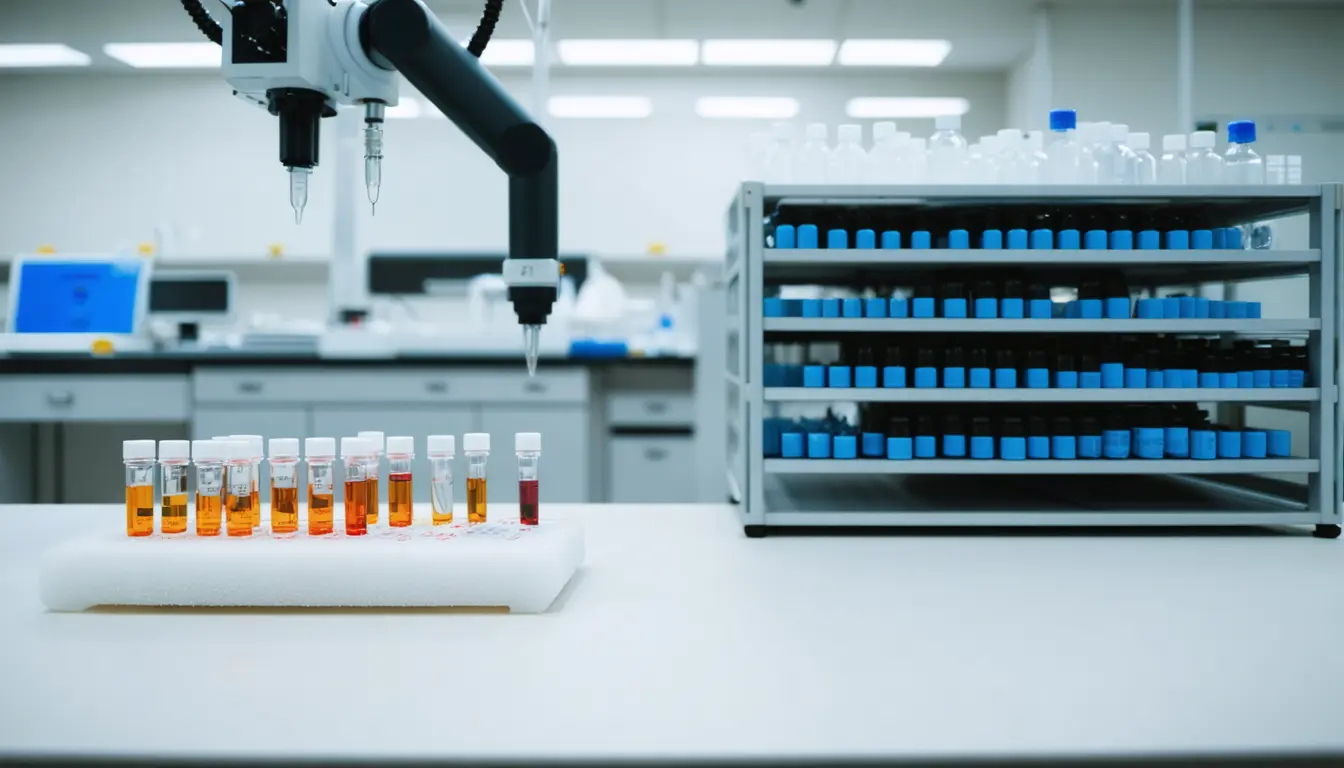
Danaher's first autonomous lab, at Abcam, is projected to lift yearly reagent output tenfold, from tens to hundreds, once at full capacity in early 2027. Danaher has disclosed no cost, so the reagent count it reports in 2027 is what the plan will be judged on.
The Investor · Invest desk
Drafted by a language model from the sources cited here and checked against its claim ledger before publication. How we use AISend a correction
What happened
- The lab combines AI and robotics with tools from Beckman Coulter Life Sciences, Cytiva, Genedata, Integrated DNA Technologies and Molecular Devices in one workflow.
- Automata, a company Danaher invested in during January 2026, developed the lab's device orchestration and robotic automation.
- Danaher projects its design, build, test and feedback loop will move a reagent from idea to validation up to eight times faster.
Compiled by The InvestorSomething wrong?How this is made
Why it matters
- contradiction CNA's version states the speed gain as a flat eight times, while Danaher's wording is up to eight, so the best case is already being repeated as the forecast.
- cost With no budget disclosed for the lab or the Automata investment, investors can judge the tenfold claim only on reagent counts, with no way to measure return per dollar spent.
- exposure A tens-to-hundreds target with an early 2027 date attached gives Danaher a public number it can miss, and the miss would be countable.
- precedent Whoever runs the next autonomous lab, Danaher or an outside research program, will show whether the instrument fleet is a product line or internal overhead.
Danaher put a qualifier on only one of its two projections. It projects progress from idea to validated reagent at "up to" eight times faster [5], and yearly output rising tenfold, from tens of reagents to hundreds [6]. Ten divided by eight leaves a factor of 1.25 [13]. A loop that ran eight times faster would on its own lift yearly output about eightfold, so the rest has to come from running more candidates at once. If the speed gain falls short of its ceiling, parallel capacity has to carry more of the tenfold figure. The version of the announcement published by CNA drops the qualifier and calls molecule discovery eight times faster [9].
Danaher's chief science officer put the weight on speed. "Speed is what supercharges that cycle. Every result sharpens the next design, so the faster each loop runs, the faster discovery compounds," JC Gutierrez-Ramos said [12]. He said scientists would keep making the key decisions while the platform handles repetitive experimental work [7]. "That frees them (scientists) to focus on the complex scientific challenges where human insight matters most," he said [10].
The loop produces research reagents. The model designs affinity reagents, antibodies among them, and each candidate is built and tested before the results go back into the model [4]. Coverage framed the lab as drug discovery [9]. By Danaher's description, what it makes is the custom antibodies and other molecular tools that scientists use in that work [1]. Hundreds a year is the output expected once the Abcam site reaches full operating capacity in early 2027 [2].
The announcement did not include a cost for the lab or the size of Danaher's January 2026 investment in Automata [11]. Without either, nobody can yet work out a price per added reagent. The better guide to where the money is meant to go (or rather, where Danaher says it wants it to go) is the plan around the lab. Danaher called it the first step toward a fleet of smart instruments that produce AI-ready data and include expert-level agentic systems, connected into integrated workflows and more autonomous labs [8]. This first site already runs tools from five operating companies in one workflow [3].
I think the lab is mainly a working demonstration for that instrument fleet, and the reagents are the evidence that the loop runs. Two other outcomes fit the evidence. The strongest case against my view is that the lab stays an in-house reagent line, and the further labs Danaher describes, running the same loop across research programs [8], are all its own. Or the early 2027 date [2] slips, leaving one site and a projection. If the next autonomous lab Danaher announces also sits inside one of its own companies, the demonstration view is wrong.
What to watch
- The reagent count Danaher reports once the Abcam lab reaches full operating capacity in early 2027, set against the hundreds a year projected.
- Any disclosure of the size or terms of Danaher's January 2026 investment in Automata, or a further deal between the two.
- Whether Beckman Coulter Life Sciences, Molecular Devices or the other operating companies begin selling the smart instruments as a packaged workflow.