InvestIndependently confirmed2 publishers3 min readPublished
CXMT sets a year-end date for 4F² server DRAM that Samsung targets for mass production in 2028
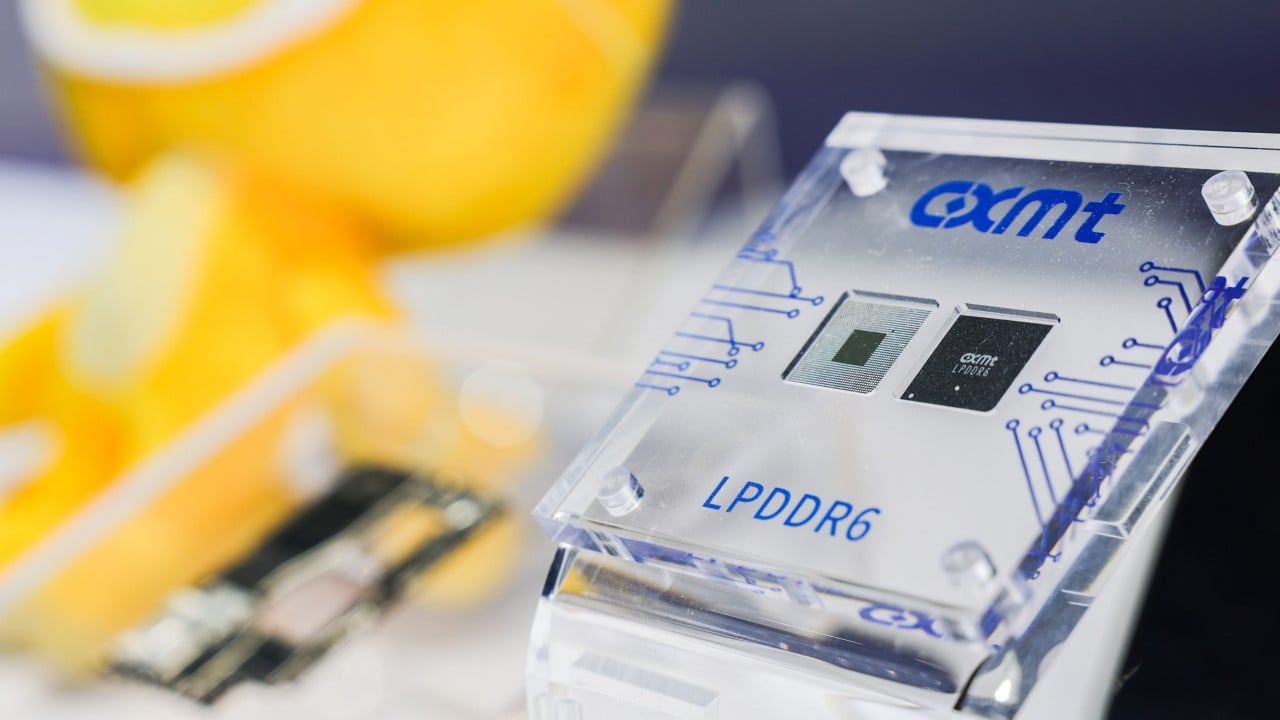
CXMT, China's largest DRAM maker, says it will launch a server DDR5 RDIMM built on a 4F² cell by year-end, a design that cuts cell area about 33%. On announced dates sedaily counts it two years ahead of Samsung, though a product launch and volume production are different milestones.
The Investor · Invest desk
Key figures: judging by announced timelines alone, CXMT would be about two years ahead of Samsung; the 4F² structure cuts cell area by about 33% versus 6F²; a 4F² cell occupies four square F, F being the minimum line width; mainstream commercial DRAM uses a 6F² cell.
| Figure | Value | Note | Claim |
|---|---|---|---|
| CXMT lead over Samsung | 2 years | about; announced timelines alone | 12 |
| Cell area cut, 4F² vs 6F² | 33% | about | 3 |
| 4F² cell area | 4 square F | 6 | |
| Mainstream DRAM cell area | 6 square F | 7 |
What happened
- Chao said CXMT has developed a vertical surrounding gate transistor to address long-standing problems such as current leakage, Securities Daily reported.
- SK hynix disclosed its own 4F² roadmap last year, and Samsung is pursuing 4F² for sub-10-nanometer DRAM with mass production targeted for 2028.
- CXMT chose server DRAM over LPDDR for its first 4F² product, and sedaily describes that as a direct challenge to South Korean chipmakers.
- South Korean industry officials told sedaily it is difficult to conclude CXMT has pulled ahead, citing limited application scope and uncertain mass production.
Why it matters
- contradiction Sedaily's timeline count puts CXMT two years ahead, while the Korean officials it quotes say the disclosed details cannot support a claim of being ahead at all.
- decision CXMT is spending its first 4F² product on the server part with the strictest reliability test, so LPDDR does not go first.
- exposure CXMT has put a year-end date on a claim its Korean rivals already doubt, so a thin or missing delivery would be visible within weeks.
A 4F² cell occupies four squares of the minimum line width F [6], and today's mainstream 6F² cell occupies six [7], so cell area falls by 1 - 4/6, or 33.3% [10], and that matches the 33% sedaily reports [3]. Run it the other way and the same cell area holds 6/4 = 1.5 times as many cells, or 50% more [11]. That is cell area alone; how much of a finished die is array decides what a whole chip gains.
The two-year lead depends on what the date means. Chao said CXMT would launch the module by year-end [2], and sedaily counts that as about two years ahead of Samsung on announced timelines alone [12]. The count is 2028 minus 2026 [16], and Samsung's 2028 is a mass-production target [4]. CXMT's is a product date: the first report says it will unveil a product [1], the second says it will roll one out [5], and neither puts a shipment volume on it. The date could therefore mean volume shipments by December, a showcase part with samples only, or a slip past year-end. We think the wording fits the middle case best. In that case the real gap to Samsung is under two years [16], and nobody outside CXMT can say by how much.
CXMT's own account of the server choice is that it is the hard option. "DDR5 RDIMM has to support servers running 24 hours a day and must avoid errors during high-speed data transmission, so the technical requirements are higher," a CXMT official said [9]. Taken at face value, the first 4F² product goes to the segment with the strictest reliability test, and LPDDR, the alternative sedaily names, does not go first [8]. That is the case for the volume reading, since we'd expect a company short of working silicon to show a more forgiving product first.
South Korean industry officials, unnamed in sedaily's report, do not concede the lead [13]. "Applying a new technology and securing a stable mass-production system are separate issues," one industry official said [14]. Another said: "Being a generation ahead in technology does not mean the actual memory performance is superior. What matters is the maturity of the technology and real performance gains, not the speed of development." [15]
Both accounts trace to CXMT's own statements: SCMP cites a company statement [5], and sedaily relays Securities Daily's report of Chao's conference remarks [17]. They differ on his title (chief executive in one, president in the other) and on the spelling of his surname (Chao and Cao). We'd take the 4F² claim as stated and the lead as unproven. A 4F² RDIMM passing a named server customer's qualification, with a stated yield, before year-end would prove the two-year gap real. A showcase part with no customer attached would leave the gap where the officials put it.
What to watch
- Whether CXMT shows the 4F² RDIMM before year-end with a process node, capacity or yield figure attached.
- Whether a named server customer qualifies the module, which would separate volume shipments from a showcase part.
- Any change to Samsung's 2028 mass-production target or a dated SK hynix 4F² product.
Clarity's read
What the record supports and how the coverage leans. The claims behind it follow.
Reality
- Evidence30
- Adoption
- Insufficient
- Hype gap+30
- Incentives
- Insufficient
- Confidence55
Claim ledger
Ranked by verification strength, evidence, and original report placement.
- [1]
ChangXin Memory Technologies, China's largest DRAM maker, said it has made meaningful progress developing the 4F² cell structure and promised to unveil a product using it before the end of this year.
ReportedSupportedSource: en.sedaily.com2 sources— create a free account to open themView cited source - [2]
Speaking at the fourth Integrated Circuit and Chiplet Conference in Shanghai on the 9th and 10th, Chao said CXMT would launch a DDR5 RDIMM for servers using the 4F² technology by year-end.
ReportedSupportedSource: en.sedaily.com2 sources— create a free account to open themView cited source - [3]
The 4F² structure can reduce cell area by about 33% compared with the 6F² structure that currently dominates the industry, allowing a chip of the same size to store more data.
ReportedSupportedSource: en.sedaily.com2 sources— create a free account to open themView cited source - [4]
SK hynix disclosed its 4F² roadmap last year, and Samsung Electronics is pursuing a plan to apply the structure to sub-10-nanometer DRAM and begin mass production, targeting 2028.
ReportedSupportedSource: en.sedaily.com2 sources— create a free account to open themView cited source - [5]
CXMT planned to roll out a new server-memory product based on the structure by the end of 2026, president Cao Kanyu said at an industrial event in Shanghai over the weekend, according to a company statement.
ReportedSupportedSource: SCMP, citing a CXMT company statement2 sources— create a free account to open themView cited source - [6]
In the 4F square design each memory cell occupies an area of four square F, with F representing the minimum line width of a semiconductor.
- [7]
Mainstream commercial DRAM currently uses a 6F square cell structure.
- [8]
CXMT's choice of server DRAM rather than low-power DRAM (LPDDR) as the first product to use the technology also signals a direct challenge to South Korean chipmakers.
- [9]
"DDR5 RDIMM has to support servers running 24 hours a day and must avoid errors during high-speed data transmission, so the technical requirements are higher," a CXMT official said.
- [10]
Moving from a 6F² to a 4F² cell cuts cell area by 33.3%.
- [11]
The same cell area holds 1.5 times as many 4F² cells as 6F² cells, 50% more.
- [12]
Judging by the announced timelines alone, CXMT would be about two years ahead of Samsung Electronics.
ReportedContestedSource: en.sedaily.com2 sources— create a free account to open themView cited source - [13]
Industry officials in South Korea said it is difficult to conclude that CXMT has pulled ahead on technology; the new technology's scope of application may be limited, and it is uncertain whether CXMT can succeed in large-scale mass production.
ReportedContestedSource: Unnamed South Korean industry officials, quoted by en.sedaily.comView cited source - [14]
"Applying a new technology and securing a stable mass-production system are separate issues," one industry official said.
ReportedContestedSource: An unnamed South Korean industry official, quoted by en.sedaily.comView cited source - [15]
Another official said: "Being a generation ahead in technology does not mean the actual memory performance is superior. What matters is the maturity of the technology and real performance gains, not the speed of development."
ReportedContestedSource: A second unnamed South Korean industry official, quoted by en.sedaily.comView cited source - [16]
Samsung's 2028 mass-production target is two years after CXMT's end-of-2026 product date.
- [17]
CXMT chief executive Chao Kanyu said the company developed a vertical surrounding gate (VSG) transistor that can address long-standing problems such as current leakage, according to a Securities Daily report on the 12th.
ReportedInsufficientSource: en.sedaily.com, citing Securities Daily, a Chinese state-run newspaperView cited source
Sources
2 independent publishers whose own reporting we read for this story.
- en.sedaily.comChina's CXMT Says Server DRAM With 4F² Design Due This Year
1 article · October 12, 2026
- scmp.comChina’s CXMT unveils ‘key progress’ on chip structure pursued by Samsung, SK Hynix
1 article · October 11, 2026
Topics and entities
Follow any of these and your For You feed starts watching them — no settings page required.