Product1 publisher3 min readPublished
RealMan wants 1,000 robots in pharmacies and power rooms next year, and a failure count to match
The Beijing firm is treating 2026 deployment as its data pipeline. That also converts its reliability claims into arithmetic anyone can check.
The Product Desk · Product desk
Drafted by a language model from the sources cited here and checked against its claim ledger before publication. How we use AISend a correction
What happened
- China-based RealMan Robotics, a Beijing-based firm, plans to deploy nearly 1,000 RealBOT robots across real-world environments in 2026 through its GLN network, using the resulting data to improve the robots' ability to perform tasks across different environments.
- RealMan unveiled its GLN real-world deployment initiative at the 2026 World Robot Conference (WRC) in Beijing.
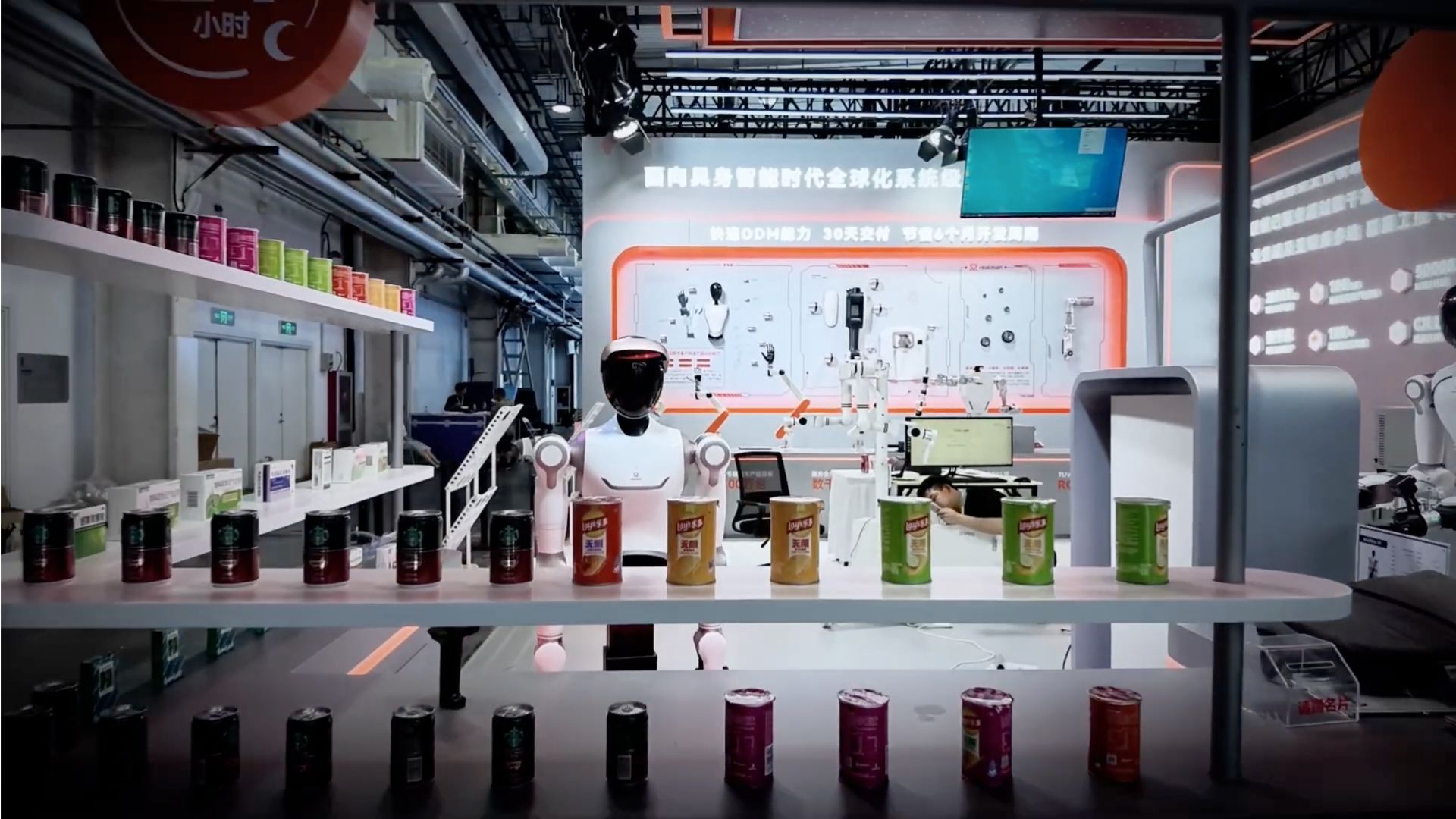
- At WRC 2026, RealMan demonstrated RealBOT robots performing medicine retrieval and restocking at a smart pharmacy, inspections in a power distribution room, pastry-making alongside human chefs, and remote operation at the company's embodied-intelligence factory in Changzhou.
- RealMan's Global Link Network (GLN) allows human operators to control robots remotely, with the company claiming millisecond-level latency even across thousands of miles.
- Remote operations generate real-world interaction data; each task provides information about perception, manipulation and decision-making in physical environments, creating a feedback loop through which robots improve their handling of different tasks and conditions.
Compiled by The Product DeskSomething wrong?How this is made
Why it matters
RealMan Robotics said at the 2026 World Robot Conference in Beijing that it plans to put nearly 1,000 RealBOT robots into real workplaces during 2026, and to use the data those robots generate to improve how they handle tasks across different environments [1][2]. That framing matters because it moves the company off the demo-reel standard and onto an operational one: once a thousand machines are dispensing medicine and walking power rooms, the interesting number stops being what the robot can do once and becomes how often it stops.
The showcased tasks were medicine retrieval and restocking in a smart pharmacy, inspection in a power distribution room, pastry-making alongside human chefs, and remote operation at the company's embodied-intelligence factory in Changzhou [3]. Underneath sits what RealMan calls the Global Link Network, a remote-operation layer that lets human operators drive the robots at distance, with the company claiming millisecond-level latency across thousands of miles [4]. The stated logic is a loop: every remotely operated task yields interaction data about perception, manipulation and decision-making in physical settings, which feeds back into capability [5]. In other words, the teleoperator is not a fallback. The teleoperator is the labelling function.
That is a coherent strategy, and it is also the point at which the reliability claims become testable. RealMan says its lightweight humanoid arms have reached a mean time between failures of 50,000 hours [7], and it collected CR L3 certification from the Shanghai Robot Industry Technology Research Institute at the same conference [6]. Fifty thousand hours is roughly 5.7 years of continuous running [10], which sounds like the end of the argument until you multiply by fleet size. A thousand robots running continuously for a year is about 8.76 million robot-hours, and at a 50,000-hour MTBF that implies on the order of 175 hardware failures a year [11]. Fleets do not run continuously and the MTBF figure is quoted for arms rather than whole robots [7], so treat that as an order of magnitude rather than a forecast. It is still the shape of the number an operator running a pharmacy shift needs to plan against.
The sensing work points the same direction. RealMan is pairing its RM75 seven-degree-of-freedom arm with tactile-sensing specialist PaXini, adding multidimensional force and tactile sensing, a six-axis force sensor and joint torque sensors [8]. Contact-force awareness is what separates restocking a pharmacy shelf from knocking it over, and it is the kind of upgrade that shows up in incident rates rather than in a video.
For comparison on the auditable-claim front, the same report notes that Figure AI completed a 200-hour autonomous livestream in May, with Figure 03 robots processing nearly 250,000 packages and no hardware failures [9] - close to 1,250 packages an hour [12]. That is a bounded, single-task, single-site number, and it is still more legible than most robotics marketing, because it names a duration, a throughput and a failure count.
What to watch: whether RealMan reports the deployment as a census with hours and interventions attached, or only as a headline count of robots shipped. Also watch how much of the work stays teleoperated. A fleet whose data flywheel depends on remote human drivers is a labour arrangement as much as an autonomy programme [5], and the ratio of operators to robots is the metric that will tell you which one it is.