Product1 distinct publisher3 min readPublished
China has put an electromagnetic catapult on an amphibious hull, which narrows the air wing to aircraft that cannot take off vertically. The GJ-21 is the candidate. Its public record is thin.
The Product Desk · Product desk

Compiled by The Product DeskSomething wrong?How this is made
A catapult is a commitment to an airframe. It fixes the launch weight bracket and the deck cycle for whatever it throws, and it goes into the ship years before the aircraft show up in squadron numbers. Vessels that look like this one usually dodge the commitment by operating helicopters and short-takeoff types such as the F-35B, which need deck space but no launch system [4]. Fitting the catapult means the payload is now something that cannot get airborne any other way, which is the reason the label "drone carrier" is being reached for at all [5].
The public record behind that specification is not deep. The GJ-21 is the naval variant of the GJ-11 stealth attack drone, shown to the public at China's Victory Day parade in September last year [7]. Counting from that parade to this month's roadside videos gives a gap of about eleven months [15]. Between those two points, what outsiders have is footage and inference.
Meanwhile the hull's original job list has not gone away. The Type 076 is still expected to carry troops, landing craft, armored vehicles and helicopters for an amphibious landing [11]. That is one ship with two customers, and deck area does not multiply to suit them. The landing force wants cycles for putting people ashore; the drone element wants the same deck for launch and recovery. That argument gets settled before the ship ever sails, in the general arrangement drawing.
The Qingdao satellite pass released on August 27 is the more interesting piece of evidence, because it shows how the navy is currently handling the ship. Sichuan appeared with two Type 052 destroyers and three Type 054 frigates, six ships in all, off the headquarters base of the PLA Northern Theatre Command navy, with the carrier Liaoning moored nearby [9][10]. Five escorts around one amphibious hull [14] suggests a vessel the navy intends to fight from, though the report stops short of calling that certain. Interesting Engineering's report calls the task-group reading speculation, and it is [12]. It is at least consistent with the division of labour the piece sketches, where a conventional carrier supplies fighters and a ship like Sichuan supplies drones, helicopters and the landing force [13].
For anyone deciding whether to build infrastructure ahead of a payload, the grid has two tests: whether the intended consumer strictly requires the mechanism or can fall back to something cheaper, and whether that consumer is fielded today or promised. If the mechanism is required and the consumer is already fielded, the build is justified. If the consumer is fielded but the mechanism was never required, the money went toward symmetry rather than need. The Sichuan's case is the third combination: the mechanism is required, but the consumer is only promised, which is where it sits on the evidence available, and that arrangement converts somebody else's schedule into your dependency. The fourth combination, where the mechanism is neither required nor promised, is decoration.
The tradeoff, plainly: the catapult buys range and payload no vertical-takeoff aircraft will hand you, and it removes the fallback in the same stroke. If the GJ-21 turns up in numbers, the ship is the only one of its kind afloat. If it is late, the hull still moves troops, and there is a launch system on the deck waiting for its one customer.
Ranked by verification strength, evidence, and original report placement.
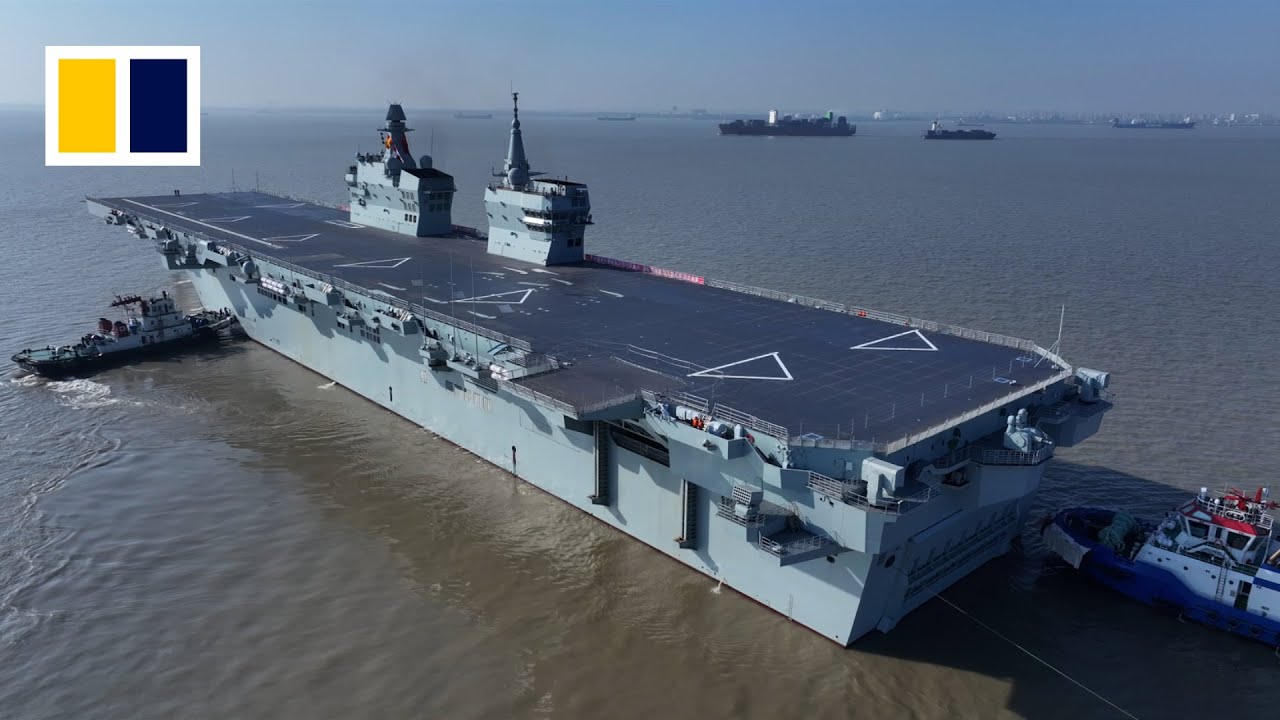
China's new Type 076 amphibious assault ship, named Sichuan, has entered its final sea trials, according to Chinese media reports relayed by Interesting Engineering.
The Sichuan displaces around 40,000 tonnes and in size sits roughly between a traditional amphibious assault ship and a small aircraft carrier.
The GJ-21 is the naval variant of China's GJ-11 stealth attack drone and was first unveiled during China's Victory Day parade in September last year.
New GJ-21 sightings showed it flying over a highway service center in Huludao, Liaoning province; another sighting on August 19 was at the same service center, and a third video released on Thursday August 27 showed the drone in the same location from a different angle.
Satellite imagery released on August 27 showed the Sichuan alongside two Type 052 destroyers and three Type 054 frigates.
All six ships in the imagery appear to have been off Qingdao naval base, headquarters of the PLA Northern Theatre Command navy, and the image also appears to show China's first aircraft carrier, the Liaoning, moored nearby.
Distinct publishers with included, body-backed reporting in this cluster.
Follow any of these and your For You feed starts watching them — no settings page required.
product
A 20-micron Hall sensor moves magnetic anomaly detection onto the component list1 distinct publisher
product
Sixty days to un-design a carrier: the order to put steam catapults back on the Doris Miller1 distinct publisher
product
US grid storage nears 52GW, and arbitrage is now writing the evening price curve1 distinct publisher
product
MIT's magnet trick makes correlated microwave signals without the cryostat1 distinct publisher
Evidence-backed comparisons of source perspectives and observed adoption signals. Read the methodology
Which Builder, Operator, and Investor concerns the observed source mix emphasized—not a truth score.
Evidence, demonstrated adoption, hype gap, incentives, and confidence are assessed independently, each on its own current evidence. How these are measured.
One relay, three hedges
Follow any detail here and it stops at the same door: Interesting Engineering summarising unnamed Chinese media plus the South China Morning Post. The catapult, which is the entire reason the story exists, is 'alleged' in the report's own word; no provider is named for the August 27 satellite image; and no PLA, US Navy or outside analyst voice appears anywhere. Tonnage, ship classes and the GJ-11 parentage are stable and easily re-reported details. Design intent is not, and it is doing the heaviest lifting.
Hull afloat, air wing unflown
A ship in final trials is real, and a drone circling a Huludao rest stop is real flying. Nothing in this reporting joins them: no launch, no recovery, no aircraft on the Sichuan's deck, not even a photograph of one parked there. What has actually been seen is six hulls in one satellite frame and three videos of one airframe over one stretch of highway — early-programme activity, scored as such.
The headline outruns the caveats
'Drone carrier' does more work in the headline than the body can pay for — the body says 'alleged', 'if true', 'just speculation', 'we cannot be sure'. Credit where it is due: the piece flags its own conditionals, which keeps the gap moderate rather than wide. The risk is what survives retelling. Tonnage and escort counts and a claim about what the hull was designed for all get quoted with the same confidence, and only two of those three were ever observed.
No provenance, no motive reading
We cannot score this honestly. Who released the August 27 satellite image, who filmed the same drone over the same service centre three times, and what Chinese outlets are permitted to publish about a warship in trials are all questions this reporting leaves alone. Sightings that arrive in clusters invite motive-reading, and that is precisely why we decline to supply one without named provenance.
Enough to watch, not to conclude
Two things here are solid: a large amphibious hull is in trials, and a naval derivative of the GJ-11 exists and flies. Everything that makes the story interesting — the catapult, and the pairing of hull and airframe — rests on one relay and a satellite frame no one has publicly re-examined. Treat it as a marker for the next trial cycle rather than a settled configuration.