ZBT router firmware ships two factory implants that beacon out on UDP/10000
SPEAKINGSTONE and DARKLANTERN both hand unauthenticated attackers root on ZBT-built hardware, and because neither advisory names a fixed firmware release, the remedy for an affected model is replacing it.
The Watch · Security desk
What happened
- VulnCheck assigned CVE-2026-74232 and CVE-2026-74233 to two factory implants in ZBT router firmware, rating each 9.3 on CVSS 4.0 and 9.8 on CVSS 3.1 with no privileges and no user interaction required.
- SPEAKINGSTONE runs as the service yunmgrd and beacons outward over UDP port 10000 to a hardcoded controller, so it works from behind NAT and ordinary egress filtering.
- DARKLANTERN listens as infosrvd on UDP port 9992, which the stock firewall opens to any internet address, and its authentication falls to a hardcoded salt and an all-zero wildcard MAC.
- VulnCheck found 203 internet-facing DARKLANTERN instances across 22 countries between August 18 and August 21, a count of hosts that answered a probe rather than of confirmed compromises.
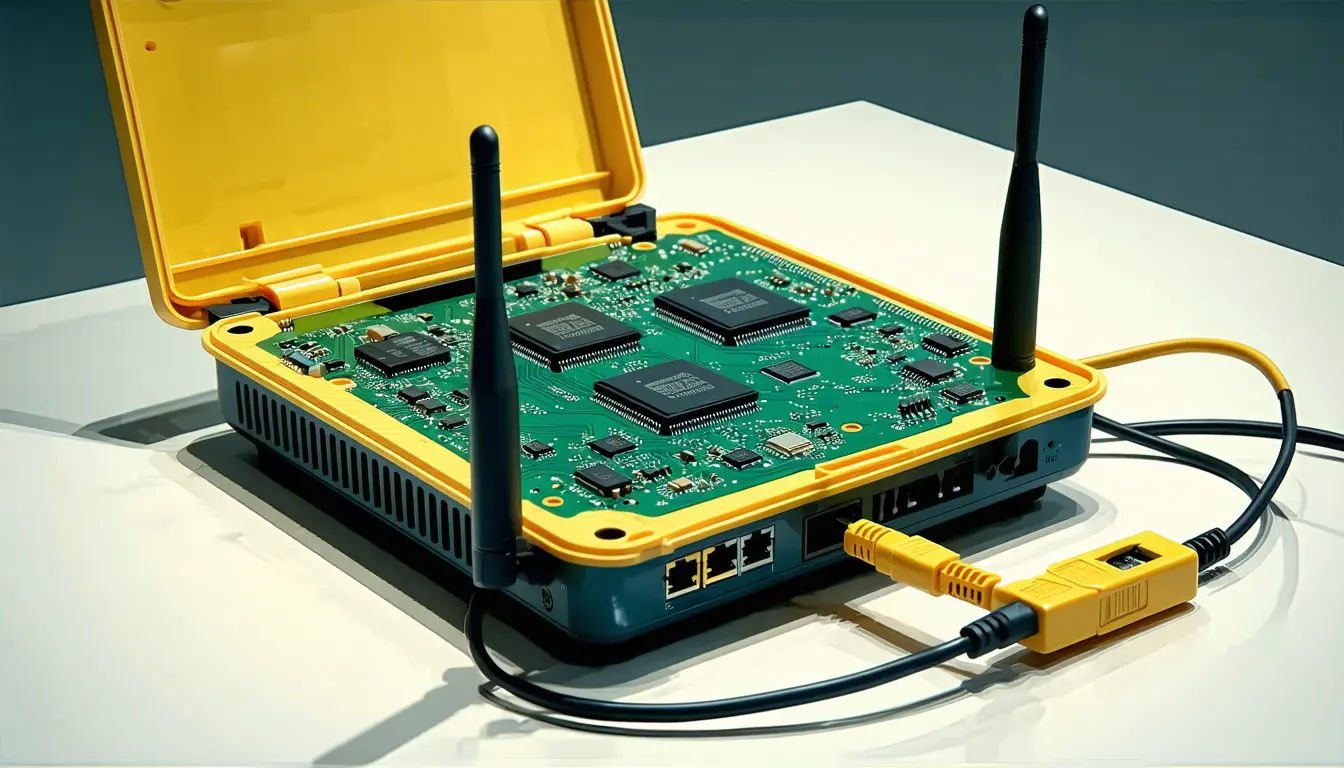
- Both implants were present on an $88 Deep Orange LTE router bought from a US supplier, a white-labeled ZBT-WE826-T2 whose firmware was built in 2019.
Why it matters
- Who has to decide decision Owners of the listed models have two options since patching is not available: keep running hardware with documented root access for an outside party, or replace the unit.
- What it limits constraint The perimeter controls most networks lean on for cheap CPE do not contain an implant that initiates its own sessions, which pushes detection onto flow records and DNS logs.
- What it costs cost At $88 a unit the replacement is a line item; the expense is the inventory work of finding which installed devices are ZBT builds sold under somebody else's brand.
- What it sets up precedent Three implants surfacing in one vendor's firmware within a single month mean buyers now need to treat ZBT's build pipeline as suspect, not just the individual models.
VulnCheck's own sinkhole produced the sharpest number in the disclosure and also the least representative one. SPEAKINGSTONE carries a hardcoded backup C2 domain that it reaches only where a primary server was never configured; the domain was unregistered, so VulnCheck registered it, stood up a reverse-engineered implementation of the protocol, and beacons began arriving as soon as the server was live [14]. By August 21, 392 unique devices had checked in, 390 of them in China [15], which leaves two outside it [20]. Of those, 363 self-reported the model L3_V2_8 on firmware 3.0.0.4.528 [16], or 92.6 percent of the sample [19]; 304 broadcast SSIDs beginning "CMCC" [16]; 83 percent sat on China Mobile's network [16], roughly 325 hosts [21]. Only units that were never given a primary C2 ever dial the backup, so the 392 is a floor drawn from an unrepresentative subset [17].
The version data is what turns this into a procurement decision. The advisory pages present affected builds as upper bounds, the CVE records name each firmware as a single exact build and set every other version's status to unknown, and no fixed release is named in either advisory [11]. An owner running a build outside the listed set has no published basis for deciding whether the implant is there.
Several entries in both CVE records sit under an unidentified vendor [18], so the published model lists are not the full set of names this firmware ships under. The Hacker News checked the IEEE-registered MAC prefix database on August 28 and found the blocks 78:A3:51 and F8:5E:3C both assigned to Shenzhen Zhibotong Electronics [13], and ZBT sells the same hardware and firmware to resellers that put their own name on the case [12]. The MAC address a device broadcasts identifies who built it more reliably than the brand printed on the case.
ENDLESSDOORS, the phone-home implant VulnCheck disclosed on August 5 in at least 20 Zbtlink models, is tracked as CVE-2026-66747 [10]. SPEAKINGSTONE's supported message types matter more than its CVSS rating: arbitrary command execution as root, exfiltration of the WAN PPPoE username and password, read and write access to a DNS hijack list, and a reverse SSH tunnel [6]. VulnCheck describes it as "a surveillance implant with root access to every device it runs on" [2]. The PPPoE credentials and the DNS list are the subscriber-facing attack; the tunnel is how an operator reaches whatever sits behind the router.
What to watch
- A fixed firmware build from ZBT or any of its resellers, since neither VulnCheck advisory names one.
- Whether third-party scanning of UDP/9992 converts the 203 DARKLANTERN probe responses into confirmed compromises.
- Further implants in ZBT builds beyond ENDLESSDOORS, SPEAKINGSTONE and DARKLANTERN, and whether the same services turn up in other ODMs' firmware.
Clarity's read
What the record supports and how the coverage leans. The claims behind it follow.
Reality
- Evidence64
- Adoption38
- Hype gap+12
- Incentives72
- Confidence62
Claim ledger
Ranked by verification strength, evidence, and original report placement.
- [1]
VulnCheck disclosed two previously undocumented factory implants in firmware for routers built by Shenzhen Zhibotong Electronics (ZBT), each giving an unauthenticated remote attacker root command execution on affected devices.
- [2]
VulnCheck said in its supply chain research: "This is a surveillance implant with root access to every device it runs on."
- [3]
The implants were named SPEAKINGSTONE and DARKLANTERN by VulnCheck's zero-day research team and are tracked as CVE-2026-74232 and CVE-2026-74233 respectively.
- [4]
VulnCheck, acting as CVE Numbering Authority, assigned both identifiers and rated each 9.3 on CVSS 4.0 and 9.8 on CVSS 3.1, with vectors recording a network attack requiring no privileges and no user interaction.
- [5]
SPEAKINGSTONE runs as the service yunmgrd and sends beacons over UDP port 10000 to a hardcoded command-and-control server; because it dials outward it functions from behind NAT and ordinary egress filtering.
- [6]
SPEAKINGSTONE's protocol supports message types that execute arbitrary commands as root, exfiltrate the WAN PPPoE username and password, write and read a DNS hijack list, and open a reverse SSH tunnel.
- [7]
DARKLANTERN operates as the service infosrvd on UDP port 9992, which the router's stock firewall opens to inbound connections from any internet address, and VulnCheck's advisory describes its authentication as ineffective, resting on a hardcoded salt and an all-zero wildcard MAC value that bypasses its own address check.
- [8]
Between August 18 and August 21, VulnCheck identified 203 internet-facing DARKLANTERN instances across 22 countries, self-reporting 16 distinct models; the figure counts hosts that answered a probe rather than devices found compromised.
- [9]
Both implants were found on an $88 Deep Orange 3G/4G/LTE Router bought from a U.S. supplier, a white-labeled ZBT-WE826-T2 whose firmware was built in 2019.
- [10]
ENDLESSDOORS (CVE-2026-66747) is a phone-home implant VulnCheck disclosed on August 5 and found in at least 20 Zbtlink router models; the 2019-build Deep Orange unit predates it.
- [11]
The advisory pages display affected firmware builds as upper bounds while the CVE records name each firmware as a single exact build and set the default status of every other version to unknown; neither advisory names a fixed firmware release, leaving an owner on a build outside the listed set without a published basis for deciding whether the flaw applies.
- [12]
Model number rather than brand is the reliable check because ZBT sells the same hardware and firmware to resellers that put their own name on the case.
- [13]
The Hacker News confirmed via the IEEE-registered MAC prefix database on August 28 that the blocks 78:A3:51 and F8:5E:3C are both assigned to Shenzhen Zhibotong Electronics.
- [14]
SPEAKINGSTONE carries a hardcoded backup C2 domain reached only where a primary server was never configured; VulnCheck found the domain unregistered, registered it, stood up a server running a reverse-engineered implementation of the protocol, and beacons began arriving as soon as the server was live.
- [15]
As of August 21, 392 unique devices had reported in to VulnCheck's server, of which 390 were in China.
- [16]
VulnCheck said 83 percent of the reporting devices were on China Mobile's network, that 304 of the 392 broadcast SSIDs beginning with "CMCC", and that 363 self-reported a single model, L3_V2_8, running firmware 3.0.0.4.528.
- [17]
Because a device reaches the backup domain only where a primary C2 was never configured, the 392 is a floor drawn from an unrepresentative subset rather than a count of affected devices.
- [18]
Several models and firmware builds in both CVE records are listed under an unidentified vendor, including CTN720-W1, LF-1541, MT7620N, WRC1, MoreQuick models, AP522, AP7628, HC5661A, APG721B, HK300 and MAP-N10.
- [19]
The 363 devices self-reporting model L3_V2_8 are 92.6 percent of the 392 that beaconed to VulnCheck's server.
- [20]
Two of the 392 devices that beaconed in were outside China.
- [21]
83 percent of 392 reporting devices is about 325 hosts on China Mobile's network.
- [22]
Three distinct factory implants in ZBT-built firmware were documented publicly within August 2026: ENDLESSDOORS on August 5, plus SPEAKINGSTONE and DARKLANTERN, whose scanning and telemetry run August 18 to August 21.
Get this ledger inside ChatGPT. Ask about any of our stories and the answer brings its figure, each claim’s verdict and the sources. Free, no account.
Sources
1 independent publisher whose own reporting we read for this story.
- thehackernews.comChina-Made ZBT Routers Ship With Two Implants Giving Unauthenticated Attackers Root Access
2 articles · August 28, 2026
Topics and entities
Follow any of these and your For You feed starts watching them — no settings page required.
Topics
- White-Label OEM RebrandingFollow
- Vulnerability Disclosure and CVE GovernanceFollow
- Router Firmware ImplantsFollow
- Hardware Supply Chain SecurityFollow
- Internet Exposure MeasurementFollow
Entities
- SPEAKINGSTONEFollow
- Shenzhen Zhibotong ElectronicsFollow
- DARKLANTERNFollow
- The Hacker NewsFollow
- ENDLESSDOORSFollow
- CVSSFollow
- CVE-2026-74232Follow
- CVE-2026-74233Follow
- ZBT WE826-T2Follow
- CISAFollow
- China MobileFollow
- VulnCheckFollow
- CVE-2026-66747Follow