InvestIndependently confirmed2 publishers3 min readPublished
China and the EU keep the terms of their hybrid car understanding private
China and the EU reached an 'understanding' on hybrid vehicle trade at talks in Beijing but did not disclose its terms. Exporters and European suppliers now have a WTO-consistent label to plan around, and no cap or price floor they can put in a forecast.
The Investor · Invest desk
What happened
- Beijing said the two sides reached agreement on 16 trade issues during the Beijing talks.
- China signaled a green channel to speed export licence reviews for rare earths and permanent magnets bound for the EU.
- Ministers plan a video conference in January and a regular meeting in March.
Compiled by The InvestorSomething wrong?How this is made
Why it matters
- constraint Carmakers and parts suppliers selling into Europe cannot put hybrid volumes or prices from this deal into a forecast until the terms are published.
- contradiction The EU sought a cap while the agreed text adopts the WTO-consistency test Beijing used against one, so until terms appear each side can present the outcome as its own.
- exposure Chinese battery-electric exporters stay on the current EU duty rate until a minimum-price deal closes; the hybrid understanding left that case open.
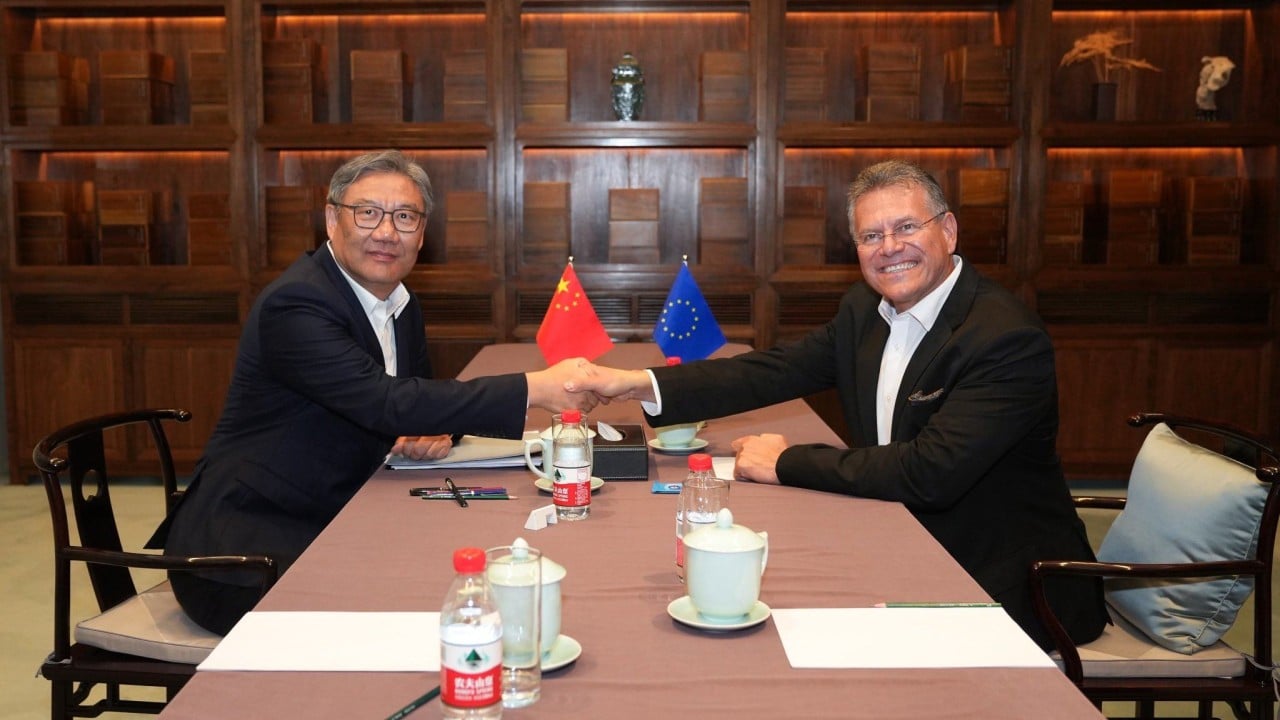
The only public description of the hybrid outcome from the second China-EU economic and trade dialogue [4] is that the two sides reached it in a manner consistent with WTO rules [1]. Beijing had used that same argument against the EU's earlier request for a voluntary cap on hybrid exports. It said such a step could conflict with WTO rules, the Seoul Economic Daily reported [5]. Maros Sefcovic had been pressing for a cap because shipments to Europe had surged in recent months, the South China Morning Post reported [6].
The wording leaves three readings open. The understanding could be a price floor. The two sides are still negotiating minimum-price deals for battery cars that would let Chinese EVs into the EU at a lower duty rate [8]. It could be a volume arrangement under another name. Or it could be a monitoring promise that leaves shipments where they are. I think the price floor is likeliest, because price-undertaking talks tied to the EU's anti-subsidy case on Chinese-made EVs are already running [7] and both sides know the format. The case against that view is the surge itself. A commissioner who came to Beijing for a cap [6] needs something that slows hybrid shipments, and a floor set at a level Beijing accepts may not do that.
Each form puts different numbers into a carmaker's plan. A floor raises revenue per car and trims units. A cap fixes units and leaves price to the market. A monitoring promise changes neither until someone tests it. The two sides did not disclose the specific terms or mechanism [2], and the South China Morning Post found little detail on the kind of deal struck [3]. That leaves open whether the understanding takes new duties on hybrids off the table at all. If the published terms set a number of cars, the price-floor view above is wrong.
Beijing said the talks produced agreement on 16 trade issues [11]. The items with a working procedure attached are in the supply chain. China signaled it would smooth licence reviews for rare earths and permanent magnets bound for the EU through a "green channel" [9], and the commerce ministry said Beijing is "willing to continue" fast-tracking rare earth licences [10]. The EU said it would work with member states to help resolve licensing issues for dual-use items exported to China [12]. China's side of that exchange is a named procedure; the EU's is a promise to coordinate with its own member states. Possible tariff cuts on certain products remain under discussion within WTO rules [15].
Ministers will hold a video conference in January and a regular meeting in March [13]. Until then, the text exporters have is the joint statement's line that the two sides "will manage trade frictions in accordance with WTO rules" [14].
What to watch
- Whether the January ministerial video conference or the March meeting puts the hybrid terms on the record.
- The price-undertaking talks in the EU's anti-subsidy case on Chinese EVs, where a minimum-price deal would lower the duty rate for battery cars.
- Chinese hybrid shipments to Europe in the months after the understanding, which would show whether it restrains volumes at all.
Clarity's read
What the record supports and how the coverage leans. The claims behind it follow.
Reality
- Evidence50
- Adoption
- Insufficient
- Hype gap+15
- Incentives45
- Confidence55
Claim ledger
Ranked by verification strength, evidence, and original report placement.
- [1]
China and the EU reached an agreement in principle on hybrid vehicle trade; the two sides said intensive negotiations had produced an "understanding" on hybrid vehicle trade in a manner consistent with WTO rules.
ReportedSupportedSource: Joint statement as reported by Seoul Economic Daily citing CCTV2 sources— create a free account to open themView cited source - [2]
China and the EU did not disclose the specific terms or mechanism agreed upon for hybrid vehicle trade.
ReportedSupportedSource: Seoul Economic Daily2 sources— create a free account to open themView cited source - [3]
China's commerce ministry said the EU and China "reached an understanding" on trade in hybrid electric vehicles during marathon negotiations in Beijing on Friday; little detail was provided on what sort of deal was reached on hybrid cars.
ReportedSupportedSource: South China Morning Post, citing China's commerce ministry statement2 sources— create a free account to open themView cited source - [4]
Chinese Commerce Minister Wang Wentao and EU Trade and Economic Security Commissioner Maros Sefcovic held the second China-EU economic and trade dialogue in Beijing over two days and issued a joint statement, CCTV reported.
ReportedSupportedSource: Seoul Economic Daily citing CCTV2 sources— create a free account to open themView cited source - [5]
The EU had earlier asked China to voluntarily restrict hybrid vehicle exports, but Beijing objected, saying such a step could conflict with WTO rules.
ReportedSupportedSource: Seoul Economic Daily2 sources— create a free account to open themView cited source - [6]
EU trade chief Maros Sefcovic, who met Chinese Commerce Minister Wang Wentao and Vice-Premier He Lifeng, had been pressing Beijing to cap exports of hybrid vehicles, as shipments to Europe had surged in recent months.
ReportedSupportedSource: South China Morning Post2 sources— create a free account to open themView cited source - [7]
China and the EU agreed to continue price undertaking talks and a review process tied to the EU's anti-subsidy investigation into Chinese-made electric vehicles.
ReportedSupportedSource: Seoul Economic Daily2 sources— create a free account to open themView cited source - [8]
The sides will continue negotiations on reducing tariffs and creating minimum price deals that would allow Chinese electric vehicles to enter the EU market at a lower duty rate.
ReportedSupportedSource: South China Morning Post, citing China's commerce ministry statement2 sources— create a free account to open themView cited source - [9]
China signaled it would smooth the review of export licences for rare earths and permanent magnets bound for the EU through a "green channel" mechanism.
ReportedSupportedSource: Seoul Economic Daily2 sources— create a free account to open themView cited source - [10]
Beijing is "willing to continue" fast-tracking licenses for rare earth mineral exports to Europe, according to China's commerce ministry statement.
ReportedSupportedSource: South China Morning Post, citing China's commerce ministry statement2 sources— create a free account to open themView cited source - [11]
Beijing said the two sides had reached an agreement on 16 trade issues during the talks.
- [12]
The EU said it would work with member states to help resolve licensing issues for dual-use items exported to China.
- [13]
China and the EU will hold a ministerial video conference in January and a regular meeting in March.
- [14]
In the joint statement, the EU and China said they "reaffirm that each is a key trading partner, and will manage trade frictions in accordance with WTO rules while developing economic and trade relations in a more stable and balanced manner."
ReportedSupportedSource: China-EU joint statement, as reported by Seoul Economic DailyView cited source - [15]
China and the EU will continue discussing possible tariff reductions on certain products within the framework of World Trade Organization rules.
Sources
2 independent publishers whose own reporting we read for this story.
- en.sedaily.comChina, EU Reach Understanding on Hybrid Car Trade
1 article · October 9, 2026
- scmp.comChina and EU reach ‘understanding’ on hybrid vehicles after crunch trade talks
1 article · October 9, 2026
Topics and entities
Follow any of these and your For You feed starts watching them — no settings page required.
Entities
- Maroš ŠefčovičFollow
- China's Ministry of CommerceFollow
- World Trade OrganizationFollow
- He LifengFollow
- China Central TelevisionFollow
- European UnionFollow
- Wang WentaoFollow