Science1 publisher3 min readPublished
Webb occultation shows Chariklo's two rings changing in opposite directions
Pablo Santos-Sanz's team used the James Webb Space Telescope to find Chariklo's inner ring 42% more opaque and its outer ring barely visible. Occultations are rare, so for now the team can show that the rings changed but not why, or how long they will last.
The Scientist · Science desk
What happened
- Observers on Earth found Chariklo's rings in 2013, making it the first solar system body besides the four giant planets known to have rings.
- Webb's October 2022 observation was the telescope's first stellar occultation, found after months of searching and predicted only a month in advance.
- The discovery team has no definitive explanation for why one ring thickened while the other thinned.
- The results were published in Science Advances on 9 September.
Compiled by The ScientistSomething wrong?How this is made
Why it matters
- constraint Webb's position cannot be forecast more than a few months out, so any repeat from space can only be planned at short notice, limiting how regularly the telescope can check the rings.
- contradiction The discovery team treats the opposing changes as unexplained, while Salo argues Chariklo's irregular gravity makes nearby orbits unstable enough that such changes are unsurprising.
- capability Webb now offers a space-based way to probe rings around small bodies that are too faint to observe directly, adding to the rare alignments available from the ground.
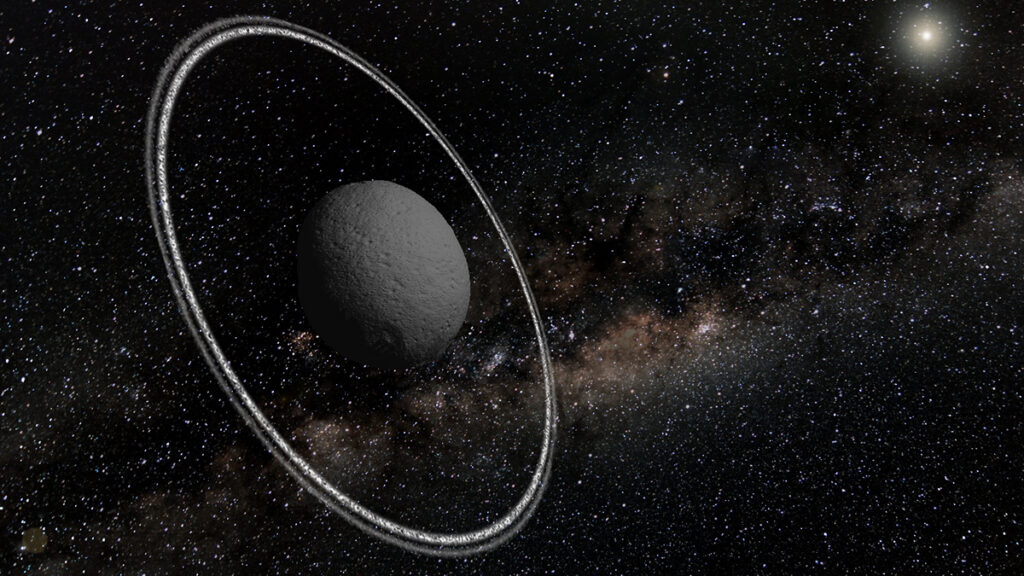
An occultation records one quantity: how much of a background star's light a ring blocks as it passes in front. For Chariklo that is the main way to see the rings at all, because they are too faint to observe directly and good alignments are rare [6]. The 2013 detection worked that way. The star dimmed twice before the asteroid covered it and twice after [4]. Later observations showed two thin, sharply defined rings only 14 kilometres apart, possibly containing water ice, around a body 302 kilometres across that is not very spherical [5][3].
Taking the measurement to Webb meant predicting three uncertain positions at once: the telescope's, Chariklo's, and that of a star drawn from the Gaia mission's catalogue [7]. "At the beginning I felt like a crazy guy proposing this," said Santos-Sanz, an astrophysicist at the Instituto de Astrofisica de Andalucia in Granada [9][18]. When he saw the results, he asked himself, "Oh, what has happened here?" [19]
The finding compares one Webb event with earlier observations. "The opacity of the outer ring is now lower than in the previous observations, but also the opacity of the inner ring was stronger," Santos-Sanz said [2]. The Eos account does not give a figure for the outer ring's decline, an uncertainty on the inner ring's 42% rise, or the number of earlier occultations in the baseline [11].
The two candidate explanations differ over the inner ring's material [22]. In one, particles there are colliding and changing how much light they reflect, while outer-ring particles drift away. In the other, an unseen satellite holds both rings in their orbits and supplies the inner ring with extra material [22].
Heikki Salo, an astronomer at the University of Oulu in Finland who was not involved in the work, thinks the change might not be so inexplicable after all [17][16]. "The perturbations induced by the highly nonspherical shape of Chariklo make most orbits in its vicinity highly unstable," he said [16]. The rings orbit in a particular gravitational resonance [17]. "The existing observations of such miniature ring systems are still very sparse, compared to the vast amount of data collected of their giant-planet analogues," Salo said [15].
Eos ran the result under the subhead "Rings Might Not Be Forever" [20]. The data support a narrower statement. Discovery and the Webb event are about nine years apart, so the observed change happened within that span [1]. A before-and-after comparison cannot tell a ring that is steadily dispersing from one that brightens and fades around a stable average. I think the result shows that Chariklo's rings change on a scale of years. How long they last is a question for a time series, and building one depends on future occultations from the ground or from space [14].
What to watch
- The next Chariklo occultation, from the ground or from space, showing whether the inner ring keeps thickening and the outer ring keeps fading.
- Any detection of a small satellite around Chariklo, which would favour the idea of a moon holding the rings in place and feeding the inner one.
- Models linking Chariklo's nonspherical shape and the rings' gravitational resonance to the measured opacity changes.