Science1 publisher2 min readPublished
Richard de Grijs expects Roman to make searching archives the core skill in astronomy
The Nancy Grace Roman Space Telescope should return its first images in early 2027, and its Wide Field Instrument will deliver them over at least 100 times the sky Hubble frames in a single pointing.
The Scientist · Science desk
What happened
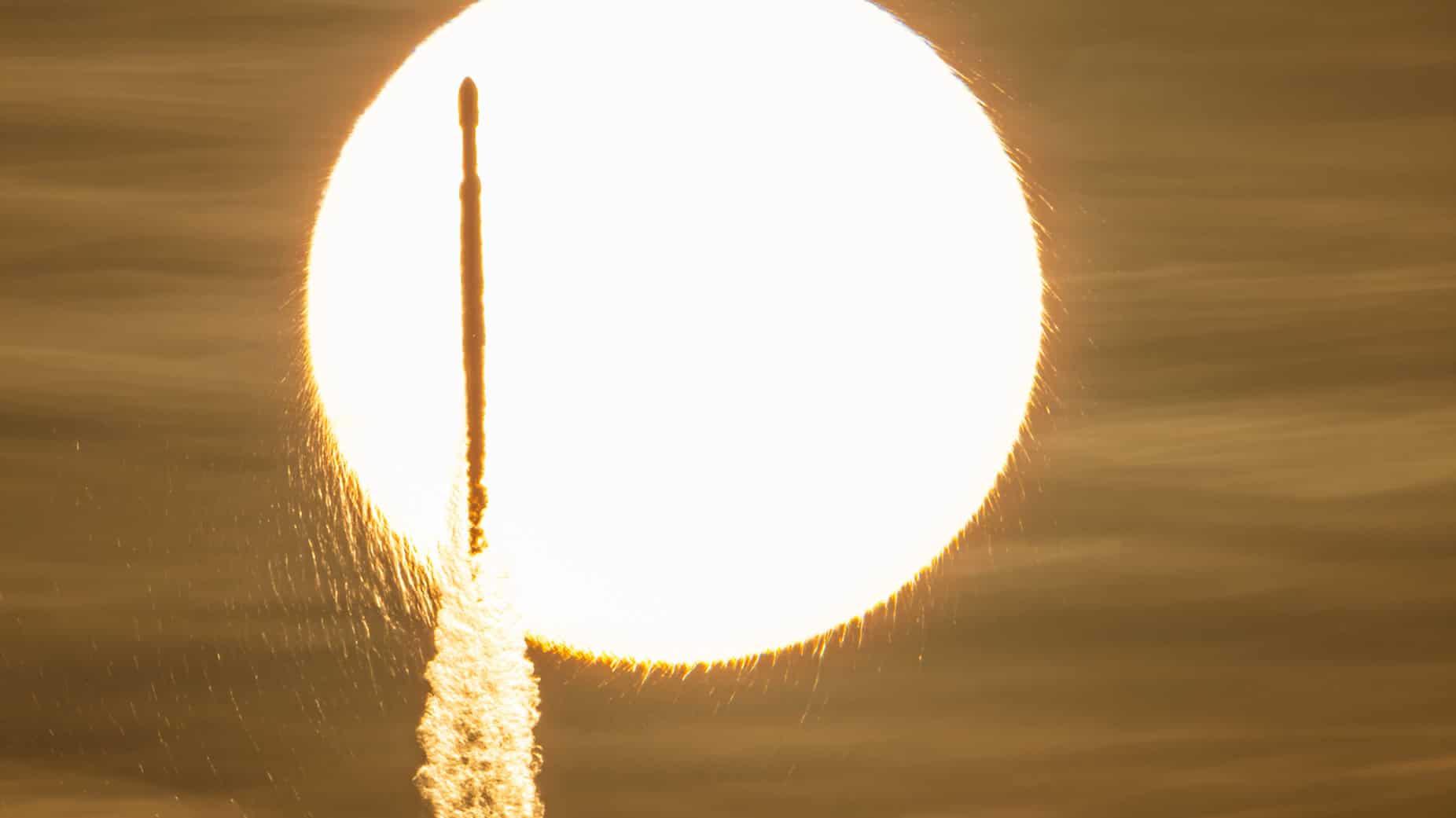
- A SpaceX Falcon Heavy lifted NASA's Nancy Grace Roman Space Telescope from the Kennedy Space Center in Florida at 7.26 a.m. on Sunday 30 August 2026.
- Roman separated from its carrier rocket 31 minutes after lift-off and set out for L2, the second Sun-Earth Lagrange point, 1.5 million kilometres from Earth.
- It arrives at L2 at the end of November, where the gravitational balance will let it hold its orbit on relatively little fuel.
- Its 2.4-metre primary mirror will give images as sharp as Hubble's, according to Richard de Grijs, writing in Physics World.
Compiled by The ScientistSomething wrong?How this is made
Why it matters
- constraint When the discovery route runs through a survey, an approved night on a telescope stops being the scarce input and the ability to pose a good query over billions of rows becomes it.
- capability A group studying one galaxy can answer questions about its neighbourhood from the same exposure, with no second campaign needed to buy the wide view.
- precedent Gaia has set the expectation that a survey's catalogue belongs to everyone, so any proprietary window on Roman data will need a public justification.
- decision Teams with a target list now have to weigh a competitive proposal for Hubble or Webb time against waiting for a map that will sweep up their object anyway.
The hundredfold figure describes sky area in one pointing, not survey speed [7]. Mapping the same patch with Hubble would take at least 100 separate pointings [21]. How much sky Roman actually maps in a year depends on how long each pointing has to stay open, and de Grijs's account does not state exposure times or data rates for the instrument [20].
During the launch broadcast, de Grijs heard NASA administrator Jared Isaacman say Roman will study the "ecology of the universe" [8]. Isaacman drew a contrast between kinds of camera: some give you an overview of a forest, others zoom in on individual birds and leaves, and Roman does both [9]. The design claim underneath the analogy is that the detailed view and the population view now come out of the same observation, so an object and the environment it belongs to sit in one dataset [10].
Gaia is the precedent with numbers attached. The ESA mission ran for 11 years, from 2014 to 2025, and took more than three trillion observations of roughly two billion stars and other objects [17]. Divide one into the other and each object was measured about 1,500 times [18]. Spread across 11 years, that averages near 750 million observations a day [19]. The Milky Way structure work came out of those public catalogues [17].
Against that, de Grijs sets out the workflow the field grew up on: a proposal, a time-allocation committee, a manageable quantity of data, and exclusive access during a proprietary period while the first paper was written [13]. "The observer knew why each exposure had been taken," he wrote [14]. A survey archive reverses the order. The exposure exists first, and the question that makes it useful can arrive later, from someone who never proposed it [12].
Targeted observing keeps its place. Hubble and Webb remain powerful because they can study a chosen object in fantastic detail [15], and Roman's own coronagraph will test active optics that suppress starlight far more effectively than existing space-based coronagraphs, enough to image giant planets orbiting nearby stars [16].
I would state the change more narrowly than de Grijs does. For a growing share of infrared results, the limiting skill will be knowing how to interrogate a public map, and how large that share gets depends on whether Roman data carry the proprietary period the older model assumed [13].
What to watch
- Whether NASA releases Roman survey data immediately or under a proprietary period like the one the targeted model assumed.
- Publication of the Wide Field Instrument survey plan, with the exposure times that set how much sky Roman covers per year.
- Whether commissioning at L2 holds the first-image date, and what query tooling the archive offers on day one.