Science1 publisher2 min readPublished
ATLAS reports entanglement between the Z bosons produced in Higgs decays
Entanglement had been confirmed in photons, electrons and trapped ions, all relatively long-lived systems. An Oxford-led team has now found it in Z bosons made inside the LHC's most violent collisions.
The Scientist · Science desk
What happened
- Oxford physicists working with CERN's Large Hadron Collider report strong evidence that pairs of Z bosons produced in Higgs boson decays are quantum entangled, in a paper published in Physical Review Letters.
- Because a Z boson vanishes almost at once, the team reconstructed both bosons' spins from the angles of the decay electrons and muons, then checked those spins for the correlations entanglement predicts.
- An earlier ATLAS analysis in 2023, inspired in part by Oxford's Alan Barr, demonstrated entanglement between pairs of top quarks, the heaviest known elementary particle.
Compiled by The ScientistSomething wrong?How this is made
Why it matters
- capability Angular analysis of decay products gives collider experiments a way to test quantum correlations at energies no optical bench can reach, using detector data they already record.
- constraint Because the decay fixes what gets observed, this design cannot vary a measurement setting the way tabletop quantum optics does, so it extends entanglement's reach while leaving chosen-setting tests open.
- precedent With top quarks in 2023 and Z bosons now, quantum-information measurements become a standing use of LHC data, and the next heavy, short-lived pair will be expected to get the same treatment.
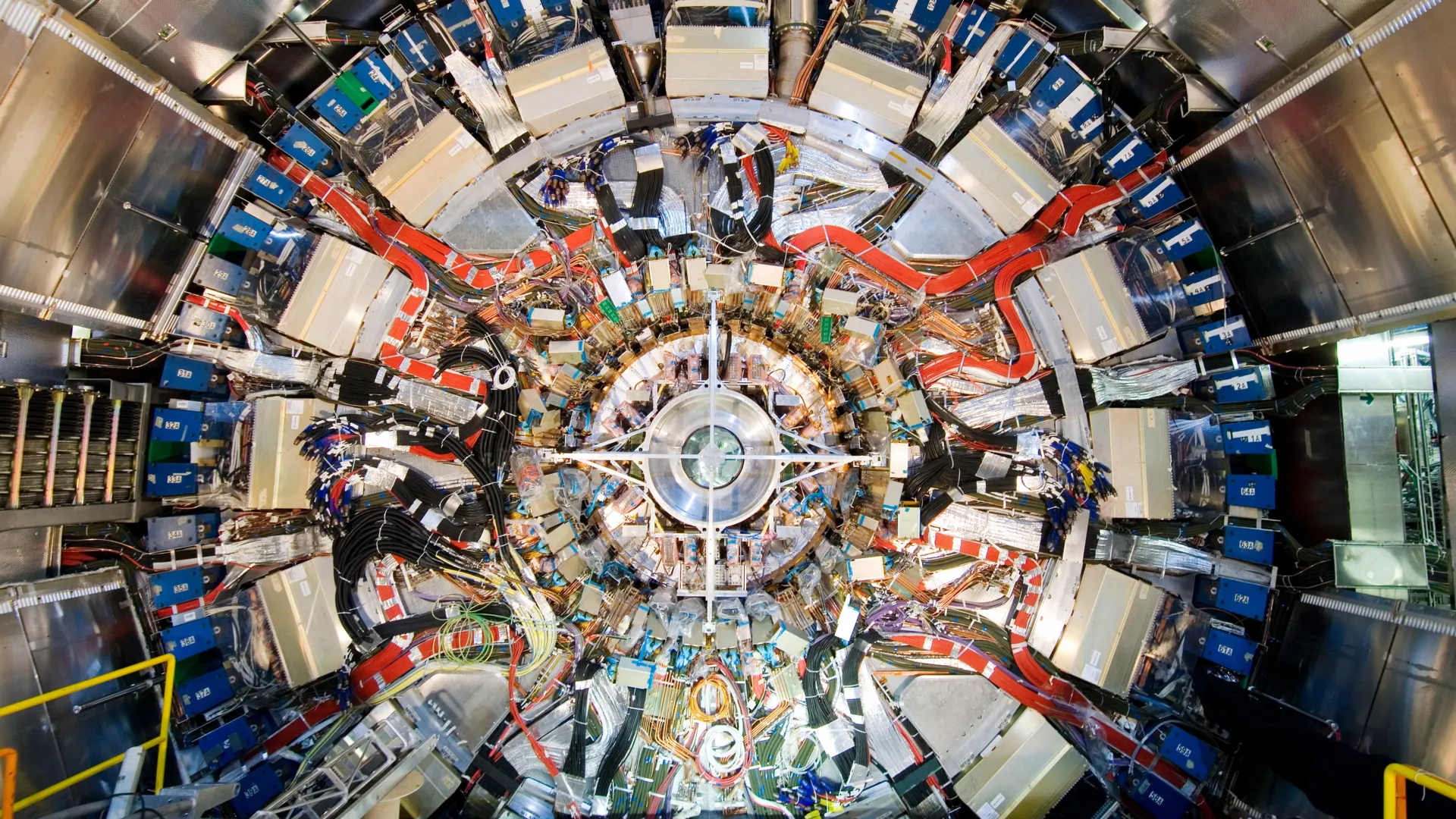
The spin state at the centre of this result was a reconstruction. The observables are the directions the electrons and muons travel, and the spins of the two Z bosons are inferred backwards from their angular distribution [6]. No measurement basis was selected for either boson [6]. Higgs bosons, discovered at the LHC in 2012, can decay into two Z bosons, and each Z boson then decays into a pair of electrons or muons [16][3]. Those leptons are what the detector sees [5].
The University of Oxford, whose physicists worked on the analysis, calls the result one of the highest energy confirmations of quantum entanglement ever achieved [1][8]. Its announcement describes the measurements as strong evidence, without a significance figure or the number of events analysed [19].
Earlier confirmations used photons, electrons and trapped ions [14], which the Oxford announcement groups as relatively long-lived quantum systems [21]. Alan Barr, a co-author and a professor in Oxford's Department of Physics, said: "We're used to thinking of entanglement as something delicate, seen in laboratory experiments with single photons." [9][12] He described finding it "alive and well among particles as heavy and short-lived as Z bosons" [10].
The question going in was whether entanglement survives the violent, high-energy collisions produced at CERN [20]. Protons in those collisions travel at 99.99% of the speed of light and meet at energies reaching thirteen trillion electron volts [4]. The reported answer is that the correlations are present at that energy [7].
Barr was among the first to argue that colliders could investigate entanglement at energies far beyond those of traditional quantum experiments, and he worked on building the LHC [12]. His ideas helped inspire a 2023 ATLAS measurement that demonstrated entanglement between pairs of top quarks, the heaviest known elementary particle [13]. The Z boson result comes three years after that one [17].
The Oxford announcement ties entanglement to quantum computers, secure communication networks and sensors, noting that it lets multiple qubits be manipulated together [15]. Barr said the finding is "a nice reminder that the same strange rules of quantum mechanics that may one day power quantum computers are at work everywhere in nature, even at the extreme energies of the Large Hadron Collider" [11]. Each Z boson in the sample existed for a tiny fraction of a second and then decayed [5].
What to watch
- The significance figure and event count in the Physical Review Letters paper, which would show how much weakening of the correlations the data can exclude.
- Whether ATLAS applies the same angular spin-reconstruction method to other heavy, short-lived pairs after top quarks and Z bosons.
- Whether the collaboration later moves from strong evidence to a discovery-level claim on the Z boson pairs.