Security1 publisher2 min readPublished
Burnham tells security chiefs to build a centre that attributes hostile state disinformation
The National Centre for Information Defence has a name, the Cabinet Office leading the initial work, and an offer to share British methods with European governments before their elections. Burnham gave few details of its shape.
The Watch · Security desk
What happened
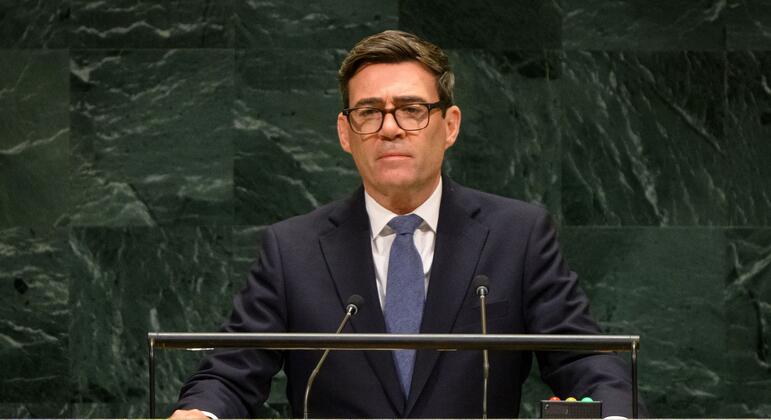
- Burnham told the U.N. General Assembly on Tuesday that he has ordered security chiefs to begin work on a new national centre to detect, attribute and disrupt hostile state disinformation.
- The Cabinet Office is understood to be leading the initial work, with intelligence agencies, other departments, law enforcement and social media companies helping determine how the centre would operate.
- Burnham accused Russian agencies of running bots and fake websites, falsifying newspaper articles and copying the branding of 28 British organizations, among them universities and the BBC.
- He put Kremlin spending on manipulating information at around £1.3 billion each year.
Compiled by The WatchSomething wrong?How this is made
Why it matters
- constraint Anything the centre publishes still has to clear the same foreign-orchestration threshold that has kept the 2023 offence largely unused, so attributing an operation and charging anyone for it remain separate problems.
- decision The choice between a unit inside the Cabinet Office and a body accountable to Parliament determines who can be challenged over an attribution once it is made public.
- capability Folding the departmental programmes into one centre would give public attribution of influence operations a single owner with a standing mandate.
- precedent Exporting the model to European governments before their votes places British attribution judgements inside other states' election disputes.
Britain already has the criminal offence. The National Security Act 2023 created one aimed at foreign interference, and Sophie Williams-Dunning, a research analyst at the Royal United Services Institute, said it has proved difficult to use so far [11]. "There's a high evidentiary threshold, particularly on proving foreign orchestration," she told Recorded Future News [12]. "That's one reason the offence has been hard to use so far. One of the first tasks for this centre will be finding a way to actually implement it" [12].
Where the centre sits is the open question. Williams-Dunning said Britain "has been overdue a more coherent strategic response to this threat" [13], and that the government's response "has so far been split across several departments" [14]. She cautioned there is "a real difference between a centre inside the Cabinet Office and an agency accountable to Parliament" [15]. "I'd hope this is meant to be the foundation for the latter, not one more unit similar in resourcing to the ones already out there," she said [16].
Joe Devanny, a senior lecturer at King's College London, wrote that a new centre "can mean a lot of different things," "from largely rebadging existing effort, to a significant rethink of your approach" [17]. He said it was unclear where on that spectrum the new body would sit, or whether those details had already been worked out [18]. A spokesperson for the prime minister's office said more information would be released in due course [19].
Burnham's £1.3 billion is an annual spending figure, about £3.6 million a day [7][8]. Spending is a proxy for volume only while the campaigns need staff. The Record reported that experts fear AI is lowering the cost of running such operations [20], and The New York Times reported last week that state-linked actors in Iran and China, along with a private Israeli firm, have begun using largely autonomous AI systems to run influence campaigns with limited human involvement [21].
More nations are grappling with these issues as elections approach across Europe, Burnham said, and "we're ready to share our understanding of how these actors work" [6]. France and Sweden already have agencies tasked with countering this activity, according to The Record [22]. The government's work also covers building community resilience in identifying and combatting disinformation, after reports linked riots in Belfast and Southampton to foreign agitation [10]. Britain and the European Union imposed sanctions earlier this year on Russian cyber and disinformation actors, including a media outlet accused of interfering in elections in Moldova and Armenia [23].
What to watch
- Whether the centre is stood up inside the Cabinet Office or given a statutory footing and parliamentary accountability.
- Whether a budget, headcount and list of absorbed departmental programmes is published when the detail follows.
- The first foreign interference charge under the National Security Act 2023 that rests on the centre's material.