Synthetic basalt melted at 7 GPa held more than 5 wt.% excess oxygen once PtO2 was added
A team led by HPSTAR's Yanhao Lin and Ho-kwang Mao found synthetic basalt glass held over 5 wt.% excess oxygen at 7 GPa, against 0.2 to 0.5 wt.% in controls. Platinum oxide supplied the oxygen, so the result shows what a melt can hold in the lab.
The Scientist · Science desk
Key figures: excess oxygen in the glass reached more than 5 wt.% at 7 GPa; control runs without PtO2 yielded 0.2 to 0.5 wt.%; a rough estimate puts the excess oxygen release from erupted magma that would supply all of today's atmospheric oxygen at 0.27 wt.%.
| Figure | Value | Note | Claim |
|---|---|---|---|
| Excess oxygen in glass at 7 GPa, more than | 5 wt.% | 4 | |
| Control runs without PtO2, at least | 0.2 wt.% | up to 0.5 wt.% | 5 |
| Estimated release to supply today's atmosphere | 0.27 wt.% | rough estimate, from erupted magma | 15 |
What happened
- Geoscientists have long assumed magma's oxygen content is fixed by its other elements, so oxygen was not treated as a volatile the way water and carbon dioxide are.
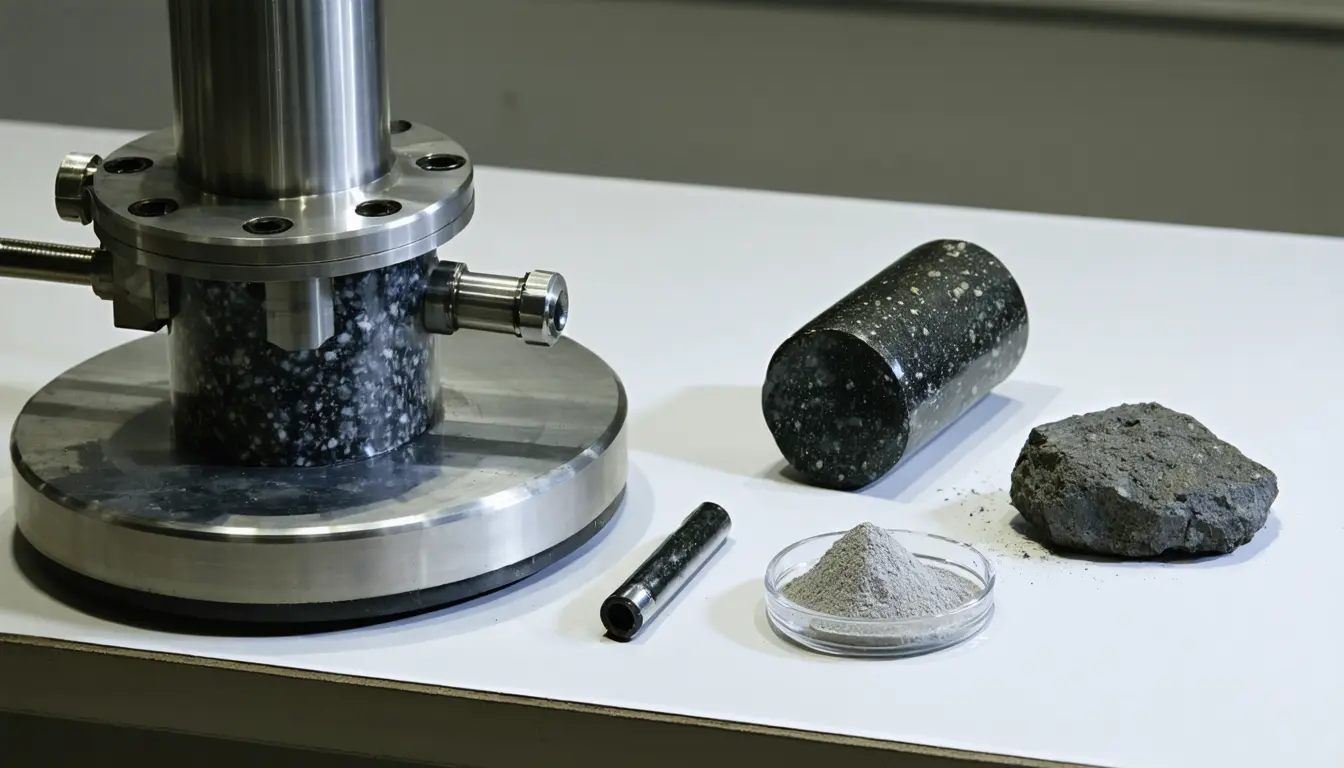
- The team melted synthetic mid-ocean ridge basalt from 1 atmosphere to 7 gigapascals and from 1,200 to 1,800 C, using piston-cylinder and cubic presses.
- They defined excess oxygen as what remained in the quenched glass after subtracting the oxygen needed to balance the other elements and the oxygen held in water and carbon dioxide.
- Simulations showed oxygen charges spreading over a wider range as the melt took up more oxygen, with a small fraction of atoms forming peroxide-like bonds.
Why it matters
- Who has to decide decision Modelers who treat magma oxygen as fixed by its other elements now face a choice: add oxygen as a separate melt component, as the authors propose, or keep the old assumption and explain the glass data.
- What it limits constraint Any atmospheric budget built on the 5 wt.% figure inherits an oxygen supply the experimenters chose, and natural mantle melts may take up less.
- What's now possible capability If melts carry oxygen upward and release it as pressure falls, models of magma ocean evolution and volatile degassing gain a term, and so do habitability estimates for other terrestrial planets.
The control is the part to read closely. Runs at the same pressures and temperatures without added PtO2 gave only 0.2 to 0.5 wt.% excess oxygen [5], while the PtO2 runs passed 5 wt.% at 7 GPa [4]. That is at least ten times the top of the control range [11]. Pressure alone did not produce the large values, because the team added PtO2 specifically to create an oxygen-rich environment [2]. The thing this doesn't tell you is how much oxygen a natural mantle source can hand to a melt.
Because excess oxygen is a residual, any error in the other measurements lands in it. Two checks bear on what the residual is. Raman spectroscopy detected no signature of oxygen gas in the glass, which indicates the oxygen is incorporated into the glass structure and not trapped as bubbles [6]. The simulations, run in a simplified magnesium-silicon-oxygen system, gave lower values than the experiments but the same rise with pressure [7].
The one known bias runs in a single direction. Some oxygen may have escaped as the samples were quenched, so Phys.org's summary of the paper in National Science Review calls the measured values likely a lower limit [12].
The atmospheric argument sits a step further out. The authors suggest that magma formed in oxidized mantle regions could carry substantial excess oxygen and release it gradually as the magma rises and pressure drops [13]. Between roughly 2.5 and 2.0 billion years ago, the atmosphere saw major increases in oxygen during the same period in which some of the largest large igneous provinces were forming [14]. A rough estimate says that releasing just 0.27 wt.% excess oxygen from magma erupted in that period would supply all the oxygen in today's atmosphere [15]. The 5 wt.% reached in the lab is more than 18 times that figure [17], though it was measured in glass at 7 GPa with PtO2 added, not in erupted magma.
Overlap in time is correlation. In our view the lab result is a measurement, and the link to the atmosphere is a hypothesis resting on a rough estimate and a shared time window.
What to watch
- Whether other groups reproduce the excess-oxygen values in natural basalt compositions and with an oxygen source other than PtO2.
- Whether a measurement that avoids oxygen loss on quench replaces the lower-limit caveat with a number.
- Whether estimates of excess oxygen in magmas from oxidized mantle sources land near the 0.27 wt.% the atmosphere estimate needs.
Clarity's read
What the record supports and how the coverage leans. The claims behind it follow.
Reality
- Evidence50
- Adoption
- Not scored
- Hype gap+30
- Incentives
- Not scored
- Confidence40
Claim ledger
Ranked by verification strength, evidence, and original report placement.
- [1]
The team melted a synthetic mid-ocean ridge basalt at pressures from 1 atmosphere to 7 gigapascals and temperatures of 1,200-1,800 C, using piston-cylinder and cubic presses.
- [2]
Platinum oxide (PtO2) was added to create an oxygen-rich environment.
- [3]
After measuring the quenched glass, the researchers subtracted the oxygen needed to balance all other elements and the oxygen in water and carbon dioxide, and defined the residual oxygen as 'excess oxygen.'
- [4]
The excess oxygen stored in the quenched silicate glass rises with pressure: it is close to zero at 1 atmosphere but reaches more than 5 wt.% at 7 gigapascals.
- [5]
Control experiments run at the same pressures and temperatures without added PtO2 yielded only 0.2-0.5 wt.% excess oxygen.
- [6]
Raman spectroscopy detected no signature of oxygen gas in the glass, indicating that the excess oxygen is incorporated into the glass structure rather than trapped as bubbles.
- [7]
Deep neural network interatomic potential simulations used a simplified magnesium-silicon-oxygen system, so the values are lower than in the experiments, but the same rise with pressure was observed.
- [8]
The simulations showed that as the melt becomes richer in oxygen, the electric charges on oxygen atoms spread over a wider range, and a small fraction of oxygen atoms form peroxide-like bonds.
- [9]
Geoscientists have long assumed that the amount of oxygen in magma is fixed by the amounts and charge states of the other elements present, so unlike water and carbon dioxide, oxygen has not been considered a volatile component that can dissolve in magma.
- [10]
The increase in oxygen content with pressure resembles how water and carbon dioxide dissolve more readily in magma at higher pressure, and the authors suggest that oxygen should be considered a separate component of silicate melts.
- [11]
The PtO2 runs at 7 GPa (more than 5 wt.%) are at least ten times the top of the control range (0.5 wt.%).
- [12]
Because some oxygen may have escaped as the samples were quenched, the measured values are likely a lower limit of what the melt can store.
- [13]
The findings suggest a possible way to carry oxidizing power from deep Earth to the surface: magma formed in oxidized mantle regions could carry substantial excess oxygen and gradually release it as it rises and pressure drops, which could oxidize the shallow mantle, the crust and the atmosphere.
- [14]
Major rises in atmospheric oxygen roughly 2.5 to 2.0 billion years ago overlap in time with the formation of some of the largest large igneous provinces.
- [15]
A rough estimate suggests that the release of just 0.27 wt.% excess oxygen from magma erupted during this period would be enough to supply all the oxygen in today's atmosphere.
- [16]
The research provides a new perspective on assessing magma ocean evolution, volatile degassing, the evolution of Earth's atmosphere and long-term habitability on other terrestrial planets.
- [17]
The more-than-5 wt.% excess oxygen reached at 7 GPa is more than 18 times the 0.27 wt.% estimated to supply the atmosphere.
Get this ledger inside ChatGPT. Ask about any of our stories and the answer brings its figure, each claim’s verdict and the sources. Free, no account.
Sources
1 independent publisher whose own reporting we read for this story.
- phys.org'Excess oxygen' stored in deep Earth magma may help explain how Earth's atmosphere became oxygen-rich
1 article · October 16, 2026
Topics and entities
Follow any of these and your For You feed starts watching them — no settings page required.