Product1 publisher3 min readPublished
DIU picks an Australian battery for PRISM, and the spec that matters is -76F to 140F
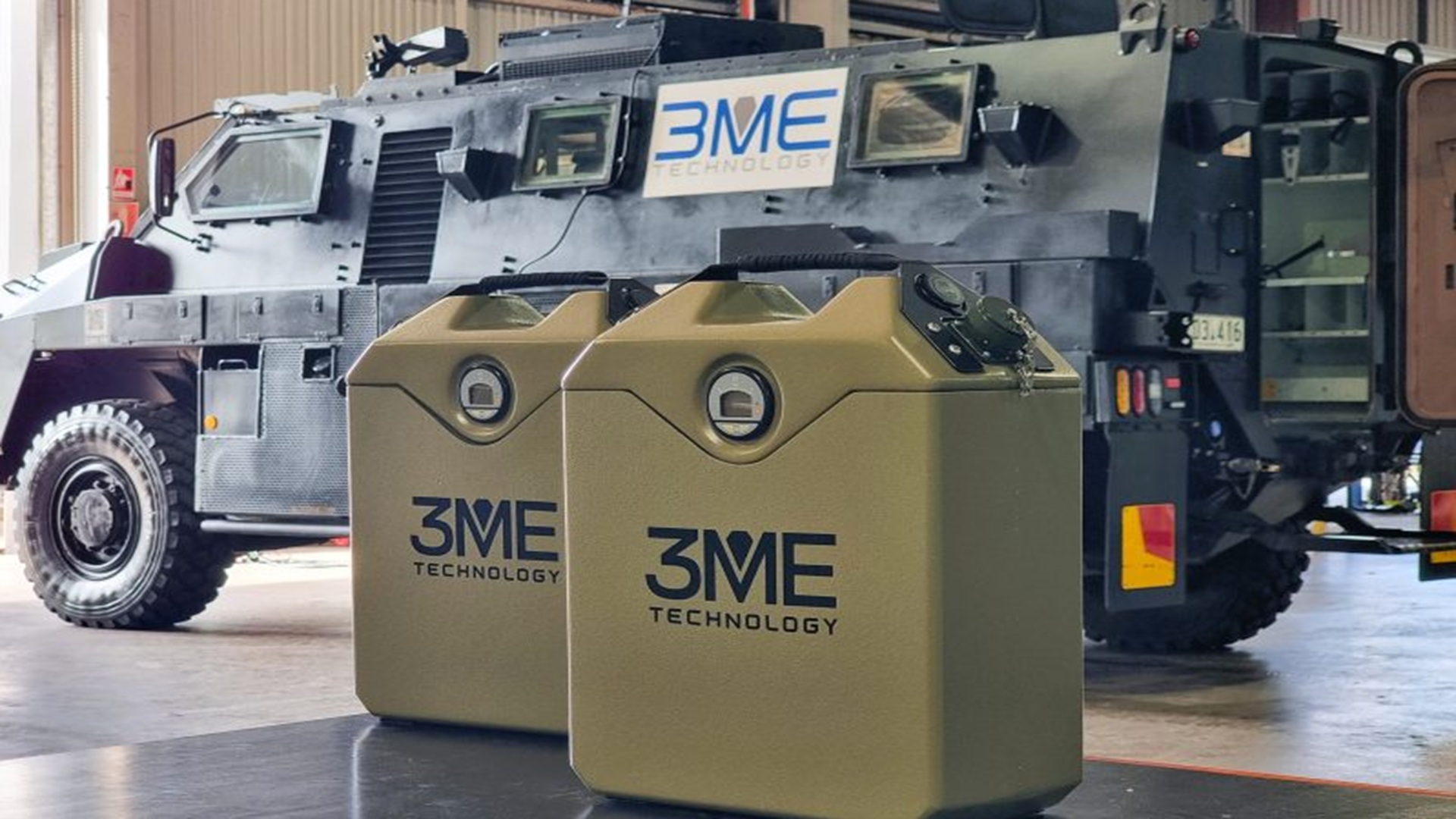
3ME Technology will prototype its EdgeVOLT pack for the US Defense Innovation Unit in two builds. The cold-weather one, using South 8's liquefied-gas cells, is the actual news.
The Product Desk · Product desk
Drafted by a language model from the sources cited here and checked against its claim ledger before publication. How we use AISend a correction
What happened
- 3ME Technology, an Australian battery and electrification company, has been selected by the U.S. Defense Innovation Unit to demonstrate a portable battery system designed for demanding field conditions.
- 3ME will deliver its EdgeVOLT portable energy storage system under the Portable Resilient Integrated Storage Module (PRISM) program.
- The PRISM prototype effort is aimed at developing deployable power systems that can support defense operations without relying as heavily on conventional fuel-based generators.
- EdgeVOLT is a rugged, modular battery system designed to provide portable power for communications equipment, sensors, field infrastructure, autonomous platforms and other mission equipment.
- The PRISM effort will include the standard EdgeVOLT configuration and a cold-weather version using battery cells from South 8 Technologies.
Compiled by The Product DeskSomething wrong?How this is made
Why it matters
The US Defense Innovation Unit has selected 3ME Technology, an Australian battery and electrification firm, to demonstrate its EdgeVOLT portable energy storage system under the Portable Resilient Integrated Storage Module program [1][2]. The part worth reading closely is that PRISM will cover two configurations: the standard EdgeVOLT, and a cold-weather version built on South 8 Technologies cells rated to operate from -76F to 140F [5][6].
Note what the announcement quantifies and what it does not. There is no kilowatt-hour rating, no pack weight, no contract value and no delivery date in the material [15]. The one number on offer is an operating envelope: -76F to 140F, which is -60C to 60C, a 120C span [13][14]. When a buyer publishes an envelope instead of a capacity, the envelope is the requirement being tested.
That follows from the stated purpose of the effort, which is deployable power that does not lean as heavily on conventional fuel-based generators [3]. Generators fail on logistics: fuel has to be moved and resupplied [11]. Batteries fail on physics, and the source frames the cold-weather variant as addressing exactly that practical problem, maintaining reliable performance when temperatures move far outside normal operating conditions [7]. South 8's LiGas technology uses liquefied-gas electrolytes, which the companies say are engineered for extreme temperatures [8]. That attribution belongs to the vendors, not to a test report.
The structurally interesting detail is the test boundary. The LiGas cells will be evaluated integrated into EdgeVOLT as part of the PRISM prototype, not demonstrated as a standalone battery technology [9]. Cell-level temperature claims are the easy half. A rugged modular system that has to serve communications equipment, sensors, field infrastructure and autonomous platforms [4] is where integration, packaging and control decisions either preserve the cell envelope or quietly narrow it.
The vendor context is straightforward. 3ME is Australian-owned and headquartered in Newcastle, New South Wales [10], and its participation is presented as reflecting the technology-sharing goals of AUKUS Pillar II [12]. Chief executive Justin Bain called the award an opportunity to show how Australian-developed energy systems can address power and endurance challenges for defense users, and described PRISM as a rapid prototype to production effort [16][17]. That phrase is the commercial stake. EdgeVOLT is also aimed at emergency response and remote industrial users, where fuel-based generators are hard to transport, operate or resupply [11], so a defense envelope requirement would carry into civilian sales.
Three things to watch. First, whether the -76F to 140F figure survives as a system-level rating after integration, or gets restated as a cell specification with a narrower pack number [9][13]. Second, whether PRISM follow-on work publishes energy and mass figures, since an envelope without capacity and weight is not yet a procurable spec [15]. Third, whether the rapid prototype to production framing produces an actual production order, which the current material does not describe [15][17].