Product1 publisher2 min readPublished
Northrop gets 24 months to deliver the Space Force a suitcase-sized GEO spy satellite
The GHOST-R prototype squeezes production, payload integration, test and delivery into two years. Irvine's TRL-11 supplies the optics, and the spacecraft comes from the company whose GSSAP satellites already watch GEO.
The Product Desk · Product desk
What happened
- Northrop Grumman has won a U.S. Space Force deal to build a reconnaissance satellite for geosynchronous orbit. It is the prototype for the Defense Innovation Unit's GHOST-R program.
- The company is working to an accelerated 24-month schedule that has to cover spacecraft production, payload integration, testing and delivery.
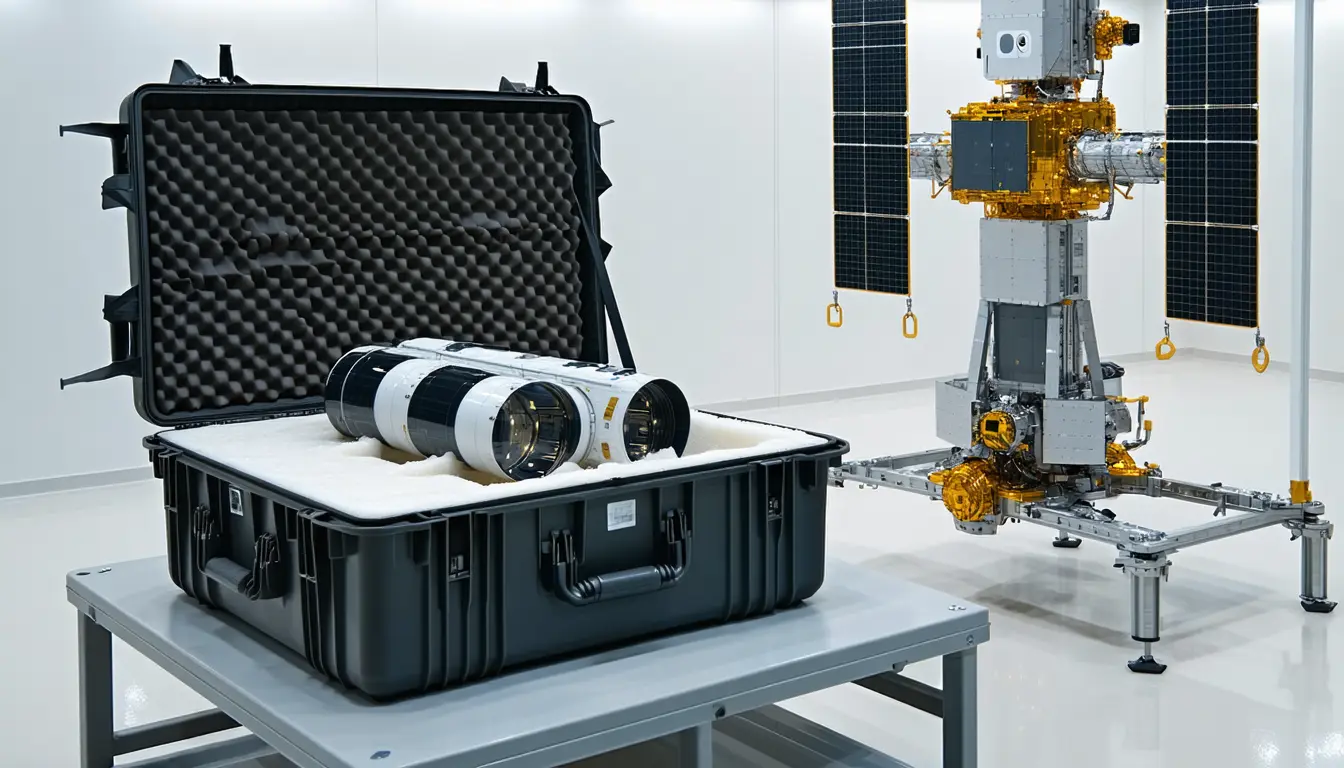
- The bus is Northrop's ESPASat-L, a compact platform roughly the size of a small suitcase, used here to carry the mission hardware.
- Irvine, California-based TRL-11 will supply the optical payload that gives the satellite its primary observation capability.
- Planned missions include characterizing resident space objects, identifying spacecraft, and battle damage assessment after an attack or other damaging event.
Compiled by The Product DeskSomething wrong?How this is made
Why it matters
- constraint A two-year clock that includes integration and test screens suppliers on readiness, so a payload firm that needs another sensor design cycle is out of contention before price is discussed.
- precedent The fast buy still runs through the prime that already flies GEO surveillance, which sets the entry point for a smaller supplier at one payload socket on someone else's spacecraft.
- capability Buying surveillance in suitcase-sized units lets the Space Force add GEO coverage in increments, with no single spacecraft carrying the whole capability.
Divide the two-year clock evenly across the four activities it covers and each one gets about six months [1]. The schedule limit still binds: an optical payload that needs designing will not reach a Northrop integration floor in Dulles, Virginia, or Gilbert, Arizona, in time to be integrated, tested and handed over for operations [7].
The stated aim of the Defense Innovation Unit program is faster and lower-cost surveillance in geosynchronous orbit [2]. The report does not state what the contract is worth or describe how the award was competed [16].
Northrop already flies this mission. Its GSSAP spacecraft monitor activity around satellites operating in geosynchronous orbit [12]. So the fast prototype went to the company with the incumbent GEO surveillance line, on a bus it already sells, with the sensor bought in from a smaller firm.
Ryan Tintner, Northrop's vice president and general manager for space superiority, pointed to rising activity around the geosynchronous belt. "Space is becoming more congested and contested every day," Tintner said [9]. He said faster deployment can improve the military's ability to understand activity around critical spacecraft [10].
ESPASat-L is modular and works with Northrop's ESPAStar rideshare architecture, so different payloads can serve different missions [5]. The Space Force plans to fly commercial spacecraft alongside government-owned satellites in a hybrid architecture [13]. The report also frames the buy as part of a wider interest in commercially derived spacecraft, where an established platform provides the foundation instead of every mission starting from a new satellite design [15].
GHOST-R sits inside DIU's Kill Web portfolio, described in the report as exploring space architectures that combine sensing, artificial intelligence and targeting technologies [11]. By that account, the connection could let future systems process orbital observations more quickly [17].
For a payload company weighing the next buy of this shape, schedule screens before price. A sensor that needs another design cycle is out of contention before price comes up [3]. The negotiation is over whether the prime's bus treats a payload as a repeatable interface [5], and whether the supplier will sell one box into a spacecraft that someone else assembles, tests and delivers [7].
What to watch
- A delivery date or launch manifest slot for the GHOST-R prototype spacecraft.
- Whether DIU buys more ESPASat-L-class spacecraft once the prototype is handed over.
- Whether TRL-11 wins optical payload slots on buses from other primes.